QUESTION IMAGE
Question
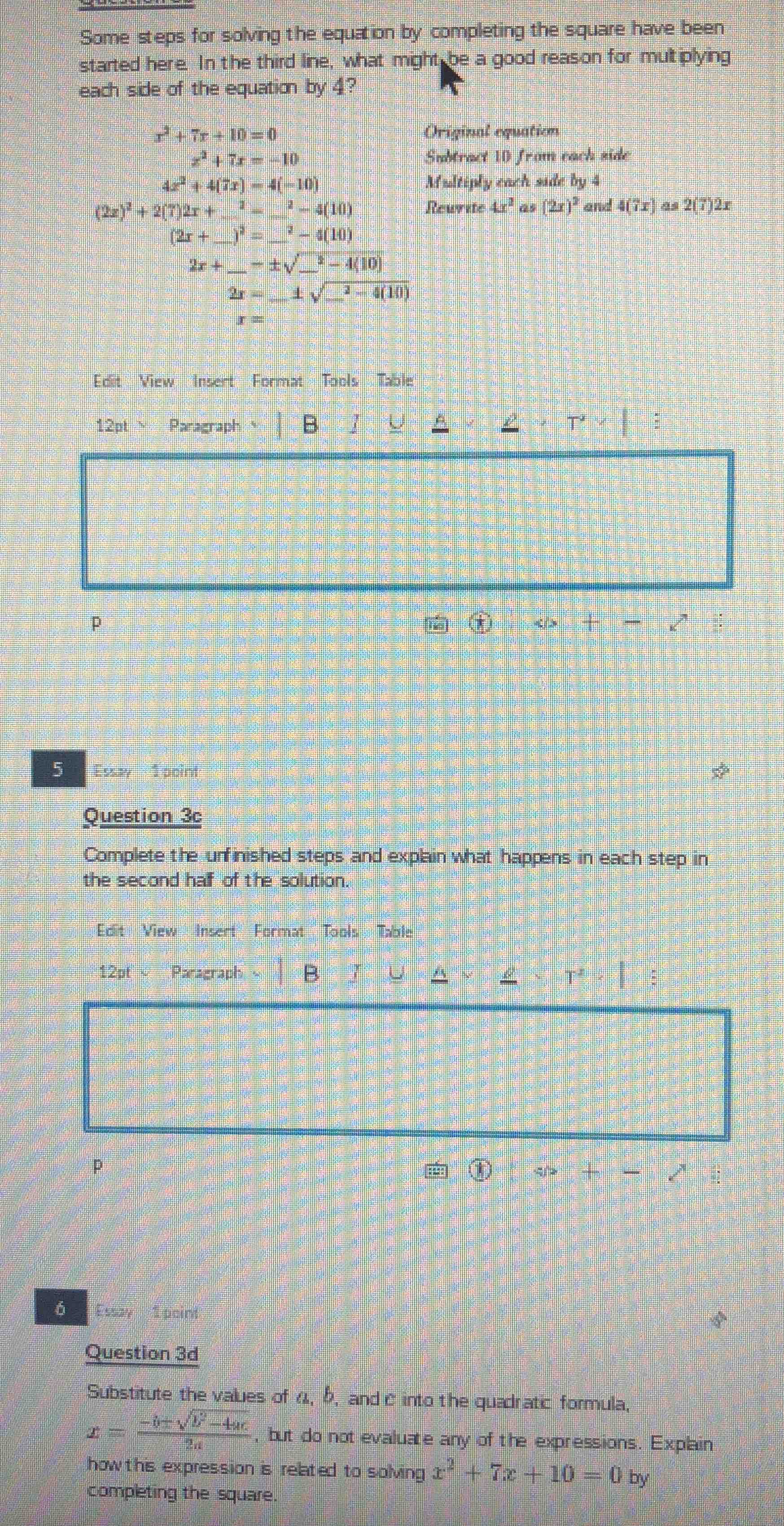
some steps for solving the equation by completing the square have been started here. in the third line, what might be a good reason for multiplying each side of the equation by 4?
$x^2 + 7x + 10 = 0$ original equation
$x^2 + 7x = -10$ subtract 10 from each side
$4x^2 + 4(7x) = 4(-10)$ multiply each side by 4
$(2x)^2 + 2(7)2x + \underline{\quad}^2 = \underline{\quad}^2 - 4(10)$ rewrite $4x^2$ as $(2x)^2$ and $4(7x)$ as $2(7)2x$
$(2x + \underline{\quad})^2 = \underline{\quad}^2 - 4(10)$
$2x + \underline{\quad} = \pm\sqrt{\underline{\quad}^2 - 4(10)}$
$2x = \underline{\quad} \pm \sqrt{\underline{\quad}^2 - 4(10)}$
$x = $
question 3c
complete the unfinished steps and explain what happens in each step in the second half of the solution.
question 3d
substitute the values of $a$, $b$, and $c$ into the quadratic formula, $x = \frac{-b\pm\sqrt{b^2-4ac}}{2a}$, but do not evaluate any of the expressions. explain how the expression is related to solving $x^2 + 7x + 10 = 0$ by completing the square.
First Question (Reason for multiplying by 4)
Multiplying by 4 transforms the coefficient of $x^2$ into a perfect square ($4=2^2$), which allows the left side of the equation to be rewritten as a square of a linear term without introducing fractions when completing the square. This simplifies the process of creating a perfect square trinomial.
Step1: Identify the missing constant
To complete the square for $(2x)^2 + 2(7)2x$, take half of the coefficient of $2x$ (which is 7), square it: $7^2=49$.
Step2: Rewrite as perfect square
Add $7^2$ to both sides: $(2x)^2 + 2(7)2x + 7^2 = 7^2 - 4(10)$
Rewrite left side as square: $(2x + 7)^2 = 7^2 - 4(10)$
Step3: Take square root of both sides
Apply square root property: $2x + 7 = \pm\sqrt{7^2 - 4(10)}$
Step4: Isolate the linear term
Subtract 7 from both sides: $2x = -7 \pm\sqrt{7^2 - 4(10)}$
Step5: Solve for x
Divide both sides by 2: $x = \frac{-7 \pm\sqrt{7^2 - 4(10)}}{2}$
Step-by-Step Explanations for the second half:
- Perfect Square Formation: We add $7^2$ to both sides to turn the left-hand side into a perfect square trinomial, since $(a+b)^2=a^2+2ab+b^2$, here $a=2x$, $2ab=2(7)(2x)$ so $b=7$.
- Square Root Property: Taking the square root of both sides reverses the perfect square, introducing the $\pm$ sign because both positive and negative roots satisfy the equation.
- Isolate Linear Term: Subtract 7 to get the term with $x$ alone on one side.
- Solve for x: Divide by 2 to isolate $x$ and get the final solutions.
For the quadratic equation $ax^2+bx+c=0$, the quadratic formula is $x=\frac{-b\pm\sqrt{b^2-4ac}}{2a}$. For $x^2+7x+10=0$, $a=1$, $b=7$, $c=10$. The expression from completing the square simplifies to the same form as the quadratic formula, showing that the quadratic formula is derived directly from the completing the square method for general quadratic equations.

Snap & solve any problem in the app
Get step-by-step solutions on Sovi AI
Photo-based solutions with guided steps
Explore more problems and detailed explanations
Multiplying by 4 converts the $x^2$ term into $(2x)^2$, a perfect square, so we can complete the square without using fractional coefficients for the linear term, simplifying the algebraic manipulation.
---