QUESTION IMAGE
Question
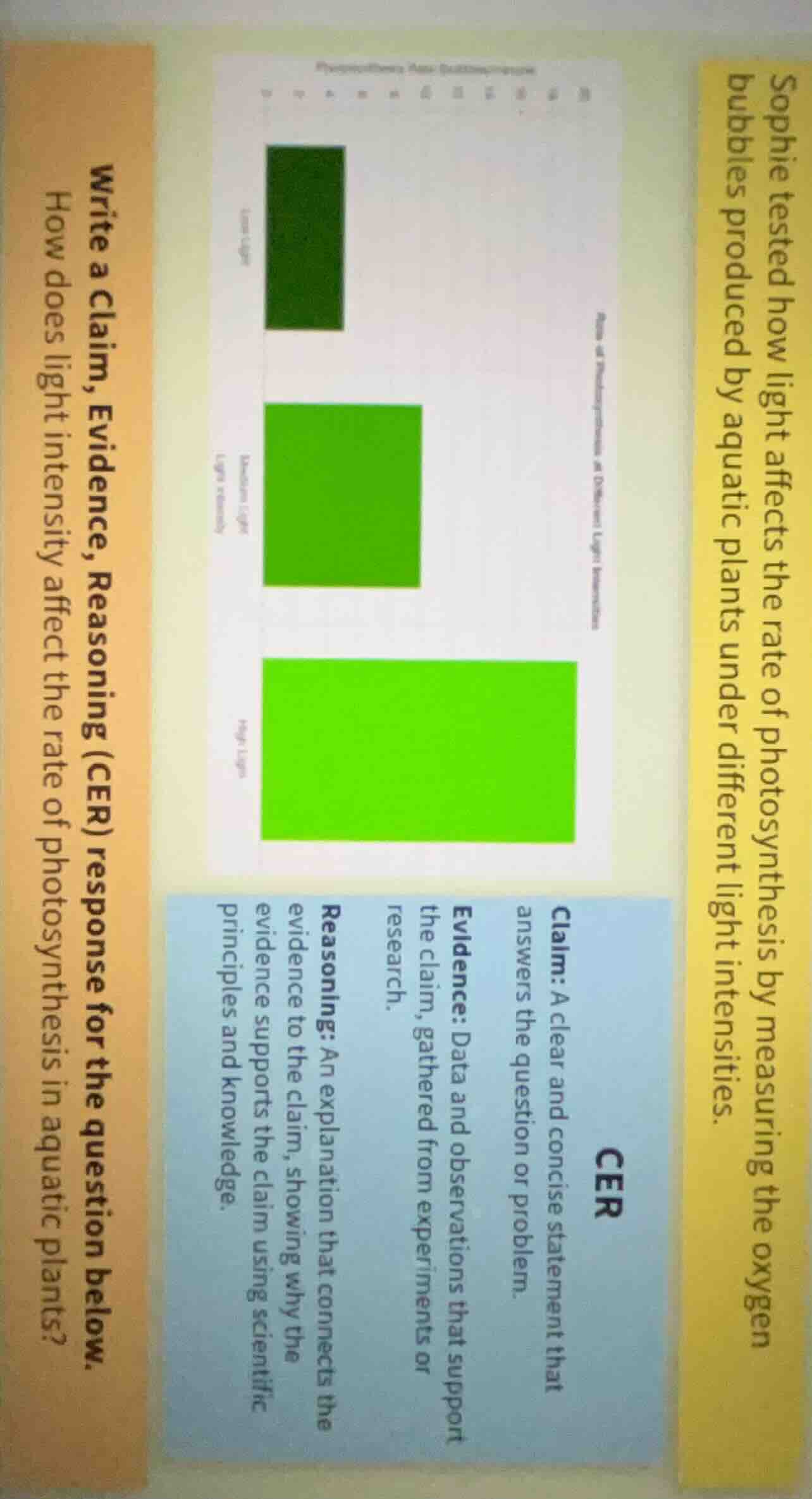
sophie tested how light affects the rate of photosynthesis by measuring the oxygen bubbles produced by aquatic plants under different light intensities.
write a claim, evidence, reasoning (cer) response for the question below.
how does light intensity affect the rate of photosynthesis in aquatic plants?
cer
claim: a clear and concise statement that answers the question or problem.
evidence: data and observations that support the claim, gathered from experiments or research.
reasoning: an explanation that connects the evidence to the claim, showing why the evidence supports the claim using scientific principles and knowledge.
- Claim: Directly states the relationship between light intensity and photosynthesis rate shown by the data.
- Evidence: Uses the measured oxygen bubble (photosynthesis product) counts from the bar graph to support the claim.
- Reasoning: Links the evidence to the scientific principle that light is a key reactant for photosynthesis; more available light (higher intensity) allows more photosynthesis reactions, producing more oxygen bubbles.

Snap & solve any problem in the app
Get step-by-step solutions on Sovi AI
Photo-based solutions with guided steps
Explore more problems and detailed explanations
Claim:
In aquatic plants, increasing light intensity increases the rate of photosynthesis.
Evidence:
- Low light intensity produces ~4 oxygen bubbles
- Medium light intensity produces ~8 oxygen bubbles
- High light intensity produces ~12 oxygen bubbles
Reasoning:
Light is a critical reactant for photosynthesis, the process that produces oxygen (measured as bubbles) in aquatic plants. As light intensity rises, more light energy is available to drive photosynthetic reactions, leading to a higher rate of oxygen production, which matches the observed increase in bubble count with higher light intensity.