QUESTION IMAGE
Question
source: andrew carnegie, \wealth,\ north american review, june 1889.
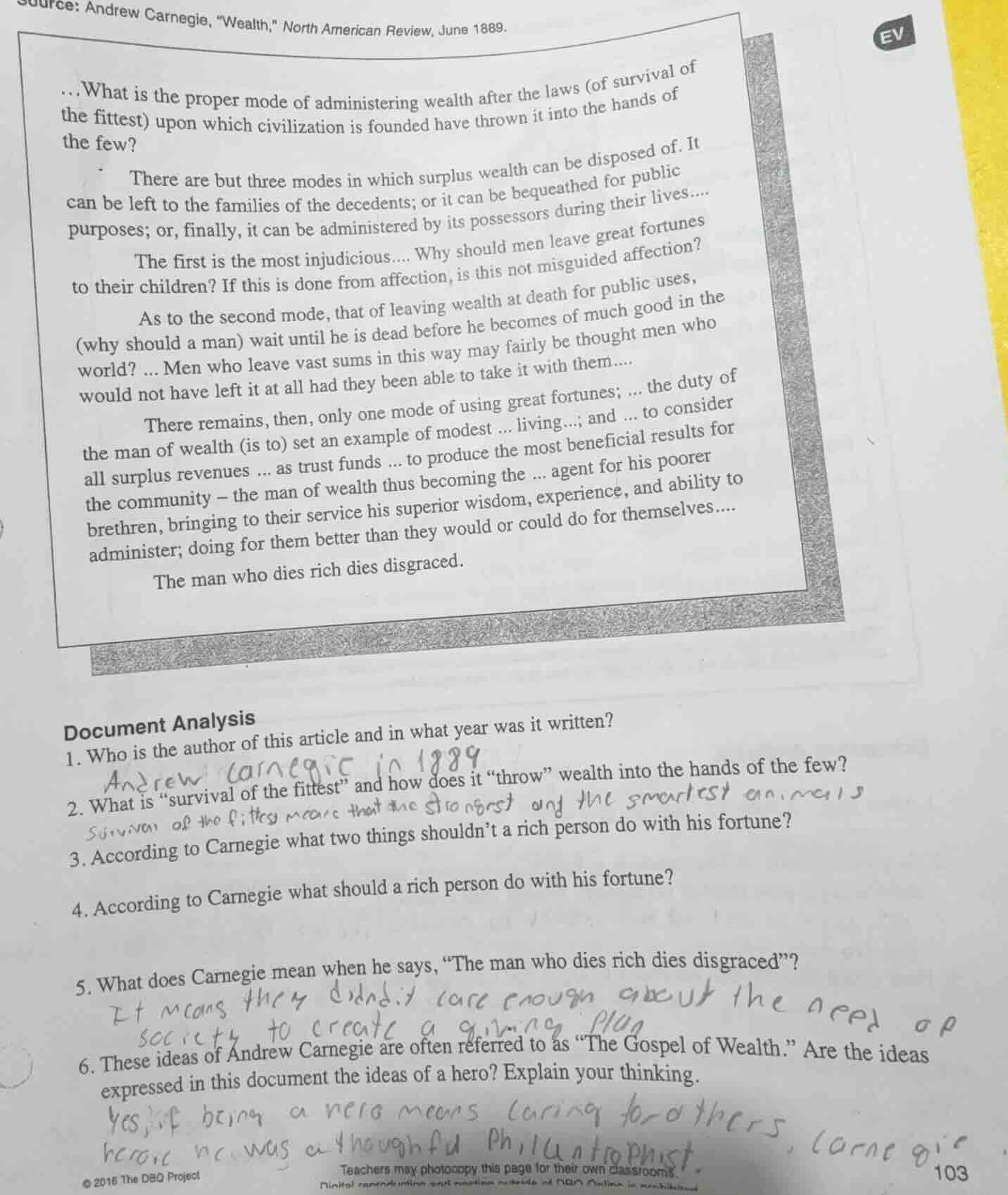
...what is the proper mode of administering wealth after the laws (of survival of
the fittest) upon which civilization is founded have thrown it into the hands of
the few?
there are but three modes in which surplus wealth can be disposed of. it
can be left to the families of the decedents; or it can be bequeathed for public
purposes; or, finally, it can be administered by its possessors during their lives....
the first is the most injudicious.... why should men leave great fortunes
to their children? if this is done from affection, is this not misguided affection?
as to the second mode, that of leaving wealth at death for public uses,
(why should a man) wait until he is dead before he becomes of much good in the
world? ... men who leave vast sums in this way may fairly be thought men who
would not have left it at all had they been able to take it with them....
there remains, then, only one mode of using great fortunes; ... the duty of
the man of wealth (is to) set an example of modest ... living...; and ... to consider
all surplus revenues ... as trust funds ... to produce the most beneficial results for
the community – the man of wealth thus becoming the ... agent for his poorer
brethren, bringing to their service his superior wisdom, experience, and ability to
administer; doing for them better than they would or could do for themselves....
the man who dies rich dies disgraced.
document analysis
- who is the author of this article and in what year was it written?
andrew carnegie in 1889
- what is \survival of the fittest\ and how does it \throw\ wealth into the hands of the few?
survival of the fittest means that the strongest and the smartest animals
- according to carnegie what two things shouldnt a rich person do with his fortune?
- according to carnegie what should a rich person do with his fortune?
- what does carnegie mean when he says, \the man who dies rich dies disgraced\?
it means they didnt care enough about the need of
society to create a giving plan
- these ideas of andrew carnegie are often referred to as \the gospel of wealth.\ are the ideas
expressed in this document the ideas of a hero? explain your thinking.
yes, if being a hero means caring for others, carnegie
heroic he was a thoughtful philanthropist.
© 2016 the dbq project teachers may photocopy this page for their own classroom use.
103

Snap & solve any problem in the app
Get step-by-step solutions on Sovi AI
Photo-based solutions with guided steps
Explore more problems and detailed explanations
- Andrew Carnegie, 1889
- A rich person shouldn't leave their fortune to their family, nor should they bequeath it for public purposes after their death.
- A rich person should live modestly, administer their surplus wealth as trust funds during their lifetime to benefit the community, acting as an agent for the less fortunate using their superior wisdom, experience, and ability.
- It means that a wealthy person who does not use their fortune to benefit the community during their lifetime and instead dies with their wealth has failed in their duty to help others, and this is a shameful failure.