QUESTION IMAGE
Question
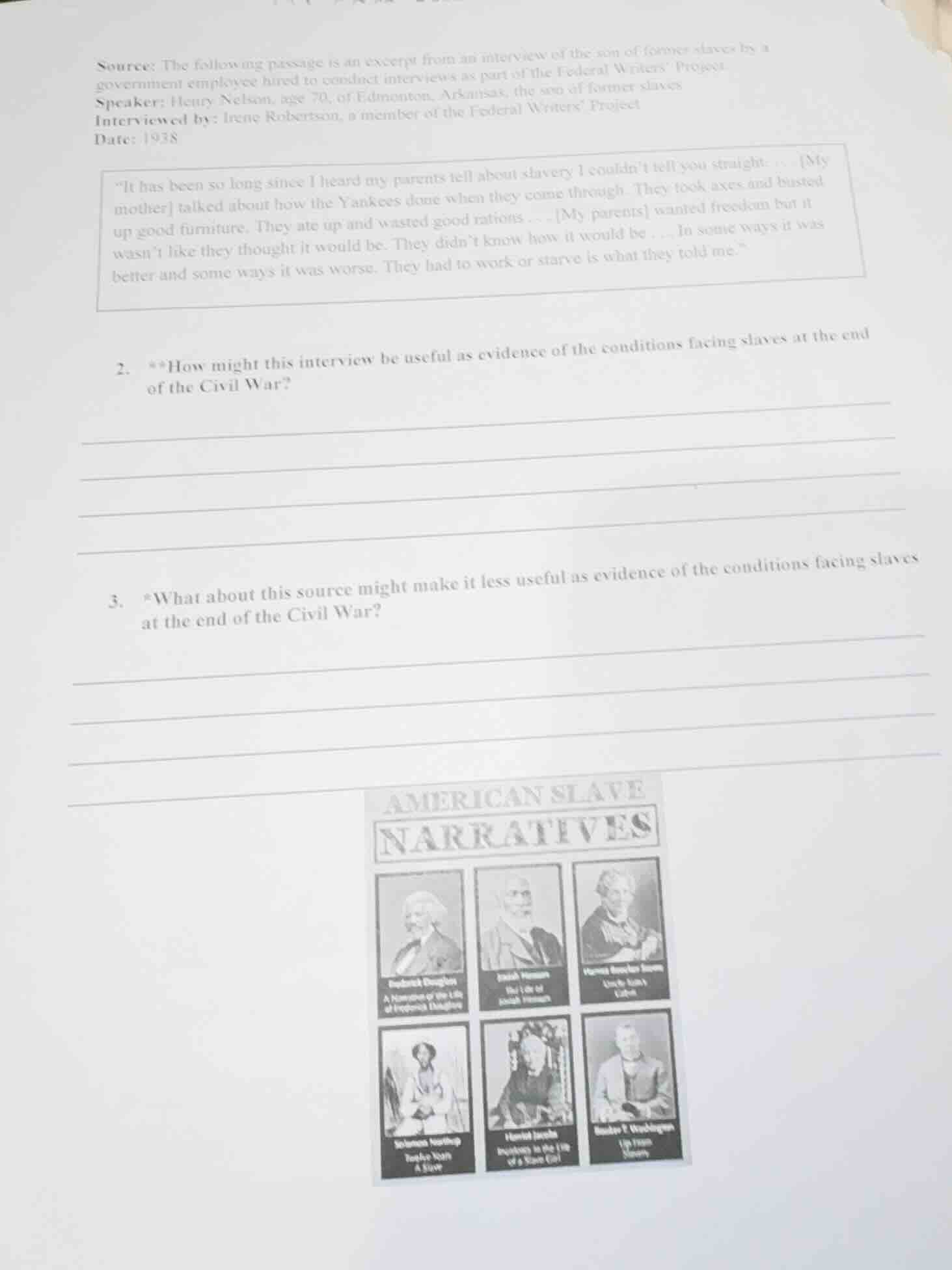
source: the following passage is an excerpt from an interview of the son of former slaves by a government employee hired to conduct interviews as part of the federal writers’ project. speaker: henry nelson, age 70, of edmonton, arkansas, the son of former slaves interviewed by: irene robertson, a member of the federal writers’ project date: 1938 “it has been so long since i heard my parents tell about slavery i couldn’t tell you straight. … my mother talked about how the yankees done when they come through. they took axes and busted up good furniture. they ate up and wasted good rations … my parents wanted freedom but it wasn’t like they thought it would be. they didn’t know how it would be … in some ways it was better and some ways it was worse. they had to work or starve is what they told me.” 2. *how might this interview be useful as evidence of the conditions facing slaves at the end of the civil war? 3. what about this source might make it less useful as evidence of the conditions facing slaves at the end of the civil war?**
For question 2: This interview provides firsthand, family-transmitted accounts of the experiences of formerly enslaved people at the end of the Civil War. It offers insights into their perspectives on Union troops, the unmet expectations of freedom, and the harsh post-emancipation survival challenges, which are personal, ground-level details not always captured in official records.
For question 3: The account is secondhand (Henry Nelson is relaying his parents' stories, not his own direct experience) and was recorded over 70 years after the end of the Civil War, which means memory distortion is highly likely. Additionally, it only reflects the specific experience of one family, so it cannot represent the full range of conditions faced by all enslaved people at the time.

Snap & solve any problem in the app
Get step-by-step solutions on Sovi AI
Photo-based solutions with guided steps
Explore more problems and detailed explanations
- It offers personal, family-passed accounts of formerly enslaved people's experiences, including their views of Union troops, unfulfilled hopes for freedom, and post-emancipation survival struggles, adding ground-level, human perspective missing from official records.
- It is secondhand testimony (relayed from parents, not direct experience), recorded decades after the events which risks memory inaccuracy, and only reflects the specific experience of one single family, so it is not representative of all enslaved people's conditions.