QUESTION IMAGE
Question
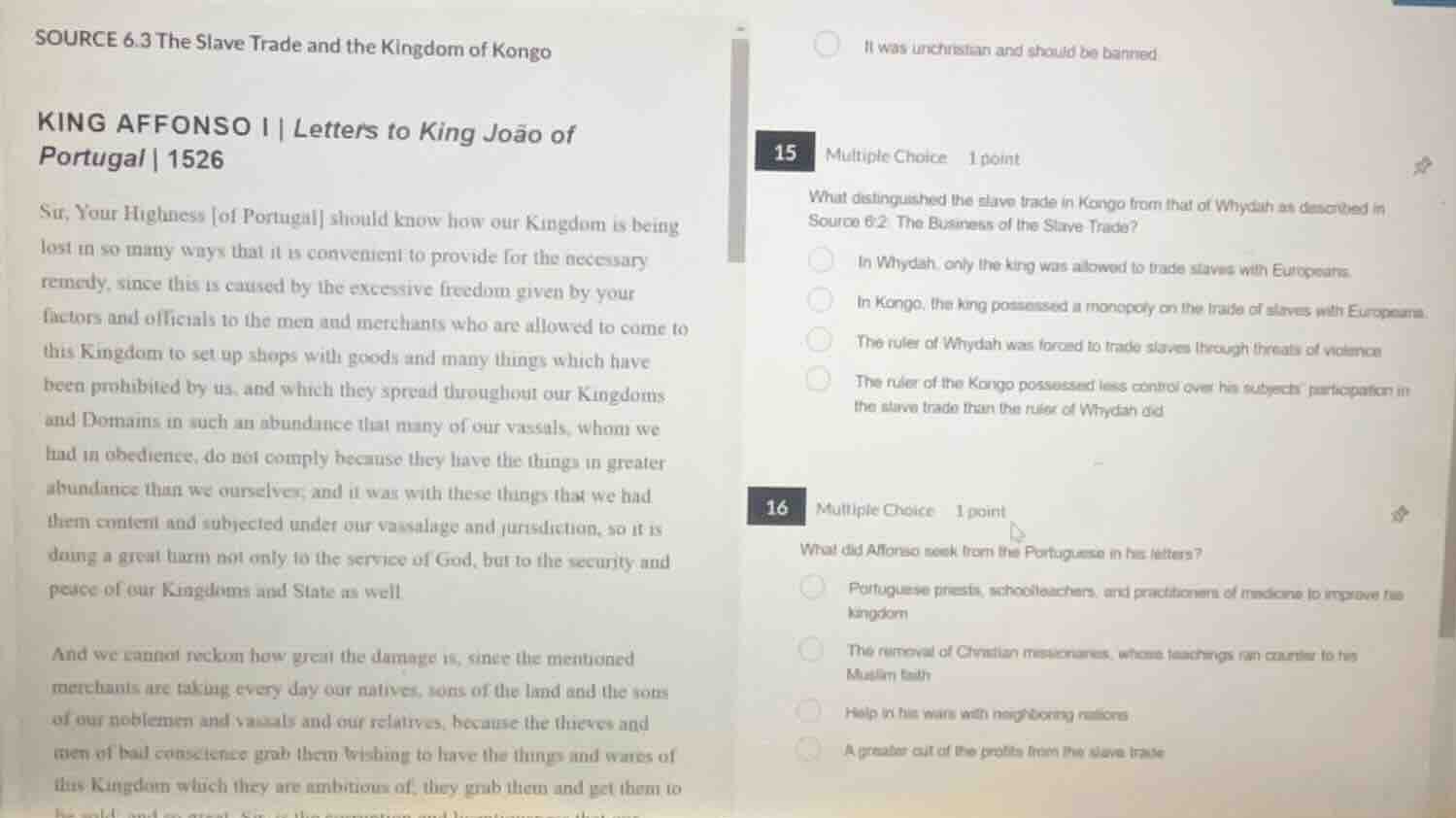
source 6.3 the slave trade and the kingdom of kongo
king affonso i | letters to king joão of
portugal | 1526
sir, your highness of portugal should know how our kingdom is being
lost in so many ways that it is convenient to provide for the necessary
remedy, since this is caused by the excessive freedom given by your
factors and officials to the men and merchants who are allowed to come to
this kingdom to set up shops with goods and many things which have
been prohibited by us, and which they spread throughout our kingdoms
and domains in such an abundance that many of our vassals, whom we
had in obedience, do not comply because they have the things in greater
abundance than we ourselves; and it was with these things that we had
them content and subjected under our vassalage and jurisdiction, so it is
doing a great harm not only to the service of god, but to the security and
peace of our kingdoms and state as well.
and we cannot reckon how great the damage is, since the mentioned
merchants are taking every day our natives, sons of the land and the sons
of our noblemen and vassals and our relatives, because the thieves and
men of bad conscience grab them wishing to have the things and wares of
this kingdom which they are ambitious of, they grab them and get them to
it was unchristian and should be banned
15 multiple choice 1 point
what distinguished the slave trade in kongo from that of whydah as described in
source 6.2 the business of the slave trade?
in whydah, only the king was allowed to trade slaves with europeans.
in kongo, the king possessed a monopoly on the trade of slaves with europeans.
the ruler of whydah was forced to trade slaves through threats of violence
the ruler of the kongo possessed less control over his subjects participation in
the slave trade than the ruler of whydah did
16 multiple choice 1 point
what did affonso seek from the portuguese in his letters?
portuguese priests, schoolteachers, and practitioners of medicine to improve his
kingdom
the removal of christian missionaries, whose teachings ran counter to his
muslim faith
help in his wars with neighboring nations
a greater cut of the profits from the slave trade
Question 15
To solve this, we analyze each option:
- Option 1: The description of Whydah's slave trade (from typical knowledge of Source 6.2) doesn't state only the king traded slaves with Europeans. Eliminate.
- Option 2: From King Affonso I's letter, it implies that in Kongo, the king had a monopoly (since he complains about merchants' excessive freedom, suggesting he should have control). This matches the distinction.
- Option 3: There's no indication the ruler of Whydah was forced via violence. Eliminate.
- Option 4: The letter shows Kongo's king had less control? No, he complains about loss of control due to merchants, meaning he should have more, so Whydah's ruler likely had more? This is opposite. Eliminate.
Analyze each option:
- Option 1: Affonso's letter focuses on the harm of slave trade and the need for order, and seeking Portuguese priests, teachers, etc. to improve the kingdom aligns (to counter the negative effects of unregulated trade and spread proper Christian influence).
- Option 2: Affonso was Christian (Kongo adopted Christianity), so he wouldn't want to remove Christian missionaries. Eliminate.
- Option 3: The letter doesn't mention wars with neighbors. Eliminate.
- Option 4: He complains about the slave trade's harm, so he wouldn't seek a greater cut. Eliminate.

Snap & solve any problem in the app
Get step-by-step solutions on Sovi AI
Photo-based solutions with guided steps
Explore more problems and detailed explanations
B. In Kongo, the king possessed a monopoly on the trade of slaves with Europeans.