QUESTION IMAGE
Question
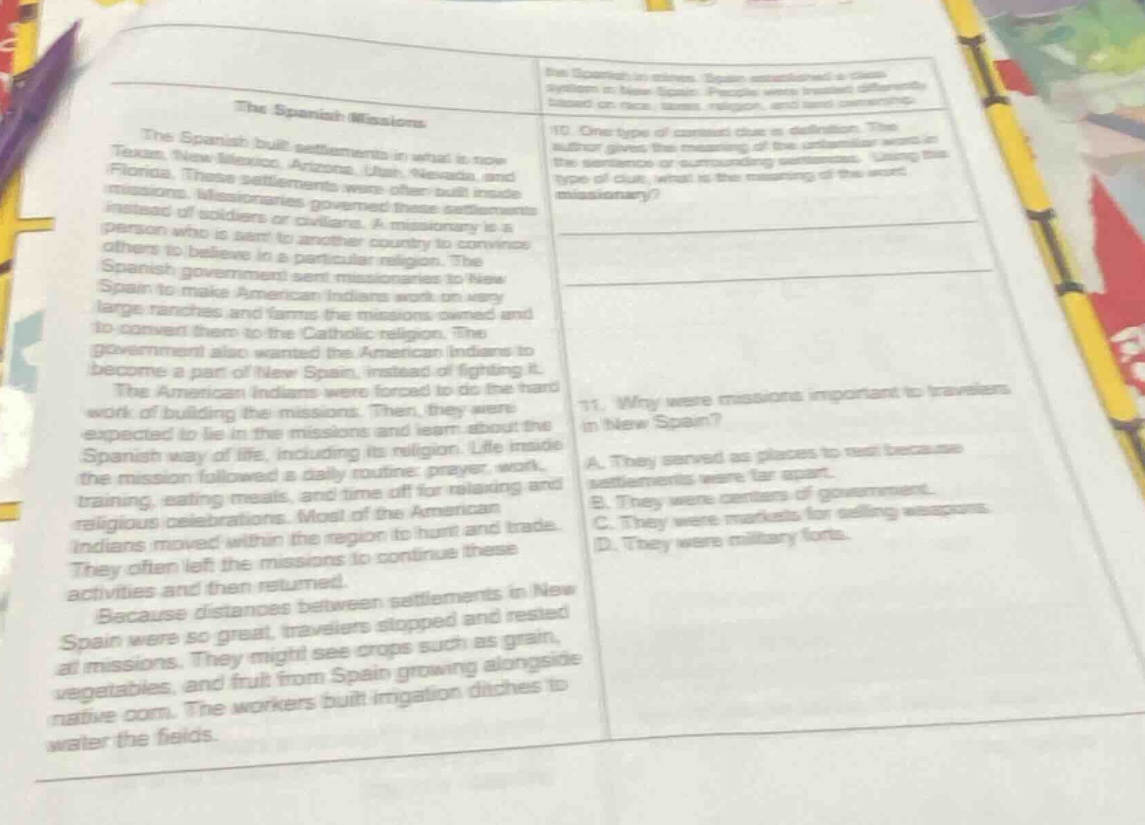
the spanish missions
the spanish built settlements in what is now texas, new mexico, arizona, utah, nevada, and florida. these settlements were often built inside missions. missionaries governed these settlements instead of soldiers or civilians. a missionary is a person who is sent to another country to convince others to believe in a particular religion. the spanish government sent missionaries to new spain to make american indians work on very large ranches and farms the missions owned and to convert them to the catholic religion. the government also wanted the american indians to become a part of new spain, instead of fighting it.
the american indians were forced to do the hard work of building the missions. then, they were expected to live in the missions and learn about the spanish way of life, including its religion. life inside the mission followed a daily routine: prayer, work, training, eating meals, and time off for relaxing and religious celebrations. most of the american indians moved within the region to hunt and trade. they often left the missions to continue these activities and then returned.
because distances between settlements in new spain were so great, travelers stopped and rested at missions. they might see crops such as grain, vegetables, and fruit from spain growing alongside native corn. the workers built irrigation ditches to water the fields.
- one type of context clue is definition. the author gives the meaning of the unfamiliar word or the sentence or surrounding sentences. using this type of clue, what is the meaning of the word missionary?
- why were missions important to travelers in new spain?
a. they served as places to rest because settlements were far apart.
b. they were centers of government.
c. they were markets for selling weapons.
d. they were military forts.
Question 10 (Determining the meaning of "missionary" via context clues)
To find the meaning of "missionary", we analyze the surrounding text. The passage states: "A missionary is a person who is sent to another country to convince others to believe in a particular religion. The Spanish government sent missionaries to New Spain to make American Indians work on very large ranches and farms the missions owned and to convert them to the Catholic religion." From this context, we can infer that a missionary is someone sent to another place (here, New Spain) to spread a religion (Catholicism) and also have the American Indians work for the missions. So the key points are: sent to another country, to convince others of a particular religion, and (in this case) also related to the missions' labor and religious conversion efforts.
- Option A: The passage says "Because distances between settlements in New Spain were so great, travelers stopped and rested at missions." This matches the idea that missions were places to rest as settlements were far apart.
- Option B: The passage states "Missionaries governed these settlements instead of soldiers or civilians" - so missionaries (not the missions as centers of government in a general sense) governed, and there's no indication missions were main government centers for travelers' benefit.
- Option C: There's no mention of missions being markets for selling weapons.
- Option D: The passage says missionaries (not soldiers) governed, and there's no indication missions were military forts.
So the correct option is A.

Snap & solve any problem in the app
Get step-by-step solutions on Sovi AI
Photo-based solutions with guided steps
Explore more problems and detailed explanations
A missionary is a person sent to another country (like New Spain) to convince others to believe in a particular religion (Catholicism here) and also involved in having the local people (American Indians) work for the missions and be converted to that religion.