QUESTION IMAGE
Question
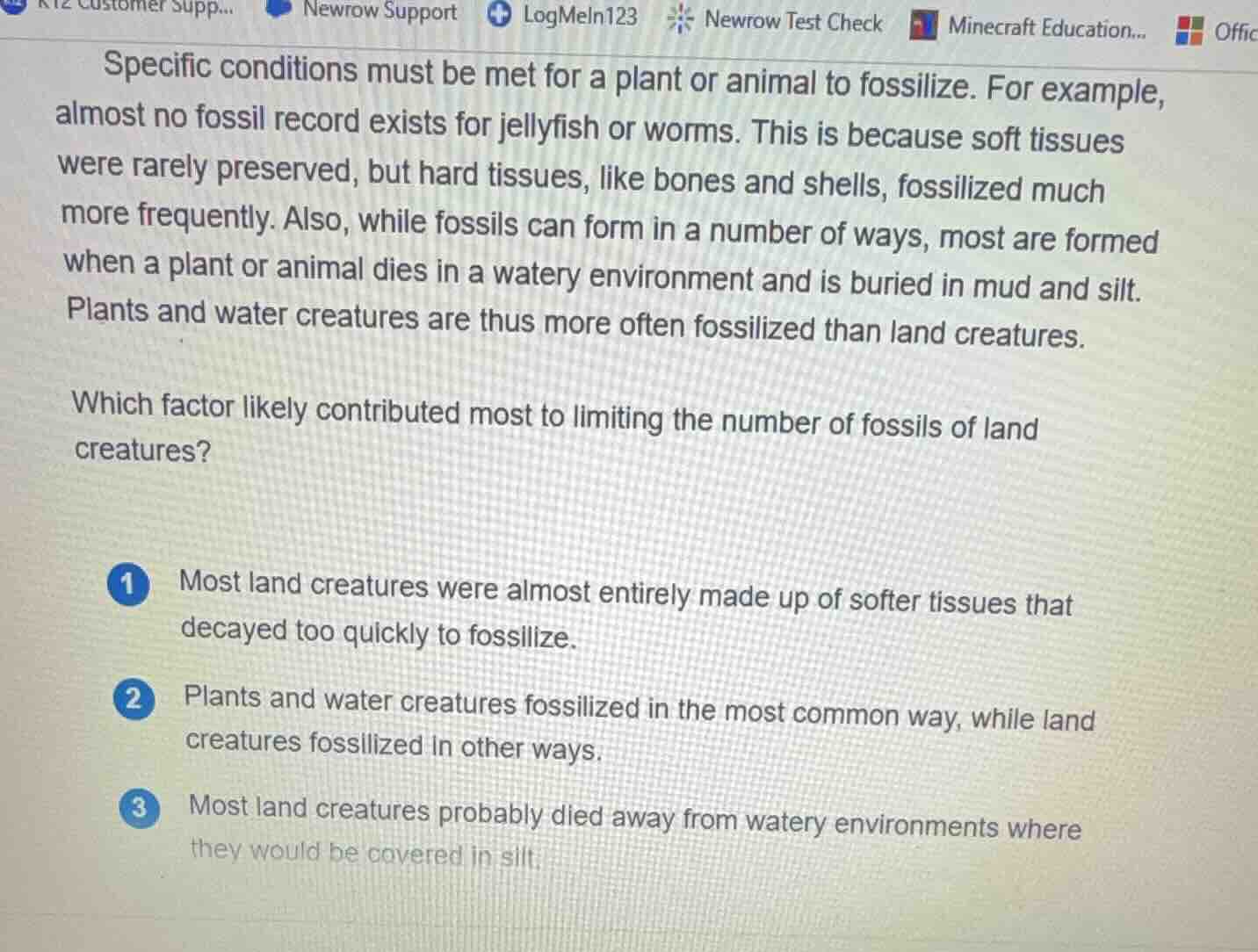
specific conditions must be met for a plant or animal to fossilize. for example, almost no fossil record exists for jellyfish or worms. this is because soft tissues were rarely preserved, but hard tissues, like bones and shells, fossilized much more frequently. also, while fossils can form in a number of ways, most are formed when a plant or animal dies in a watery environment and is buried in mud and silt. plants and water creatures are thus more often fossilized than land creatures. which factor likely contributed most to limiting the number of fossils of land creatures? 1 most land creatures were almost entirely made up of softer tissues that decayed too quickly to fossilize. 2 plants and water creatures fossilized in the most common way, while land creatures fossilized in other ways. 3 most land creatures probably died away from watery environments where they would be covered in silt.
The passage states that the most common fossilization occurs when organisms die in watery environments and are buried in mud/silt, and plants/water creatures are fossilized more often than land creatures. Option 1 is incorrect because land creatures like mammals have hard tissues (bones). Option 2 is incorrect as the passage does not state land creatures use different fossilization methods. Option 3 aligns with the key condition: land creatures often die away from the watery, silt/mud environments needed for the most common fossilization process.

Snap & solve any problem in the app
Get step-by-step solutions on Sovi AI
Photo-based solutions with guided steps
Explore more problems and detailed explanations
- Most land creatures probably died away from watery environments where they would be covered in silt.