QUESTION IMAGE
Question
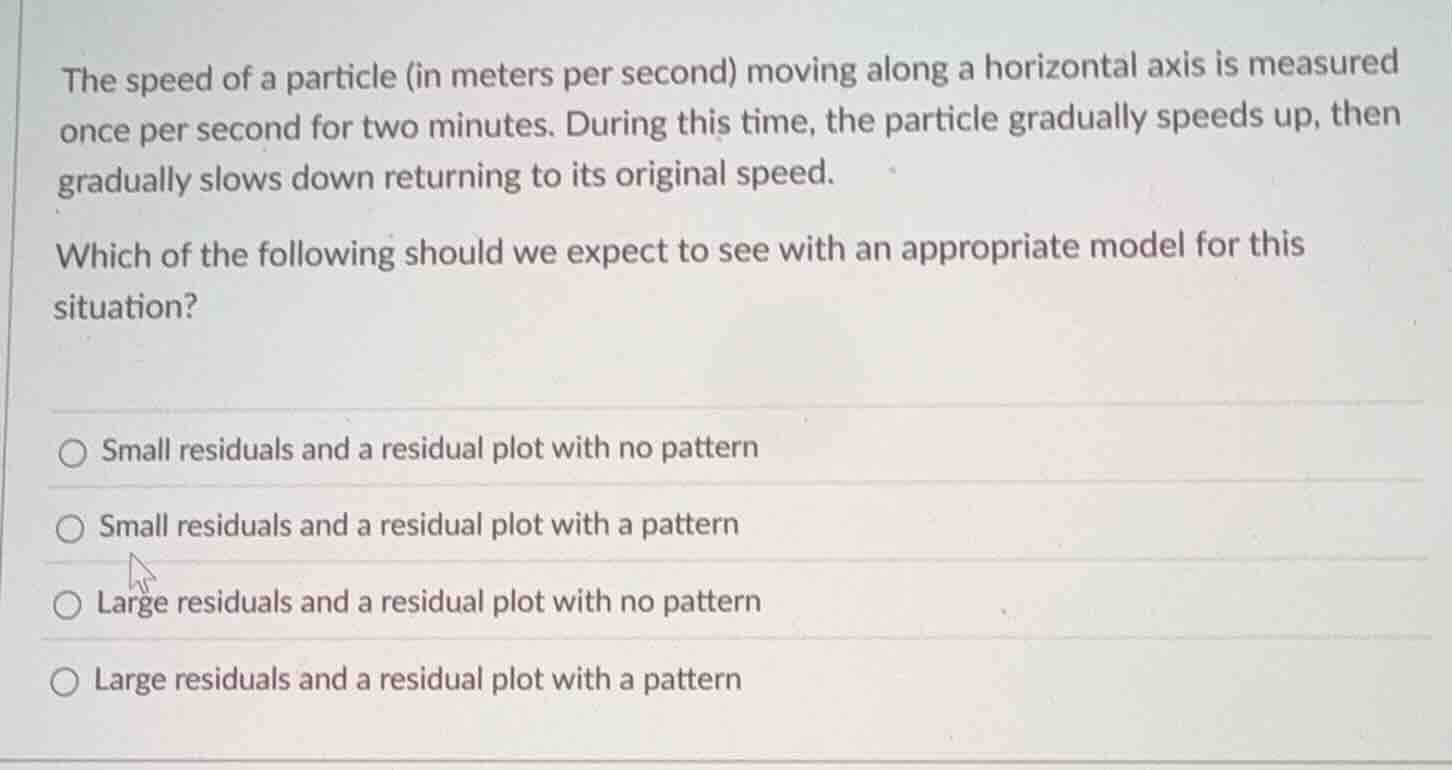
the speed of a particle (in meters per second) moving along a horizontal axis is measured once per second for two minutes. during this time, the particle gradually speeds up, then gradually slows down returning to its original speed.which of the following should we expect to see with an appropriate model for this situation?small residuals and a residual plot with no patternsmall residuals and a residual plot with a patternlarge residuals and a residual plot with no patternlarge residuals and a residual plot with a pattern
An appropriate model will closely match the particle's speed behavior (speeding up then slowing down, symmetric speed change), leading to small residuals (low error between model and measured values). However, the speed follows a curved (quadratic-like) pattern; if a linear model was incorrectly used, or even if a correct curved model is assessed, the residual plot would show a pattern if the model doesn't perfectly capture the curvature, but more importantly, the key is that a good model has small residuals, and the non-linear nature of the speed change means residuals will have a pattern if a mis-specified model is used, but the scenario states an appropriate model—wait, no: the speed's trajectory is a symmetric peak, so an appropriate quadratic model would fit well, but residuals would still show no pattern? No, wait: no, the actual data follows a smooth curve, so an appropriate model (like quadratic) would have small residuals, and the residual plot would have no pattern? No, wait no—wait, the particle's speed increases then decreases back to original, so the speed vs time is a parabola. An appropriate quadratic model would fit this nearly perfectly, leading to small residuals, and the residual plot would have no pattern (random scatter). Wait, no, let's correct: if the model is appropriate, residuals are small and random (no pattern). Wait, but why would there be a pattern? If the model was wrong (like linear), residuals would have a pattern, but the question says appropriate model. Oh right, the question specifies an appropriate model. So an appropriate model will fit the data well (small residuals) and since it captures the true pattern, residuals will be random with no pattern. Wait, no, wait the description: "gradually speeds up, then gradually slows down returning to its original speed"—that's a symmetric quadratic curve. An appropriate quadratic model would have small residuals, and residual plot with no pattern (random noise). Wait, but let's re-express:
- Small residuals: An appropriate model closely matches the measured data, so residuals (differences between model and measurements) are small.
- No pattern in residual plot: A well-fitting (appropriate) model will have residuals that are randomly scattered, with no discernible pattern, as all systematic variation is captured by the model.
Wait, but let's confirm: if the data is a perfect parabola, and we use a quadratic model, residuals are just random measurement error, so no pattern. So the correct option is the first one.

Snap & solve any problem in the app
Get step-by-step solutions on Sovi AI
Photo-based solutions with guided steps
Explore more problems and detailed explanations
Small residuals and a residual plot with no pattern