QUESTION IMAGE
Question
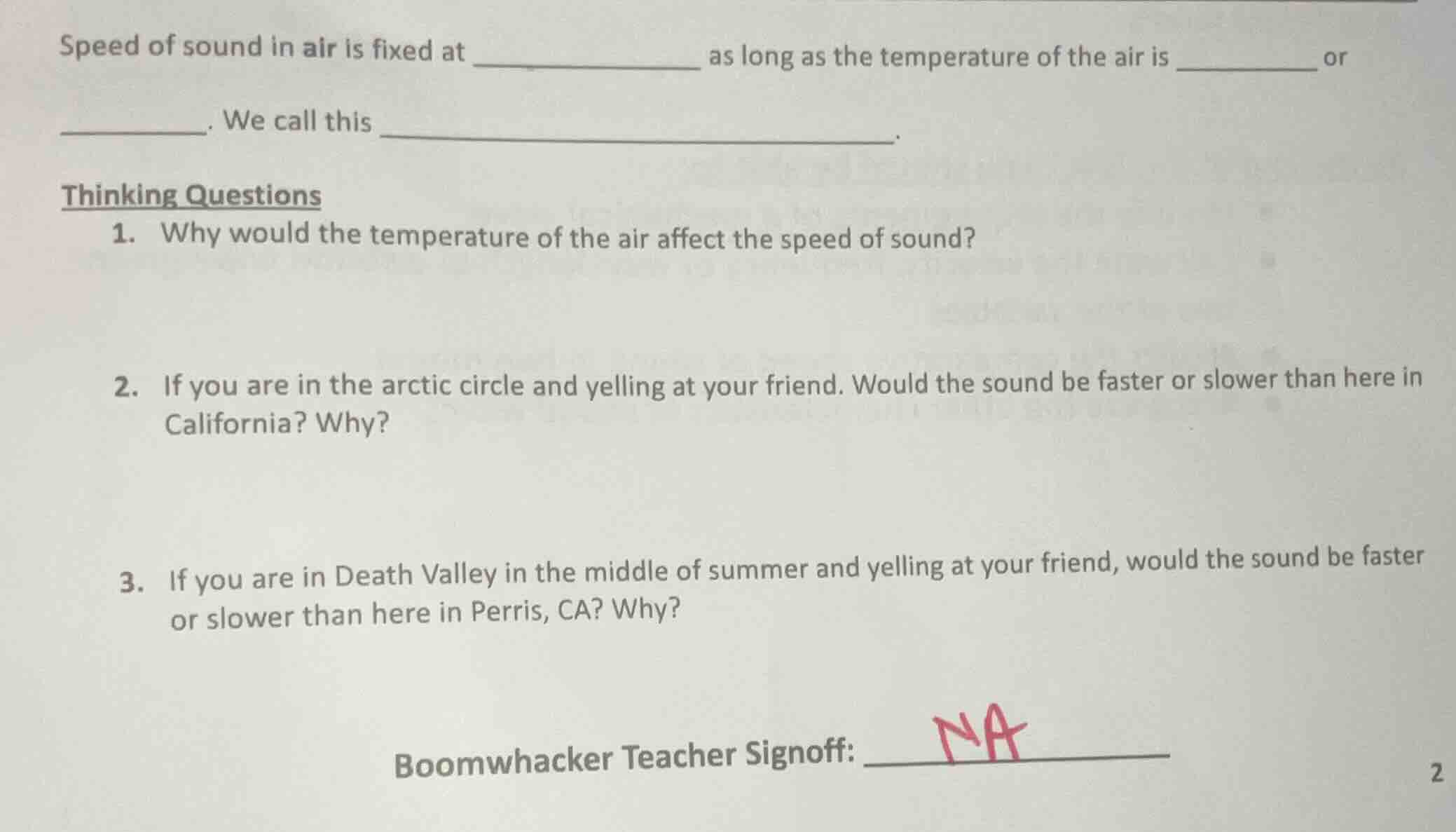
speed of sound in air is fixed at _____________ as long as the temperature of the air is ______ or ______. we call this ___________________________.
thinking questions
- why would the temperature of the air affect the speed of sound?
- if you are in the arctic circle and yelling at your friend. would the sound be faster or slower than here in california? why?
- if you are in death valley in the middle of summer and yelling at your friend, would the sound be faster or slower than here in perris, ca? why?
boomwhacker teacher signoff: __na__
Fill-in-the-blank section:
The standard reference speed of sound in dry air is defined at a specific temperature. This fixed value is used as a baseline for calculations.
Thinking Question 1:
Sound travels via air molecule collisions. Higher air temperature increases molecular kinetic energy, making collisions faster, which speeds up sound propagation.
Thinking Question 2:
The Arctic Circle has far colder average temperatures than California. Colder air has slower-moving molecules, so sound travels more slowly there.
Thinking Question 3:
Death Valley in summer has extremely high temperatures, much warmer than Perris, CA. Warmer air has faster-moving molecules, so sound travels faster in Death Valley.

Snap & solve any problem in the app
Get step-by-step solutions on Sovi AI
Photo-based solutions with guided steps
Explore more problems and detailed explanations
Fill-in-the-blank:
Speed of sound in air is fixed at $343 \text{ m/s}$ (or $767 \text{ mph}$) as long as the temperature of the air is $20^\circ\text{C}$ or $68^\circ\text{F}$. We call this the reference speed of sound in dry air.
Thinking Question 1:
Air temperature affects molecular kinetic energy; warmer air molecules move faster, increasing the speed of sound by speeding up the collisions that transmit sound waves.
Thinking Question 2:
Slower. The Arctic Circle has much colder air than California, and sound travels slower in colder air due to less kinetic energy in air molecules.
Thinking Question 3:
Faster. Death Valley in summer is significantly warmer than Perris, CA, and sound travels faster in warmer air because higher temperatures increase air molecule kinetic energy, speeding up sound wave transmission.