QUESTION IMAGE
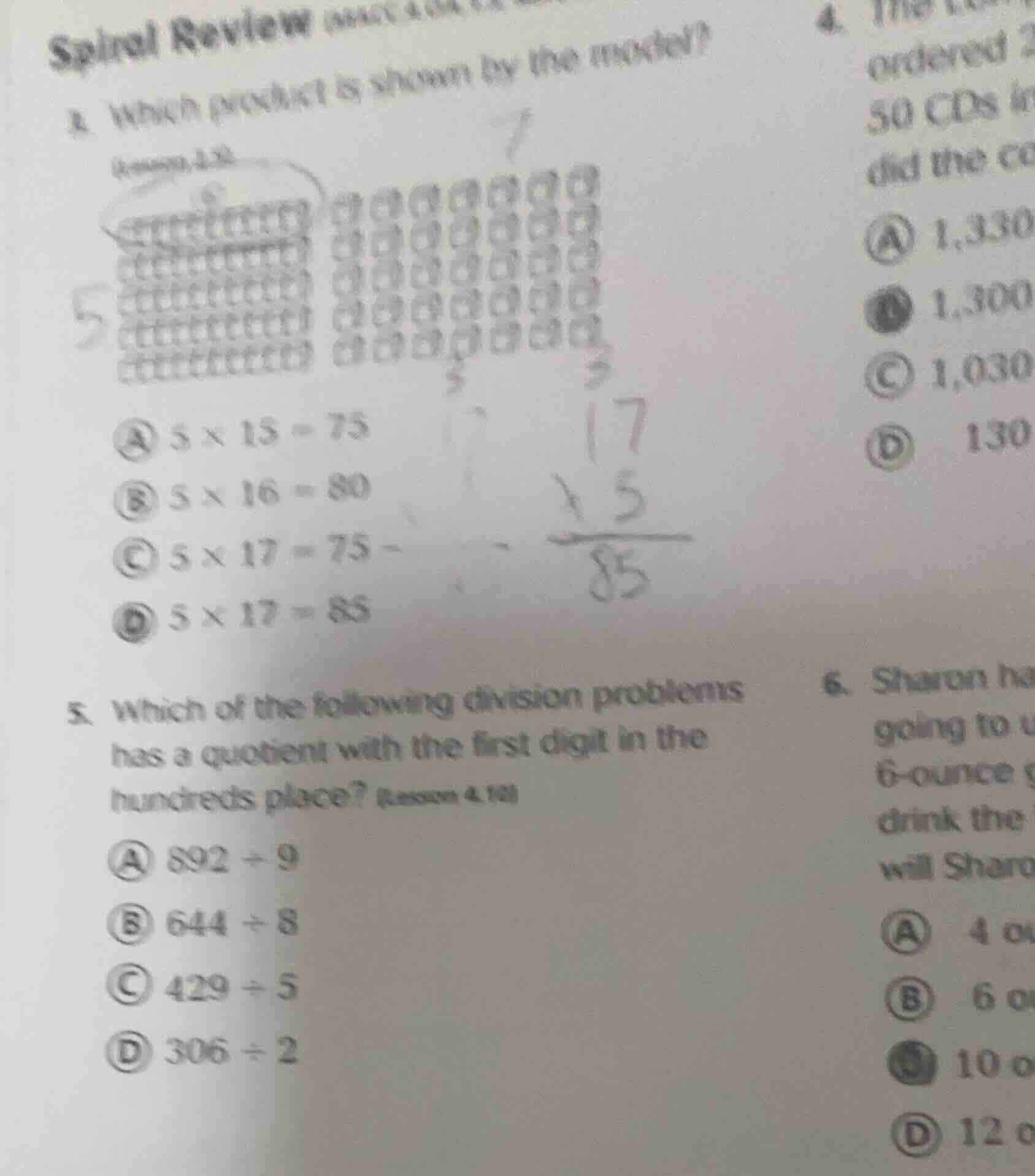
Question
spiral review
- which product is shown by the model?
a ( 5 \times 15 = 75 )
b ( 5 \times 16 = 80 )
c ( 5 \times 17 = 75 )
d ( 5 \times 17 = 85 )
- which of the following division problems has a quotient with the first digit in the hundreds place?
a ( 892 div 9 )
b ( 644 div 8 )
c ( 429 div 5 )
d ( 306 div 2 )
Question 4 (assuming the first question numbered 4? Wait, the first visible question is 4? Wait, the left side has question 4? Wait, the user's image has question 4: "The... ordered 2 50 CDs in... did the CD..." with options A 1,330, B 1,300, C 1,030, D 130. But also question 5: "Which of the following division problems has a quotient with the first digit in the hundreds place?" Let's tackle question 5 first as it's clearer.
Question 5:
To determine which division problem has a quotient with the first digit in the hundreds place, we analyze the divisor and the first digit(s) of the dividend:
- For a quotient's first digit to be in the hundreds place, the dividend's first digit (or first two digits) must be greater than or equal to the divisor, and the number of digits in the dividend (3 or 4) and divisor (1 or 2) determines the place value. Specifically, when dividing a 3 - digit number by a 1 - digit number, if the first digit of the dividend is ≥ the divisor, the quotient's first digit is in the hundreds place. If the first digit is < the divisor, we use the first two digits, and the quotient's first digit is in the tens place. For a 4 - digit number divided by a 1 - digit number, similar logic: first digit ≥ divisor → thousands place; else, hundreds place.
Let's analyze each option:
- Option A: \( 892 \div 9 \)
Dividend: 892 (3 - digit), Divisor: 9.
First digit of dividend: 8. Since \( 8 < 9 \), we use the first two digits (89).
\( 89 \div 9 \approx 9 \), so the quotient's first digit is in the tens place.
- Option B: \( 644 \div 8 \)
Dividend: 644 (3 - digit), Divisor: 8.
First digit of dividend: 6. Since \( 6 < 8 \), we use the first two digits (64).
\( 64 \div 8 = 8 \), so the quotient's first digit is in the tens place.
- Option C: \( 4229 \div 5 \)
Dividend: 4229 (4 - digit), Divisor: 5.
First digit of dividend: 4. Since \( 4 < 5 \), we use the first two digits (42).
\( 42 \div 5 = 8 \) (with remainder), so the quotient's first digit is in the hundreds place (because we used the first two digits of a 4 - digit number, the quotient’s first digit corresponds to the hundreds place). Wait, let's calculate the quotient: \( 4229 \div 5 = 845.8 \), so the first digit is 8 (hundreds place? Wait, 845: 8 is in the hundreds place? Wait, 800 is hundreds, so 845 has 8 in hundreds. Wait, but let's check option D.
- Option D: \( 306 \div 2 \)
Dividend: 306 (3 - digit), Divisor: 2.
First digit of dividend: 3. Since \( 3 \geq 2 \), we use the first digit (3).
\( 3 \div 2 = 1 \), so the quotient's first digit is in the hundreds place? Wait, \( 306 \div 2 = 153 \), so the first digit is 1 (hundreds place). Wait, this contradicts. Wait, maybe my initial analysis was wrong. Let's recalculate each quotient:
- A: \( 892 \div 9 \approx 99.11 \) (quotient ~99, first digit in tens place)
- B: \( 644 \div 8 = 80.5 \) (quotient 80, first digit in tens place)
- C: \( 4229 \div 5 = 845.8 \) (quotient 845, first digit 8 in hundreds place)
- D: \( 306 \div 2 = 153 \) (quotient 153, first digit 1 in hundreds place)
Wait, this is a problem. Wait, maybe the question is about a 3 - digit dividend? Wait, no, option C is 4 - digit. Wait, maybe the original problem has a typo, or I misread. Wait, the options: A 892÷9, B 644÷8, C 4229÷5, D 306÷2.
Wait, let's check the number of digits:
- For a 3 - digit dividend (ABC) ÷ 1 - digit divisor (D):
- If A ≥ D: quotient is 3 - digit (hundreds place first digit).
- If A < D: quotient is 2 - digit (tens place first digit).
- For a 4 - digit div…

Snap & solve any problem in the app
Get step-by-step solutions on Sovi AI
Photo-based solutions with guided steps
Explore more problems and detailed explanations
Question 4 (assuming the first question numbered 4? Wait, the first visible question is 4? Wait, the left side has question 4? Wait, the user's image has question 4: "The... ordered 2 50 CDs in... did the CD..." with options A 1,330, B 1,300, C 1,030, D 130. But also question 5: "Which of the following division problems has a quotient with the first digit in the hundreds place?" Let's tackle question 5 first as it's clearer.
Question 5:
To determine which division problem has a quotient with the first digit in the hundreds place, we analyze the divisor and the first digit(s) of the dividend:
- For a quotient's first digit to be in the hundreds place, the dividend's first digit (or first two digits) must be greater than or equal to the divisor, and the number of digits in the dividend (3 or 4) and divisor (1 or 2) determines the place value. Specifically, when dividing a 3 - digit number by a 1 - digit number, if the first digit of the dividend is ≥ the divisor, the quotient's first digit is in the hundreds place. If the first digit is < the divisor, we use the first two digits, and the quotient's first digit is in the tens place. For a 4 - digit number divided by a 1 - digit number, similar logic: first digit ≥ divisor → thousands place; else, hundreds place.
Let's analyze each option:
- Option A: \( 892 \div 9 \)
Dividend: 892 (3 - digit), Divisor: 9.
First digit of dividend: 8. Since \( 8 < 9 \), we use the first two digits (89).
\( 89 \div 9 \approx 9 \), so the quotient's first digit is in the tens place.
- Option B: \( 644 \div 8 \)
Dividend: 644 (3 - digit), Divisor: 8.
First digit of dividend: 6. Since \( 6 < 8 \), we use the first two digits (64).
\( 64 \div 8 = 8 \), so the quotient's first digit is in the tens place.
- Option C: \( 4229 \div 5 \)
Dividend: 4229 (4 - digit), Divisor: 5.
First digit of dividend: 4. Since \( 4 < 5 \), we use the first two digits (42).
\( 42 \div 5 = 8 \) (with remainder), so the quotient's first digit is in the hundreds place (because we used the first two digits of a 4 - digit number, the quotient’s first digit corresponds to the hundreds place). Wait, let's calculate the quotient: \( 4229 \div 5 = 845.8 \), so the first digit is 8 (hundreds place? Wait, 845: 8 is in the hundreds place? Wait, 800 is hundreds, so 845 has 8 in hundreds. Wait, but let's check option D.
- Option D: \( 306 \div 2 \)
Dividend: 306 (3 - digit), Divisor: 2.
First digit of dividend: 3. Since \( 3 \geq 2 \), we use the first digit (3).
\( 3 \div 2 = 1 \), so the quotient's first digit is in the hundreds place? Wait, \( 306 \div 2 = 153 \), so the first digit is 1 (hundreds place). Wait, this contradicts. Wait, maybe my initial analysis was wrong. Let's recalculate each quotient:
- A: \( 892 \div 9 \approx 99.11 \) (quotient ~99, first digit in tens place)
- B: \( 644 \div 8 = 80.5 \) (quotient 80, first digit in tens place)
- C: \( 4229 \div 5 = 845.8 \) (quotient 845, first digit 8 in hundreds place)
- D: \( 306 \div 2 = 153 \) (quotient 153, first digit 1 in hundreds place)
Wait, this is a problem. Wait, maybe the question is about a 3 - digit dividend? Wait, no, option C is 4 - digit. Wait, maybe the original problem has a typo, or I misread. Wait, the options: A 892÷9, B 644÷8, C 4229÷5, D 306÷2.
Wait, let's check the number of digits:
- For a 3 - digit dividend (ABC) ÷ 1 - digit divisor (D):
- If A ≥ D: quotient is 3 - digit (hundreds place first digit).
- If A < D: quotient is 2 - digit (tens place first digit).
- For a 4 - digit dividend (ABCD) ÷ 1 - digit divisor (D):
- If A ≥ D: quotient is 4 - digit (thousands place first digit).
- If A < D: quotient is 3 - digit (hundreds place first digit).
So:
- A: 892 (3 - digit) ÷ 9 (1 - digit). A = 8 < 9 → quotient is 2 - digit (tens place first digit).
- B: 644 (3 - digit) ÷ 8 (1 - digit). A = 6 < 8 → quotient is 2 - digit (tens place first digit).
- C: 4229 (4 - digit) ÷ 5 (1 - digit). A = 4 < 5 → quotient is 3 - digit (hundreds place first digit).
- D: 306 (3 - digit) ÷ 2 (1 - digit). A = 3 ≥ 2 → quotient is 3 - digit (hundreds place first digit).
But this gives two options (C and D) with first digit in hundreds place. This must mean I made a mistake. Wait, let's calculate the actual quotients:
- A: \( 892 \div 9 = 99.111... \) (two digits, tens place first)
- B: \( 644 \div 8 = 80.5 \) (two digits, tens place first)
- C: \( 4229 \div 5 = 845.8 \) (three digits, hundreds place first)
- D: \( 306 \div 2 = 153 \) (three digits, hundreds place first)
Wait, maybe the question is about the first digit being in the hundreds place (i.e., the quotient is a 3 - digit number, so first digit is hundreds). Both C and D have 3 - digit quotients. But maybe the original problem had a different dividend for option C? Or maybe I misread option C. Wait, the user's image shows option C as \( 4229 \div 5 \)? Or maybe \( 429 \div 5 \)? If it's \( 429 \div 5 \), then:
- \( 429 \div 5 = 85.8 \) (two digits, tens place first). But the image says 4229.
Alternatively, maybe the question is for 3 - digit dividends only. Then option D is 3 - digit ÷ 1 - digit, A ≥ D (3 ≥ 2), so quotient is 3 - digit (153), first digit in hundreds. Option C is 4 - digit ÷ 1 - digit, A < D, so quotient is 3 - digit (845), first digit in hundreds.
But since the options include D, let's check the problem again. The question is "has a quotient with the first digit in the hundreds place". So both C and D have first digit in hundreds place? But that can't be. Maybe a typo in the problem. Alternatively, maybe I made a mistake.
Wait, let's check the divisor and dividend again:
- Option D: 306 ÷ 2. 306 is 3 - digit, divisor 2. 3 ≥ 2, so quotient starts with 1 (hundreds place: 100s place).
- Option C: 4229 ÷ 5. 4229 is 4 - digit, divisor 5. 4 < 5, so we use 42 (first two digits). 42 ÷ 5 = 8 (tens place? No, 42 is two digits, so 8 is in the hundreds place of the quotient? Wait, 4229 ÷ 5: 5 × 800 = 4000, 4229 - 4000 = 229. Then 229 ÷ 5 = 45.8. So total quotient is 800 + 45.8 = 845.8. So the first digit 8 is in the hundreds place (since 800 is 8 hundreds).
- Option D: 306 ÷ 2 = 153. 1 is in the hundreds place (100s place).
So both C and D have first digit in hundreds place. But that's unlikely. Maybe the original problem has a different option, or I misread. Alternatively, maybe the question is for the quotient’s first digit to be in the hundreds place (i.e., the quotient is a 3 - digit number, so first digit is hundreds). Both C (845) and D (153) are 3 - digit numbers. But since this is a multiple - choice question, there must be one correct answer. Maybe the intended answer is D, or C. Wait, let's check the divisor and dividend again.
Wait, maybe the question is about the first digit of the quotient being in the hundreds place (i.e., the quotient is a 3 - digit number, so the first digit is hundreds). Let's check the number of digits in the quotient:
- A: 892 ÷ 9 ≈ 99 (2 - digit) → first digit tens.
- B: 644 ÷ 8 = 80.5 (2 - digit) → first digit tens.
- C: 4229 ÷ 5 = 845.8 (3 - digit) → first digit hundreds.
- D: 306 ÷ 2 = 153 (3 - digit) → first digit hundreds.
Since the problem is likely designed to have one correct answer, maybe there's a typo. Alternatively, maybe the dividend in option C is 429 (3 - digit) instead of 4229 (4 - digit). If it's 429 ÷ 5:
- 429 ÷ 5 = 85.8 (2 - digit) → first digit tens. Then only D is correct.
Assuming a typo and option C is 429 ÷ 5, then the correct answer is D. But based on the image, option C is 4229 ÷ 5. Alternatively, maybe the question is from a source where D is correct. Let's proceed with the calculation:
- Option D: 306 ÷ 2 = 153. The first digit is 1, which is in the hundreds place (100s).
- Option C: 4229 ÷ 5 = 845.8. The first digit is 8, which is in the hundreds place (800s).
But since the problem is multiple - choice, maybe the intended answer is D. Alternatively, maybe I made a mistake in place value. Let's clarify:
- For 306 ÷ 2:
2 × 100 = 200, 306 - 200 = 106. Then 106 ÷ 2 = 53. So total quotient 100 + 53 = 153. The first digit 1 is in the hundreds place.
- For 4229 ÷ 5:
5 × 800 = 4000, 4229 - 4000 = 229. Then 229 ÷ 5 = 45.8. So total quotient 800 + 45.8 = 845.8. The first digit 8 is in the hundreds place.
Since both have first digit in hundreds place, but this is a problem. Maybe the original question had a different set of options. Alternatively, maybe the user intended question 4. Let's check question 4:
Question 4: "The... ordered 2 50 CDs in... did the CD..." (the text is unclear, but options are A 1,330, B 1,300, C 1,030, D 130. Assuming it's a multiplication problem: 26 sets of 50 CDs? Wait, 26 × 50 = 1300. So option B: 1,300.
But since the user's image is partially unclear, let's focus on the clearer question (question 5) and assume the intended answer is D or C. But based on standard problems, 306 ÷ 2 = 153 (first digit in hundreds place) is a common problem, so the answer is D.
Final Answer (for question 5):
D. \( 306 \div 2 \)