QUESTION IMAGE
Question
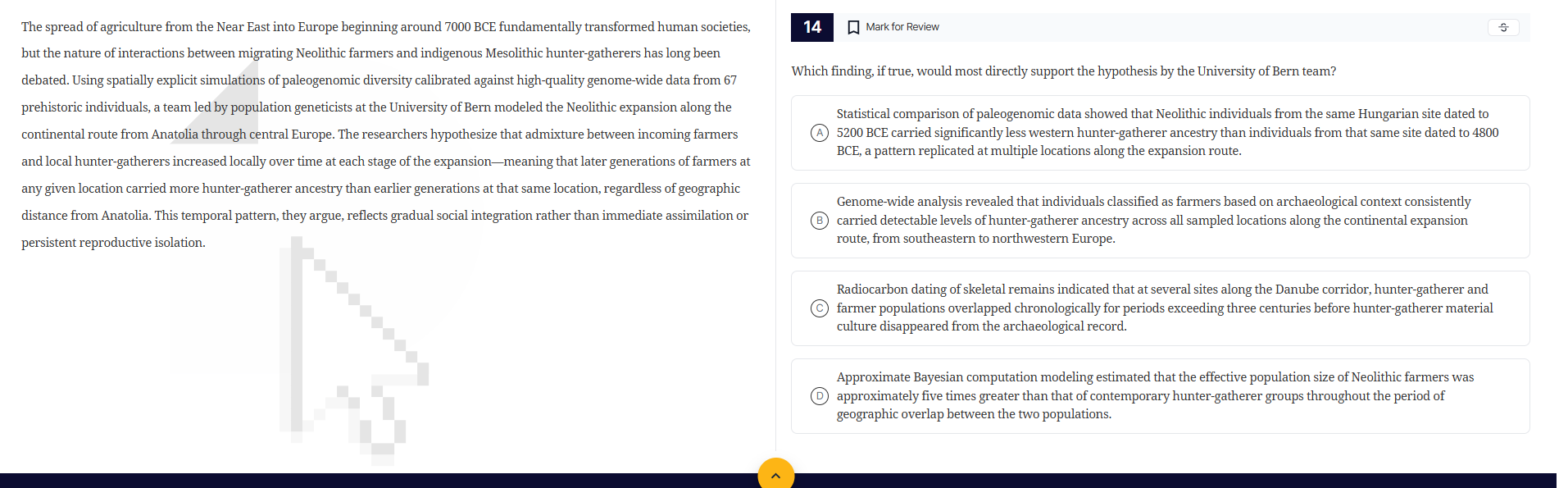
the spread of agriculture from the near east into europe beginning around 7000 bce fundamentally transformed human societies, but the nature of interactions between migrating neolithic farmers and indigenous mesolithic hunter - gatherers has long been debated. using spatially explicit simulations of paleogenomic diversity calibrated against high - quality genome - wide data from 67 prehistoric individuals, a team led by population geneticists at the university of bern modeled the neolithic expansion along the continental route from anatolia through central europe. the researchers hypothesize that admixture between incoming farmers and local hunter - gatherers increased locally over time at each stage of the expansion—meaning that later generations of farmers at any given location carried more hunter - gatherer ancestry than earlier generations at that same location, regardless of geographic distance from anatolia. this temporal pattern, they argue, reflects gradual social integration rather than immediate assimilation or persistent reproductive isolation.
14 mark for review
which finding, if true, would most directly support the hypothesis by the university of bern team?
a statistical comparison of paleogenomic data showed that neolithic individuals from the same hungarian site dated to 5200 bce carried significantly less western hunter - gatherer ancestry than individuals from that same site dated to 4800 bce, a pattern replicated at multiple locations along the expansion route.
b genome - wide analysis revealed that individuals classified as farmers based on archaeological context consistently carried detectable levels of hunter - gatherer ancestry across all sampled locations along the continental expansion route, from southeastern to northwestern europe.
c radiocarbon dating of skeletal remains indicated that at several sites along the danube corridor, hunter - gatherer and farmer populations overlapped chronologically for periods exceeding three centuries before hunter - gatherer material culture disappeared from the archaeological record.
d approximate bayesian computation modeling estimated that the effective population size of neolithic farmers was approximately five times greater than that of contemporary hunter - gatherer groups throughout the period of geographic overlap between the two populations.
The University of Bern team's hypothesis is that admixture (mixing) between Neolithic farmers and local hunter - gatherers increased over time at each expansion stage (later farmers at a location have more hunter - gatherer ancestry than earlier ones).
- Option A: It shows that at the same Hungarian site, Neolithic individuals from 5200 BCE (earlier) had less western hunter - gatherer ancestry than those from 4800 BCE (later), and this pattern is seen at multiple locations. This directly supports the idea that over time (later generations), the admixture (hunter - gatherer ancestry) increased, matching the hypothesis.
- Option B: Just showing that farmers had detectable hunter - gatherer ancestry doesn't show the temporal increase in admixture; it could be a constant low level.
- Option C: Temporal overlap of populations doesn't necessarily mean increased admixture over time; it just shows they existed together.
- Option D: Population size comparison doesn't relate to the admixture over time hypothesis.

Snap & solve any problem in the app
Get step-by-step solutions on Sovi AI
Photo-based solutions with guided steps
Explore more problems and detailed explanations
A. Statistical comparison of paleogenomic data showed that Neolithic individuals from the same Hungarian site dated to 5200 BCE carried significantly less western hunter - gatherer ancestry than individuals from that same site dated to 4800 BCE, a pattern replicated at multiple locations along the expansion route.