QUESTION IMAGE
Question
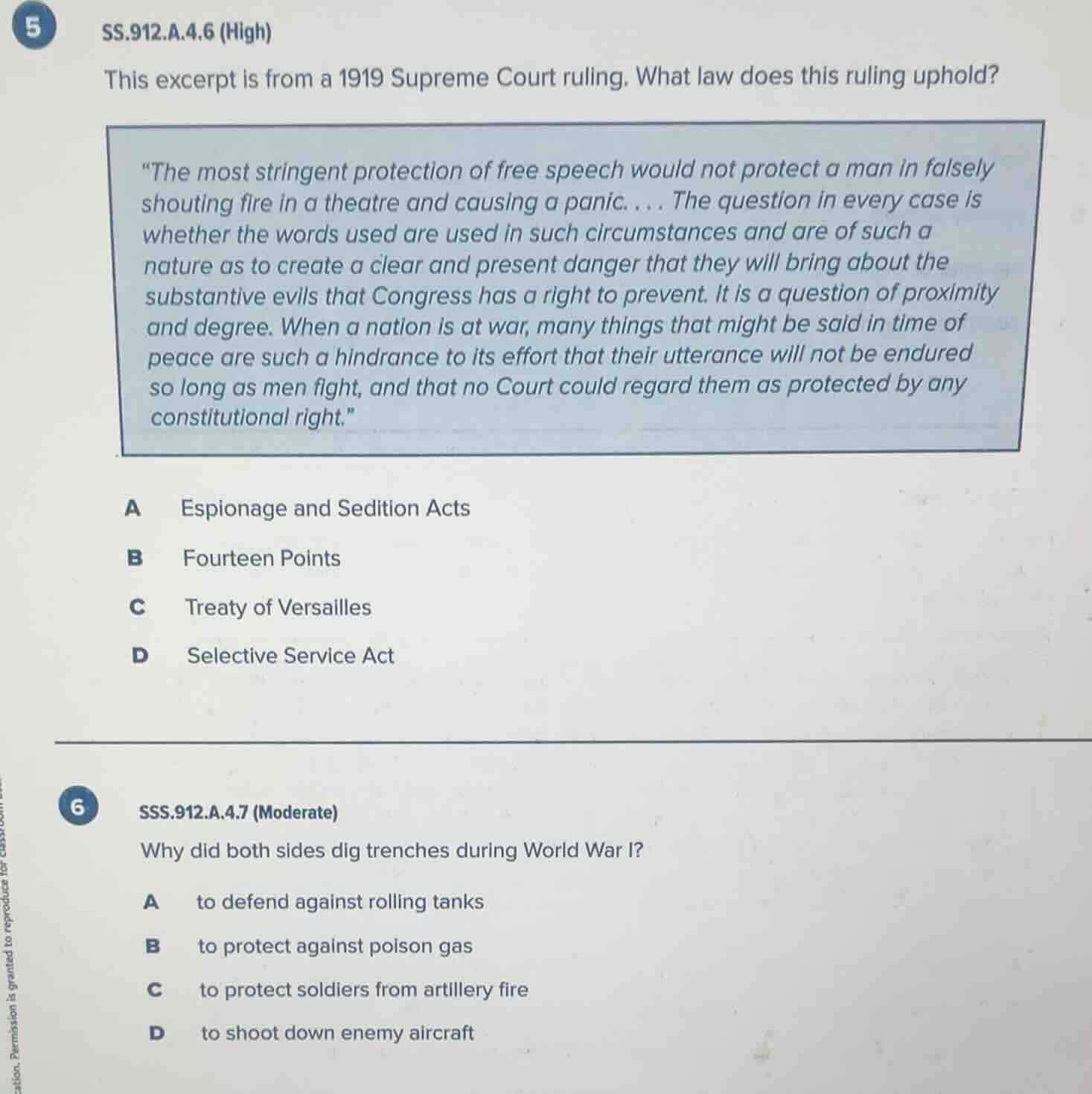
5 ss.912.a.4.6 (high) this excerpt is from a 1919 supreme court ruling. what law does this ruling uphold? \the most stringent protection of free speech would not protect a man in falsely shouting fire in a theatre and causing a panic.... the question in every case is whether the words used are used in such circumstances and are of such a nature as to create a clear and present danger that they will bring about the substantive evils that congress has a right to prevent. it is a question of proximity and degree. when a nation is at war, many things that might be said in time of peace are such a hindrance to its effort that their utterance will not be endured so long as men fight, and that no court could regard them as protected by any constitutional right.\ a espionage and sedition acts b fourteen points c treaty of versailles d selective service act 6 sss.912.a.4.7 (moderate) why did both sides dig trenches during world war i? a to defend against rolling tanks b to protect against poison gas c to protect soldiers from artillery fire d to shoot down enemy aircraft
For Question 5:
The excerpt is from the Schenck v. United States (1919) ruling, which established the "clear and present danger" test for free speech. This ruling upheld the Espionage and Sedition Acts, which restricted speech deemed harmful to the U.S. war effort during World War I. The other options are unrelated: the Fourteen Points were peace proposals, the Treaty of Versailles ended WWI, and the Selective Service Act governed military conscription.
For Question 6:
Trenches became a defining feature of WWI primarily to shield soldiers from the massive and widespread artillery fire that dominated the conflict. While trenches offered some protection from gas, this was a secondary benefit; tanks were a late-war development, and trenches were ineffective against aircraft.

Snap & solve any problem in the app
Get step-by-step solutions on Sovi AI
Photo-based solutions with guided steps
Explore more problems and detailed explanations
- A. Espionage and Sedition Acts
- C. to protect soldiers from artillery fire