QUESTION IMAGE
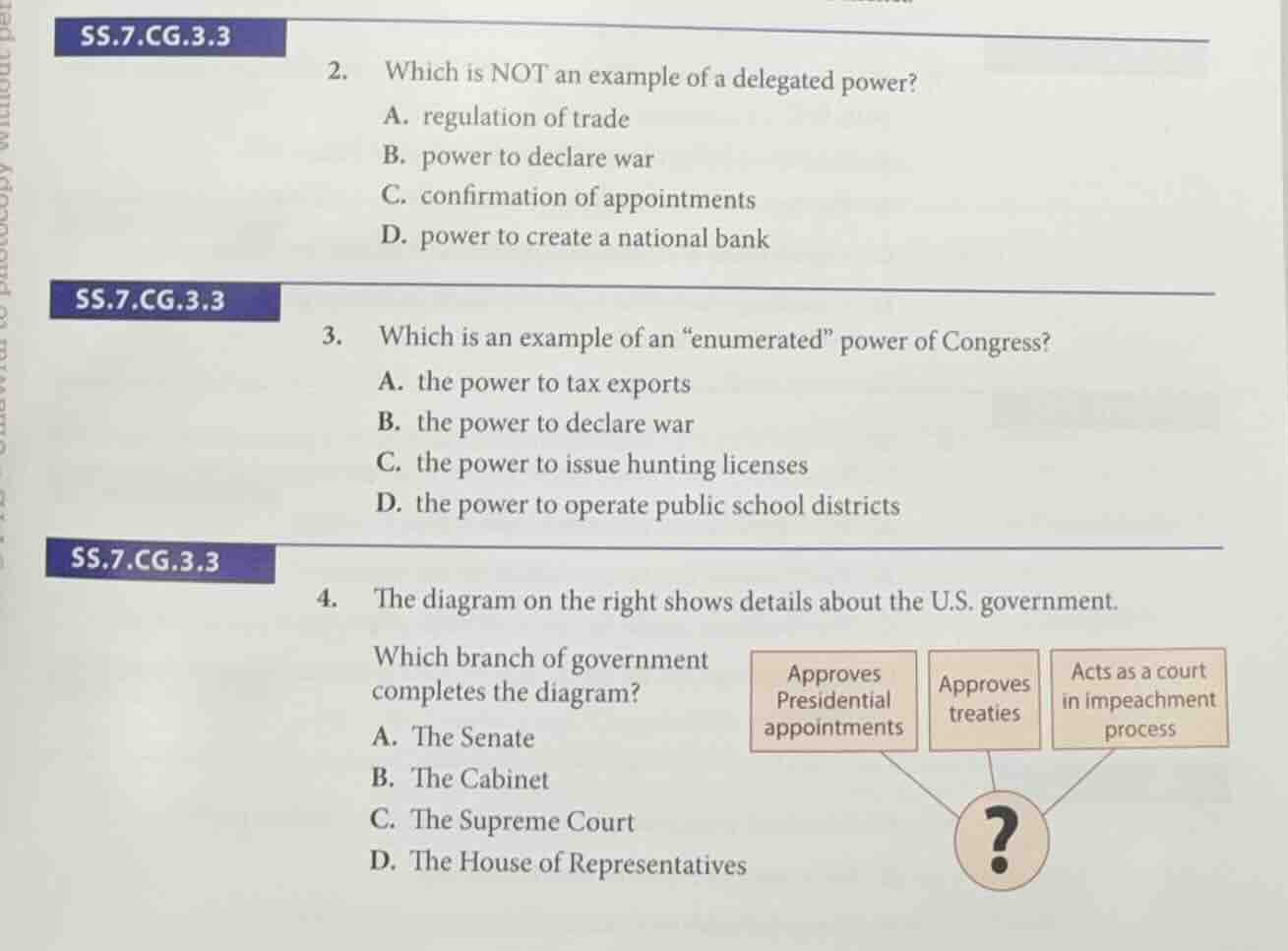
Question
ss.7.cg.3.3
- which is not an example of a delegated power?
a. regulation of trade
b. power to declare war
c. confirmation of appointments
d. power to create a national bank
ss.7.cg.3.3
- which is an example of an \enumerated\ power of congress?
a. the power to tax exports
b. the power to declare war
c. the power to issue hunting licenses
d. the power to operate public school districts
ss.7.cg.3.3
- the diagram on the right shows details about the u.s. government.
which branch of government completes the diagram?
a. the senate
b. the cabinet
c. the supreme court
d. the house of representatives
diagram: approves presidential appointments, approves treaties, acts as a court in impeachment process, all connected to a?
Question 2
Delegated powers are those given to the federal government (specifically Congress) by the Constitution. Regulation of trade (A), power to declare war (B), and confirmation of appointments (C) are delegated powers. The power to create a national bank is an implied power (from the necessary and proper clause), not a delegated power in the strict enumerated sense. So D is not a delegated power.
Enumerated powers are those explicitly listed in the Constitution for Congress. Congress cannot tax exports (A is wrong). Issuing hunting licenses (C) and operating public schools (D) are state powers. The power to declare war is an enumerated power of Congress (Article I, Section 8). So B is correct.
The Senate approves presidential appointments, approves treaties, and acts as a court in impeachment. The Cabinet (B) is part of the executive branch. The Supreme Court (C) is judicial. The House (D) has different roles. So the Senate (A) fits the diagram.

Snap & solve any problem in the app
Get step-by-step solutions on Sovi AI
Photo-based solutions with guided steps
Explore more problems and detailed explanations
D. power to create a national bank