QUESTION IMAGE
Question
the stages of meiosis
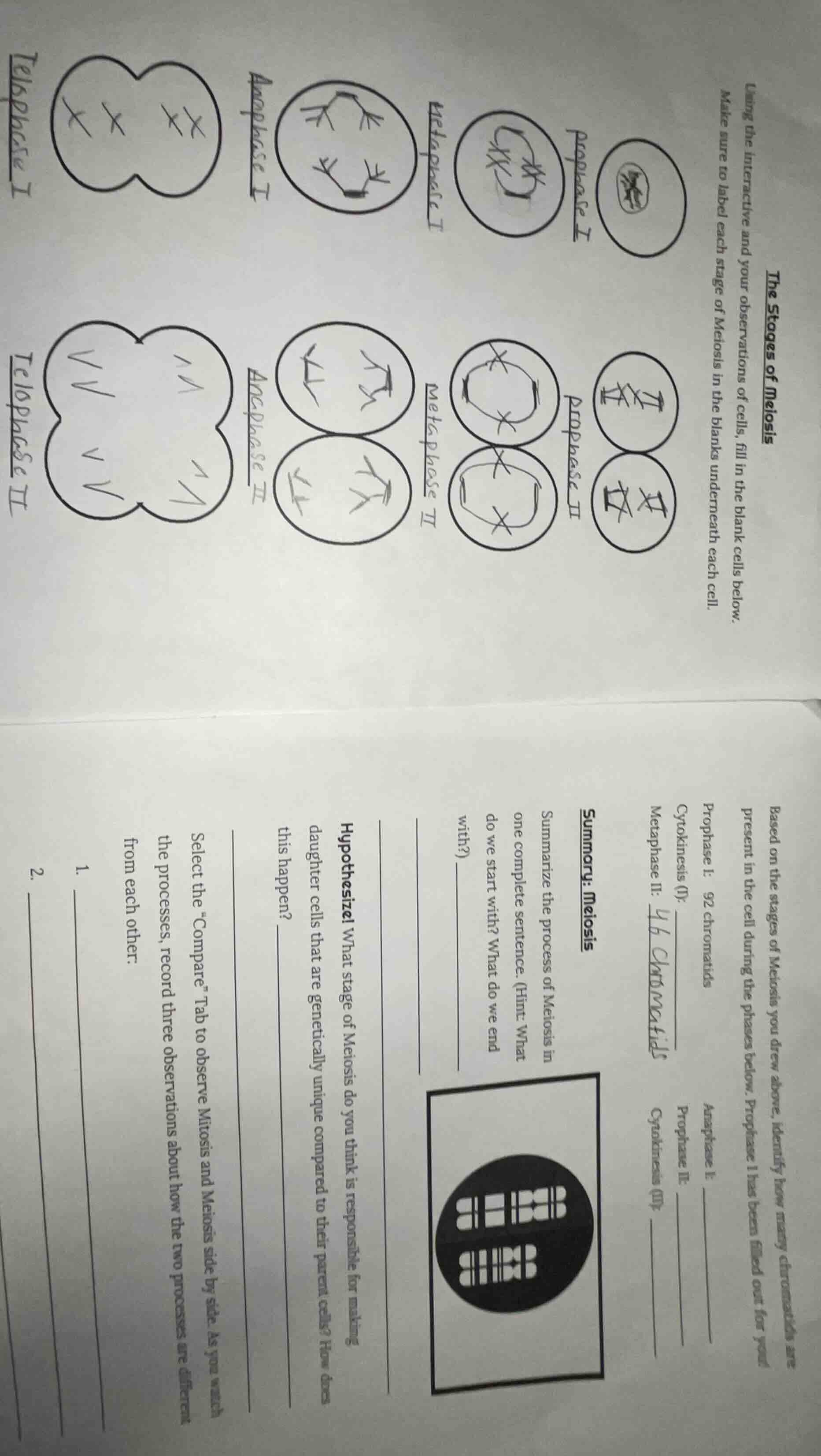
using the interactive and your observations of cells, fill in the blank cells below. make sure to label each stage of meiosis in the blanks underneath each cell.
based on the stages of meiosis you drew above, identify how many chromatids are present in the cell during the phases below. prophase i has been filled out for you.
prophase i: 92 chromatids
cytokinesis (i):
metaphase ii:
summary: meiosis
summarize the process of meiosis in one complete sentence. (hint: what do we start with? what do we end with?)
hypothesize! what stage of meiosis do you think is responsible for making daughter cells that are genetically unique compared to their parent cells? how does this happen?
select the “compare” tab to observe mitosis and meiosis side by side. as you watch the processes, record three observations about how the two processes are different from each other.
1.
2.
Step1: Fill chromatid counts (Anaphase I)
Anaphase I separates homologous pairs, sister chromatids remain attached, so chromatid count stays 92.
Step2: Fill chromatid counts (Cytokinesis I)
Cytokinesis I splits the parent cell; each new cell has half the chromosomes, each with 2 chromatids: $\frac{92}{2} = 46$ chromatids.
Step3: Fill chromatid counts (Prophase II)
No DNA replication between meiosis I and II, so chromatid count remains 46.
Step4: Fill chromatid counts (Cytokinesis II)
Cytokinesis II splits cells after sister chromatids separate; each cell has 23 chromatids (now chromosomes): $\frac{46}{2} = 23$.
Step5: Summarize meiosis process
Meiosis starts with a diploid parent cell (with duplicated chromosomes) and ends with 4 genetically unique haploid daughter cells, each with half the number of chromosomes of the parent cell.
Step6: Answer hypothesis question
Prophase I is responsible: crossing over (exchange of genetic material between homologous chromosomes) and independent assortment of homologous pairs create genetic variation, making daughter cells unique from the parent and each other.
Step7: List mitosis/meiosis differences
- Mitosis produces 2 diploid daughter cells; meiosis produces 4 haploid cells.
- Mitosis has 1 division; meiosis has 2 divisions.
- Mitosis creates genetically identical cells; meiosis creates genetically unique cells.

Snap & solve any problem in the app
Get step-by-step solutions on Sovi AI
Photo-based solutions with guided steps
Explore more problems and detailed explanations
Chromatid Counts:
Anaphase I: 92 chromatids
Cytokinesis (I): 46 chromatids
Prophase II: 46 chromatids
Cytokinesis (II): 23 chromatids
Summary:
Meiosis is a two-stage cell division process that starts with one diploid parent cell containing duplicated chromosomes, and ends with four genetically distinct haploid daughter cells, each with half the number of chromosomes of the original parent cell.
Hypothesize:
Prophase I of meiosis is responsible. During this stage, homologous chromosomes undergo crossing over (exchange of segments of genetic material) and independent assortment, which shuffles genetic information. This creates new combinations of genes that differ from the parent cell, resulting in genetically unique daughter cells.
Mitosis & Meiosis Differences:
- Mitosis forms 2 diploid cells; meiosis forms 4 haploid cells.
- Mitosis involves 1 cell division; meiosis involves 2.
- Mitosis yields genetically identical cells; meiosis yields genetically unique cells.