QUESTION IMAGE
Question
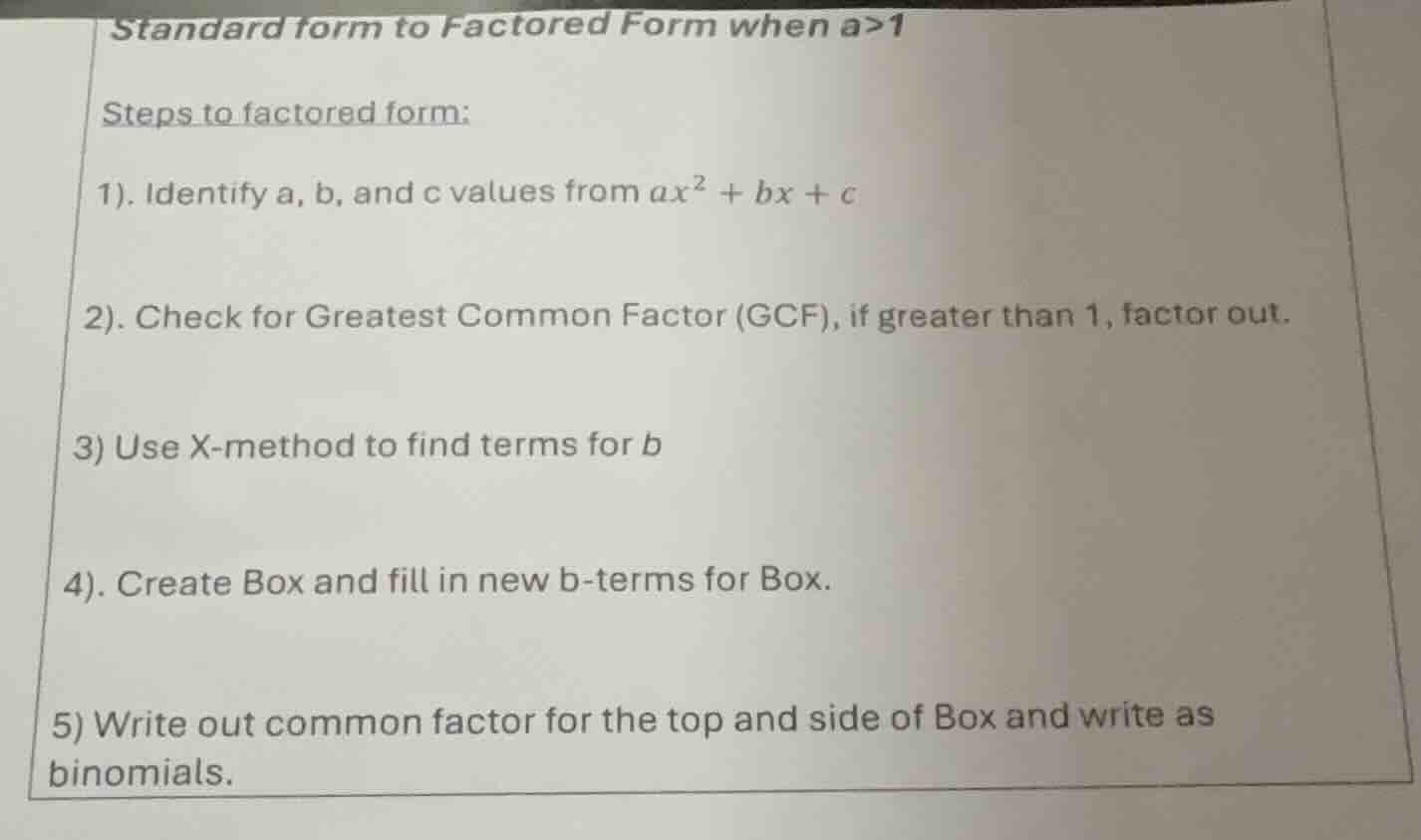
standard form to factored form when a>1
steps to factored form:
1). identify a, b, and c values from $ax^2 + bx + c$
2). check for greatest common factor (gcf), if greater than 1, factor out.
- use x - method to find terms for b
4). create box and fill in new b - terms for box.
- write out common factor for the top and side of box and write as binomials.
Since no specific quadratic equation is given to convert from standard to factored form, we can't perform the steps. But let's take an example to demonstrate the process. Let's use the quadratic equation \( 2x^2 + 6x + 4 \) (here \( a = 2 \), \( b = 6 \), \( c = 4 \) and \( a>1 \)).
Step 1: Identify a, b, c
For \( 2x^2 + 6x + 4 \), we have \( a = 2 \), \( b = 6 \), \( c = 4 \).
Step 2: Check GCF
The GCF of 2, 6, and 4 is 2. Factor out 2: \( 2(x^2 + 3x + 2) \).
Step 3: Use X - method (for the quadratic inside the parentheses \( x^2+3x + 2 \), here \( a = 1 \) now, but originally for the outer quadratic \( a = 2 \), after factoring GCF, we deal with the simpler quadratic). For \( x^2+3x + 2 \), we need two numbers that multiply to \( a\times c=1\times2 = 2 \) and add up to \( b = 3 \). The numbers are 1 and 2.
Step 4: Create Box (for the quadratic \( x^2+3x + 2 \))
| \( x \) | \( 1 \) | |
|---|---|---|
| \( 2 \) | \( 2x \) | \( 2 \) |
Step 5: Write common factors
The first row has a common factor of \( x \), and the second row has a common factor of 2. The first column has a common factor of \( x \), and the second column has a common factor of 1. So the factored form of \( x^2 + 3x + 2 \) is \( (x + 1)(x + 2) \). Then the factored form of the original quadratic \( 2x^2+6x + 4 \) is \( 2(x + 1)(x + 2) \).
If you provide a specific quadratic equation with \( a>1 \), we can follow the steps to convert it from standard to factored form.

Snap & solve any problem in the app
Get step-by-step solutions on Sovi AI
Photo-based solutions with guided steps
Explore more problems and detailed explanations
Step 1: Identify a, b, c
For \( 2x^2 + 6x + 4 \), we have \( a = 2 \), \( b = 6 \), \( c = 4 \).
Step 2: Check GCF
The GCF of 2, 6, and 4 is 2. Factor out 2: \( 2(x^2 + 3x + 2) \).
Step 3: Use X - method (for the quadratic inside the parentheses \( x^2+3x + 2 \), here \( a = 1 \) now, but originally for the outer quadratic \( a = 2 \), after factoring GCF, we deal with the simpler quadratic). For \( x^2+3x + 2 \), we need two numbers that multiply to \( a\times c=1\times2 = 2 \) and add up to \( b = 3 \). The numbers are 1 and 2.
Step 4: Create Box (for the quadratic \( x^2+3x + 2 \))
| \( x \) | \( 1 \) | |
|---|---|---|
| \( 2 \) | \( 2x \) | \( 2 \) |
Step 5: Write common factors
The first row has a common factor of \( x \), and the second row has a common factor of 2. The first column has a common factor of \( x \), and the second column has a common factor of 1. So the factored form of \( x^2 + 3x + 2 \) is \( (x + 1)(x + 2) \). Then the factored form of the original quadratic \( 2x^2+6x + 4 \) is \( 2(x + 1)(x + 2) \).
If you provide a specific quadratic equation with \( a>1 \), we can follow the steps to convert it from standard to factored form.