QUESTION IMAGE
Question
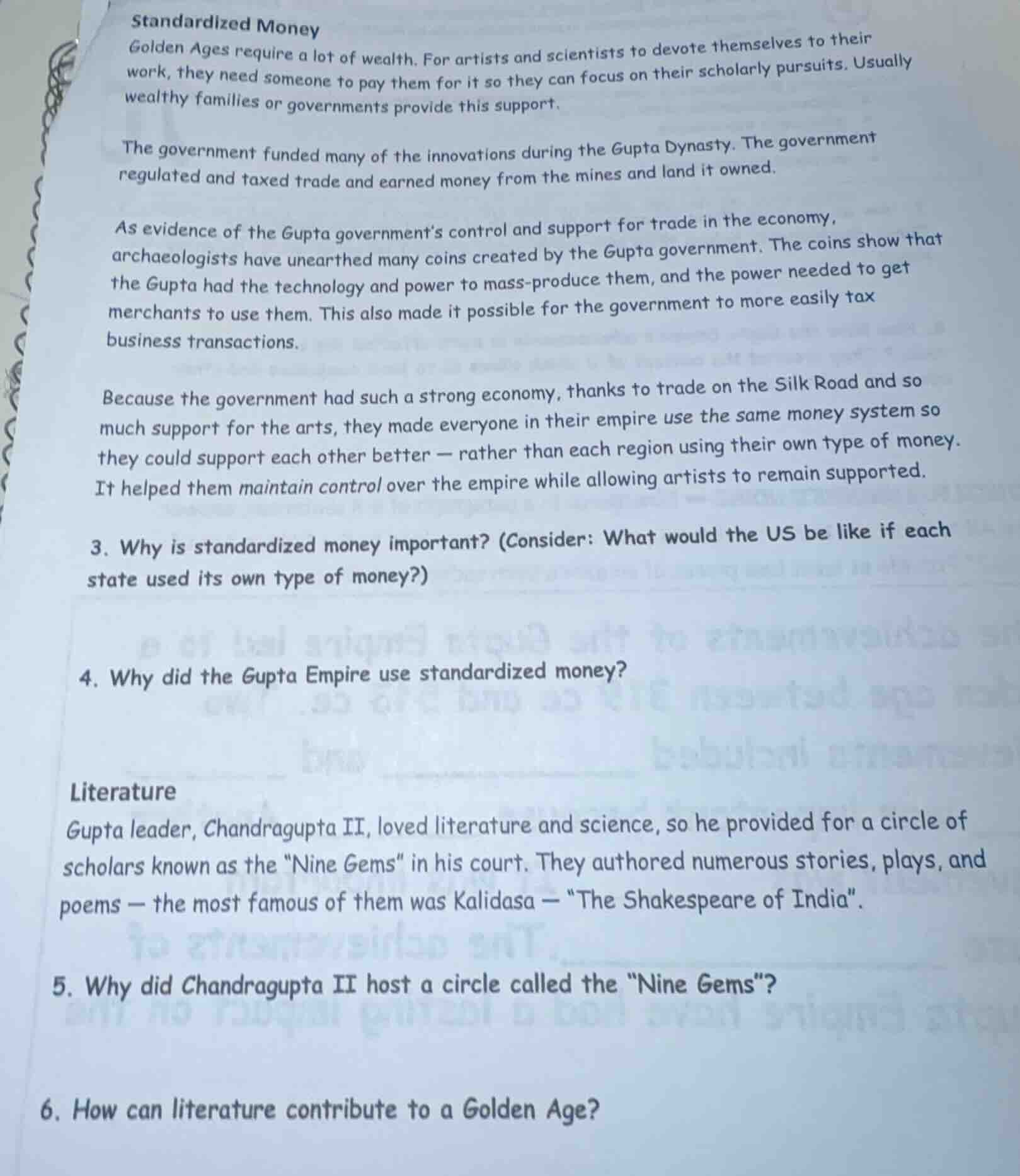
standardized money
golden ages require a lot of wealth. for artists and scientists to devote themselves to their
work, they need someone to pay them for it so they can focus on their scholarly pursuits. usually
wealthy families or governments provide this support.
the government funded many of the innovations during the gupta dynasty. the government
regulated and taxed trade and earned money from the mines and land it owned.
as evidence of the gupta government’s control and support for trade in the economy,
archaeologists have unearthed many coins created by the gupta government. the coins show that
the gupta had the technology and power to mass - produce them, and the power needed to get
merchants to use them. this also made it possible for the government to more easily tax
business transactions.
because the government had such a strong economy, thanks to trade on the silk road and so
much support for the arts, they made everyone in their empire use the same money system so
they could support each other better — rather than each region using their own type of money.
it helped them maintain control over the empire while allowing artists to remain supported.
- why is standardized money important? (consider: what would the us be like if each
state used its own type of money?)
- why did the gupta empire use standardized money?
literature
gupta leader, chandragupta ii, loved literature and science, so he provided for a circle of
scholars known as the “nine gems” in his court. they authored numerous stories, plays, and
poems — the most famous of them was kalidasa — “the shakespeare of india”.
- why did chandragupta ii host a circle called the “nine gems”?
- how can literature contribute to a golden age?
- For question 3: Standardized money simplifies cross-region trade, ensures consistent value for transactions, makes tax collection efficient, and unifies economic activity. If US states had separate currencies, trade between states would be costly and complicated (needing currency exchange), economic coordination would break down, and national economic stability would be weakened.
- For question 4: The Gupta Empire used standardized money to unify its economy, make trade easier across regions, simplify tax collection for the government, maintain control over the empire, and sustain funding for arts and scholarly pursuits that supported its golden age.
- For question 5: Chandragupta II hosted the "Nine Gems" because he had a personal love for literature and science, and wanted to support and foster scholarly and creative work in his court.
- For question 6: Literature contributes to a Golden Age by preserving cultural identity, fostering intellectual growth, creating enduring cultural works that define the era, and attracting and supporting creative talent that enhances the era's reputation for innovation and achievement.

Snap & solve any problem in the app
Get step-by-step solutions on Sovi AI
Photo-based solutions with guided steps
Explore more problems and detailed explanations
- Standardized money unifies economies, simplifies trade, eases tax collection, and stabilizes economic activity. If US states used separate currencies, inter-state trade would be inefficient (requiring currency exchange), economic coordination would fail, and national economic stability would decline.
- The Gupta Empire used standardized money to unify regional economies, simplify trade, streamline tax collection, maintain imperial control, and sustain funding for arts and scholarship.
- Chandragupta II hosted the "Nine Gems" because he loved literature and science, and wanted to support scholarly and creative work in his court.
- Literature contributes to a Golden Age by preserving culture, fostering intellectual growth, creating iconic cultural works, and supporting creative talent that defines the era's prosperity.