QUESTION IMAGE
Question
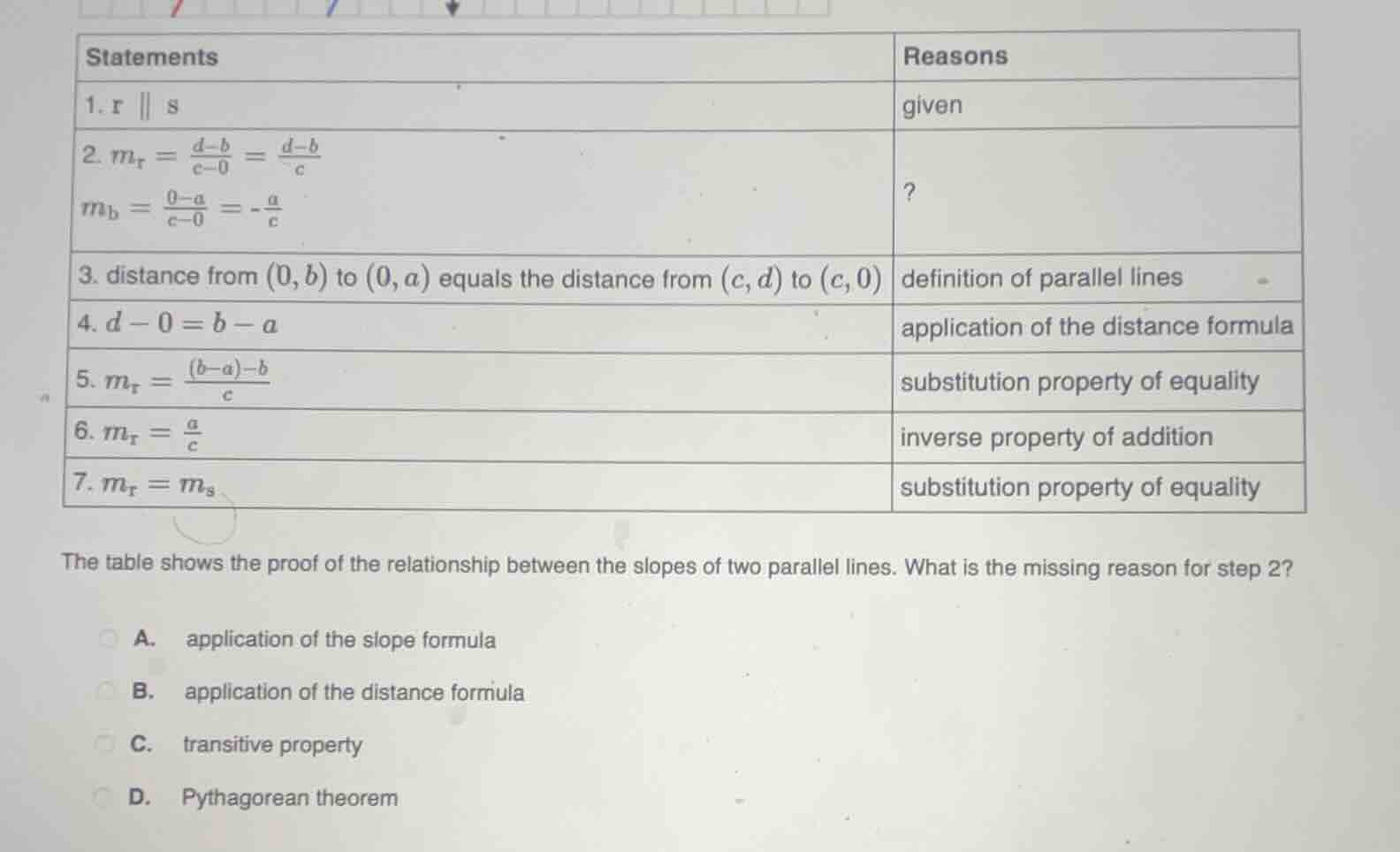
statements reasons 1. r ∥ s given 2. $m_r = \frac{d - b}{c - 0} = \frac{d - b}{c}$ $m_b = \frac{0 - a}{c - 0} = -\frac{a}{c}$? 3. distance from (0, b) to (0, a) equals the distance from (c, d) to (c, 0) definition of parallel lines 4. $d - 0 = b - a$ application of the distance formula 5. $m_r = \frac{(b - a) - b}{c}$ substitution property of equality 6. $m_r = \frac{a}{c}$ inverse property of addition 7. $m_r = m_s$ substitution property of equality the table shows the proof of the relationship between the slopes of two parallel lines. what is the missing reason for step 2? a. application of the slope formula b. application of the distance formula c. transitive property d. pythagorean theorem
Step 2 calculates the slopes of lines using two points on each line. The slope formula is $m=\frac{y_2-y_1}{x_2-x_1}$, which matches the calculations shown. Option A directly describes this action, while other options refer to unrelated formulas or properties.

Snap & solve any problem in the app
Get step-by-step solutions on Sovi AI
Photo-based solutions with guided steps
Explore more problems and detailed explanations
A. application of the slope formula