QUESTION IMAGE
Question
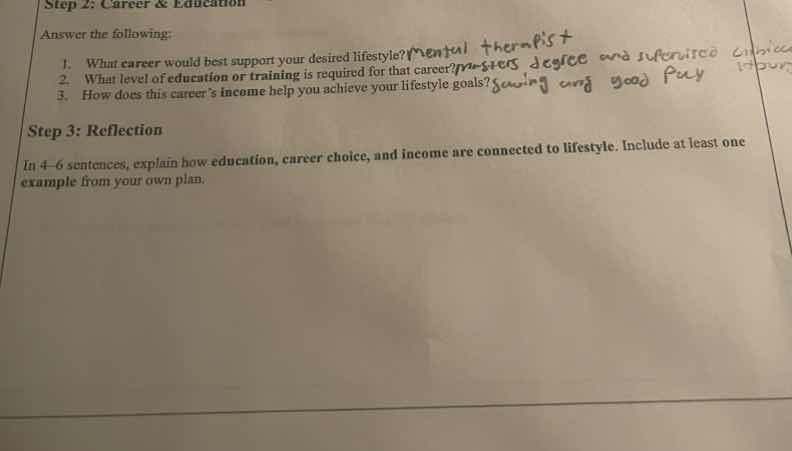
step 2: career & education
answer the following:
- what career would best support your desired lifestyle?
- what level of education or training is required for that career?
- how does this career’s income help you achieve your lifestyle goals?
step 3: reflection
in 4 - 6 sentences, explain how education, career choice, and income are connected to lifestyle. include at least one example from your own plan.
Step 2 Answers:
- Answer: Mental Therapist
(Explanation: A mental therapist career can support a lifestyle focused on helping others, with a work - life balance that allows for personal growth and financial stability.)
- Answer: Master’s degree and supervised clinical hours
(Explanation: Most mental therapist roles require a master's degree in psychology or a related field, along with supervised clinical experience to gain practical skills.)
- Answer: A mental therapist’s income provides financial resources to cover living expenses, save for future goals (like buying a home or traveling), and invest in personal well - being, which aligns with a desired lifestyle of stability and self - care.
Step 3 Reflection:
Education, career choice, and income are deeply intertwined with lifestyle. Education equips individuals with the skills and knowledge needed for a chosen career. For example, to become a mental therapist, a master’s degree in psychology provides the theoretical and practical foundation. Career choice then determines the type of work one does, which impacts daily life and job satisfaction. A mental therapist career, for instance, offers the opportunity to make a positive impact on others' lives, which can be fulfilling. Income from the career allows for meeting basic needs, pursuing hobbies, and achieving long - term lifestyle goals. In my plan, the education (master’s degree) for mental therapy leads to a career that provides a good income, enabling me to live in a comfortable home, travel to learn about different cultures (which enriches my lifestyle), and have the financial security to support my mental and physical well - being.

Snap & solve any problem in the app
Get step-by-step solutions on Sovi AI
Photo-based solutions with guided steps
Explore more problems and detailed explanations
Step 2 Answers:
- Answer: Mental Therapist
(Explanation: A mental therapist career can support a lifestyle focused on helping others, with a work - life balance that allows for personal growth and financial stability.)
- Answer: Master’s degree and supervised clinical hours
(Explanation: Most mental therapist roles require a master's degree in psychology or a related field, along with supervised clinical experience to gain practical skills.)
- Answer: A mental therapist’s income provides financial resources to cover living expenses, save for future goals (like buying a home or traveling), and invest in personal well - being, which aligns with a desired lifestyle of stability and self - care.
Step 3 Reflection:
Education, career choice, and income are deeply intertwined with lifestyle. Education equips individuals with the skills and knowledge needed for a chosen career. For example, to become a mental therapist, a master’s degree in psychology provides the theoretical and practical foundation. Career choice then determines the type of work one does, which impacts daily life and job satisfaction. A mental therapist career, for instance, offers the opportunity to make a positive impact on others' lives, which can be fulfilling. Income from the career allows for meeting basic needs, pursuing hobbies, and achieving long - term lifestyle goals. In my plan, the education (master’s degree) for mental therapy leads to a career that provides a good income, enabling me to live in a comfortable home, travel to learn about different cultures (which enriches my lifestyle), and have the financial security to support my mental and physical well - being.