QUESTION IMAGE
Question
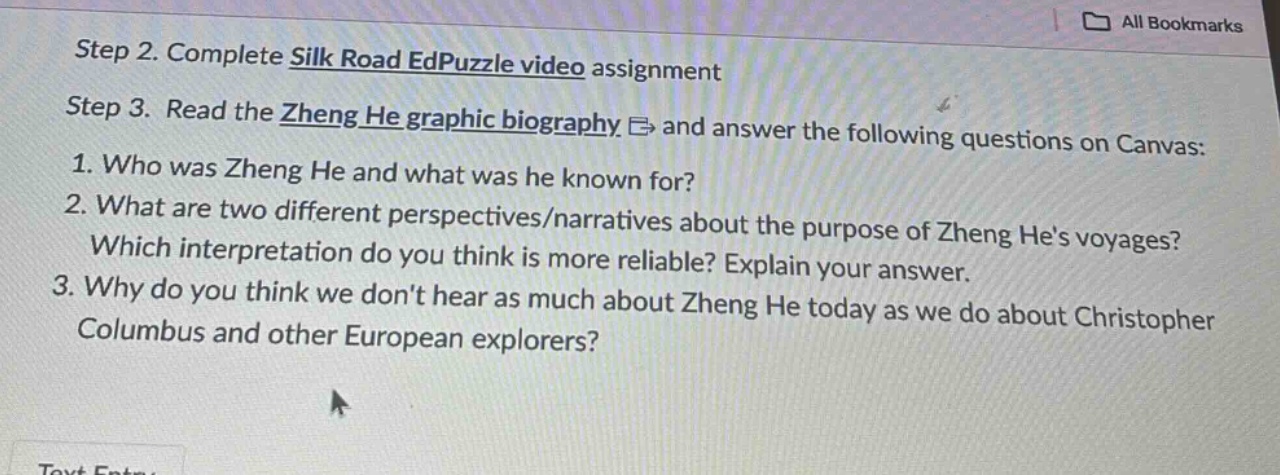
step 2. complete silk road edpuzzle video assignment
step 3. read the zheng he graphic biography and answer the following questions on canvas:
- who was zheng he and what was he known for?
- what are two different perspectives/narratives about the purpose of zheng hes voyages? which interpretation do you think is more reliable? explain your answer.
- why do you think we dont hear as much about zheng he today as we do about christopher columbus and other european explorers?
Question 1
Zheng He was a Chinese mariner, explorer, diplomat, and fleet admiral during the Ming dynasty. He is known for leading seven large - scale naval expeditions across the Indian Ocean, reaching as far as East Africa. These voyages were remarkable for their size (in terms of the number of ships and crew), technological advancement (such as the design of the junks), and their role in promoting trade, diplomacy, and cultural exchange between China and other regions.
- Perspective 1 (Trade and Diplomacy): One narrative is that the purpose of Zheng He's voyages was to establish and strengthen trade and diplomatic relations. The fleets carried valuable Chinese goods like silk, porcelain, and tea to trade with other regions, and also brought back exotic products. They also aimed to show the might of the Ming dynasty and receive tribute from other states, thereby enhancing China's prestige in the region.
- Perspective 2 (Search for the Emperor's Relative): Another perspective is that the voyages were partly to search for the deposed Emperor Jianwen, who some believed had escaped after the Yongle Emperor (who commissioned Zheng He) seized power.
- Reliability: The trade and diplomacy perspective is more reliable. The scale of the voyages (with large fleets and diverse goods for trade) and the establishment of diplomatic ties with many states (evidenced by the tribute - based system and cultural exchanges) are well - documented. The search for a deposed emperor is more of a speculative theory with less concrete evidence compared to the extensive records of trade, diplomacy, and the display of Ming's power through these voyages.
- Euro - centric Historical Narrative: Much of the historical narrative in modern - day education and popular culture has been Euro - centric. The Age of Exploration (with figures like Columbus) was part of the narrative of European expansion, colonization, and the subsequent rise of European powers, which has been more prominently documented and taught in many parts of the world (especially in Western - dominated educational systems).
- Different Historical Priorities: In China, after the Ming dynasty, there was a shift in focus away from maritime exploration (e.g., the Ming later adopted a more insular policy), and over time, the memory of Zheng He's voyages was not as actively promoted in the same way as European powers promoted the stories of their explorers to justify colonization and their rise to global dominance.
- Limited Global Dissemination of Chinese Historical Records: The historical records of Zheng He's voyages were not as widely disseminated globally as the European exploration narratives. European exploration stories were spread through colonial empires and their cultural influence, while Zheng He's story was more of a regional (East Asian) historical event for a long time, with less global reach in terms of popular historical discourse.

Snap & solve any problem in the app
Get step-by-step solutions on Sovi AI
Photo-based solutions with guided steps
Explore more problems and detailed explanations
Zheng He was a Ming - dynasty Chinese mariner, explorer, diplomat, and fleet admiral. He is known for leading seven large - scale naval expeditions across the Indian Ocean (reaching East Africa), which promoted trade, diplomacy, and cultural exchange, and were notable for their scale and technological advancement.