QUESTION IMAGE
Question
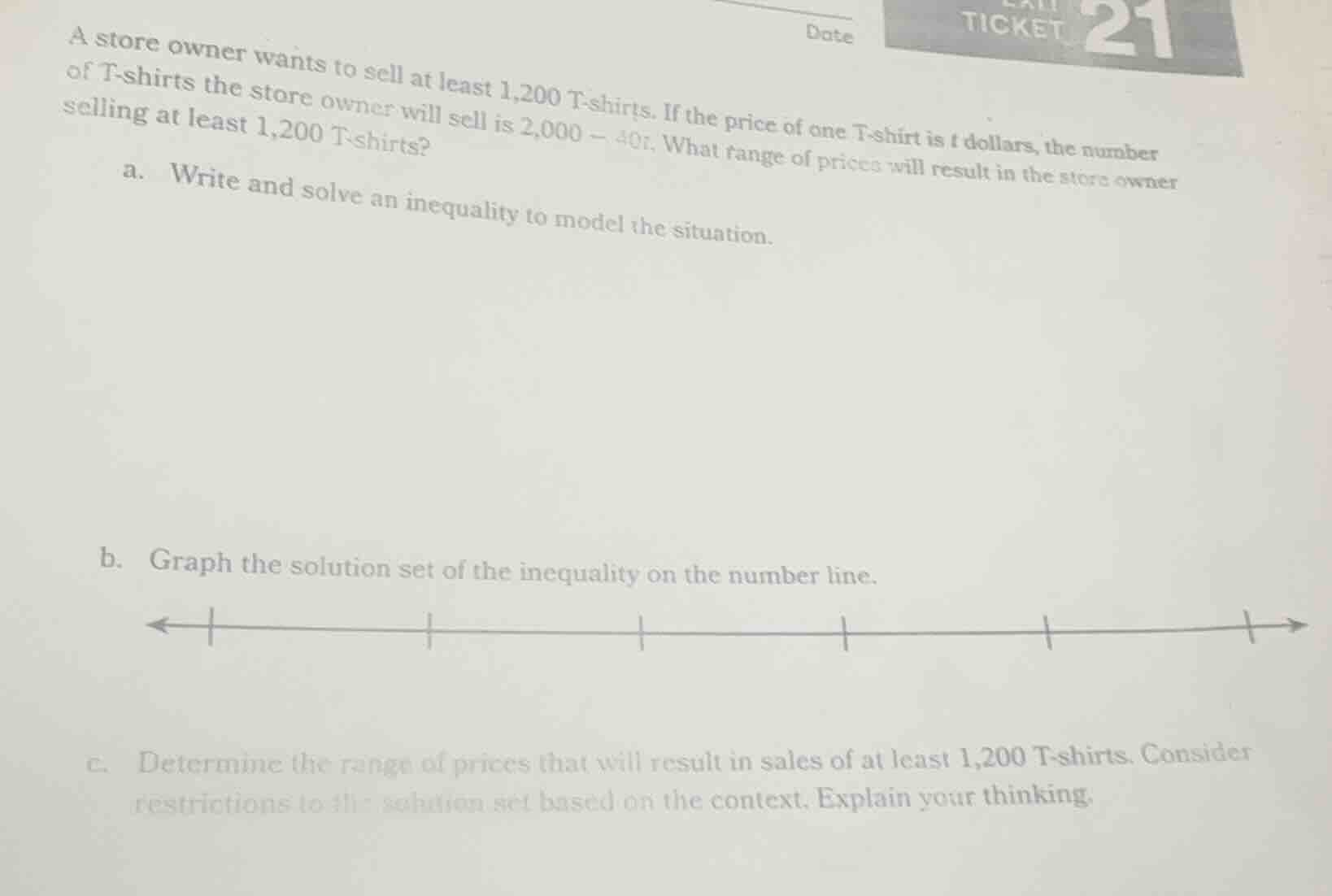
a store owner wants to sell at least 1,200 t - shirts. if the price of one t - shirt is t dollars, the number of t - shirts the store owner will sell is 2,000 - 40t. what range of prices will result in the store owner selling at least 1,200 t - shirts?
a. write and solve an inequality to model the situation.
b. graph the solution set of the inequality on the number line.
(there is a number line with arrows on both ends and several vertical marks on it)
c. determine the range of prices that will result in sales of at least 1,200 t - shirts. consider restrictions to the solution set based on the context. explain your thinking.
Part a
Step1: Define the inequality
The number of T - shirts sold is \(2000 - 40t\) and we want to sell at least 1200 T - shirts. So the inequality is \(2000-40t\geq1200\).
Step2: Subtract 2000 from both sides
Subtract 2000 from each side of the inequality: \(2000 - 40t-2000\geq1200 - 2000\), which simplifies to \(- 40t\geq - 800\).
Step3: Divide by - 40 (reverse inequality)
Divide both sides by - 40. When dividing an inequality by a negative number, the direction of the inequality sign changes. So \(\frac{-40t}{-40}\leq\frac{-800}{-40}\), which gives \(t\leq20\). Also, since the price \(t\) must be non - negative (you can't have a negative price), we also have \(t\geq0\). But we are mainly solving \(2000 - 40t\geq1200\) for now.
To graph the solution set of \(t\leq20\) (and \(t\geq0\)) on the number line:
- Draw a number line.
- Locate the point 20 on the number line. Since the inequality is \(t\leq20\), we use a closed circle at 20 (because the inequality includes equality).
- Then draw an arrow to the left from 20 to represent all numbers less than or equal to 20. Also, since the price can't be negative, we start from 0 (with a closed circle at 0 as well, because \(t = 0\) is a valid price in theory, although in a real - world context, the price is likely to be greater than 0, but from the inequality \(2000-40t\geq1200\) we first get \(t\leq20\) and \(t\geq0\) from the context of price being non - negative).
- From part a, we have the inequality \(2000-40t\geq1200\) which solves to \(t\leq20\).
- In the context of the problem, the price of a T - shirt \(t\) must be greater than or equal to 0 (because a negative price doesn't make sense in a real - world selling situation). Also, we can think about the upper and lower bounds. If \(t = 0\), the number of T - shirts sold is \(2000-40(0)=2000\) which is more than 1200. As \(t\) increases, the number of T - shirts sold decreases. When \(t = 20\), the number of T - shirts sold is \(2000-40\times20=2000 - 800 = 1200\), which meets the "at least 1200" requirement. If \(t>20\), say \(t = 21\), then the number of T - shirts sold is \(2000-40\times21=2000 - 840 = 1160<1200\), which does not meet the requirement. And since the price can't be negative, \(t\geq0\). But in a real - world store - owner situation, the price is likely to be greater than 0 (because selling T - shirts for $0$ would not be a sustainable business model), but from the mathematical model and the basic context of non - negative price, the range of prices is \(0\leq t\leq20\) (in dollars).

Snap & solve any problem in the app
Get step-by-step solutions on Sovi AI
Photo-based solutions with guided steps
Explore more problems and detailed explanations
The inequality is \(2000 - 40t\geq1200\), and the solution (before considering non - negative price) is \(t\leq20\).