QUESTION IMAGE
Question
structures of informational texts
discovering king tut’s tomb
tutankhamun (also known as king tut) became an egyptian pharaoh in 1332 bc when he was just a young boy. his father was a controversial leader who closed sacred temples and overturned ancient religions. when tut became pharaoh, he undid many of his father’s decisions. however, the reputation of tut was still viewed negatively. tut was not considered an influential ruler. his name was left out of historical records after his death. when tutankhamun died around the age of 18, he was buried in a royal tomb in egypt’s valley of the kings.
the search of king tut’s tomb began with english egyptologist howard carter, who decided to look for king tut’s tomb in 1914. other archaeologists determined the tombs in the valley of the kings contained precious treasure, which made them targets for robbers. most archaeologists believed that all the tombs in that region had either been discovered or looted. but carter insisted he would find tut’s tomb, and valley of the kings located close to the nile rivers luxor and carnarvon, it seemed to just be the money for carter’s search. after seven years, carnarvon was ready to pull the funding because carter had not made any discoveries. finally, in early november 1922, signs of a sealed door were uncovered from the desert sand that had buried them for the centuries.
on november 26, 1922, carter broke through the sealed door and found a passage filled with rubble. he was worried that the grave had been robbed because there were markings on the passing that appeared to have been dragged. after clearing the passage, carter came to another sealed door. upon opening tutankhamun’s tomb, symbols, objects, and treasure. carter knew they had found the missing pharaoh’s tomb. he was, however, still unsure what was still in that great chamber had discovered a long ago.
when carter entered the tomb, he found large chests were contained in the rooms. the archaeologists, scientists, and financial backer of tutankhamun, alistair macpherson, performed genetic tests. tut’s gold throne, golden figurines, gilded statues, precious gems, and jewelry were discovered. also, tut’s coffin was constructed by a huge golden shrine. in the innermost burial chamber, carter found a box of jewelry rings. according to the egyptian belief of tut’s era, the gods would have been pleased to take from it the offerings.
carter and his team removed, tagged, and photographed the artifacts found in king tut’s tomb. a king’s biography not only increased the mystery of king tut, but they provided the world with an enormous amount of information about ancient egypt.
4
drag each event to the correct location on the image
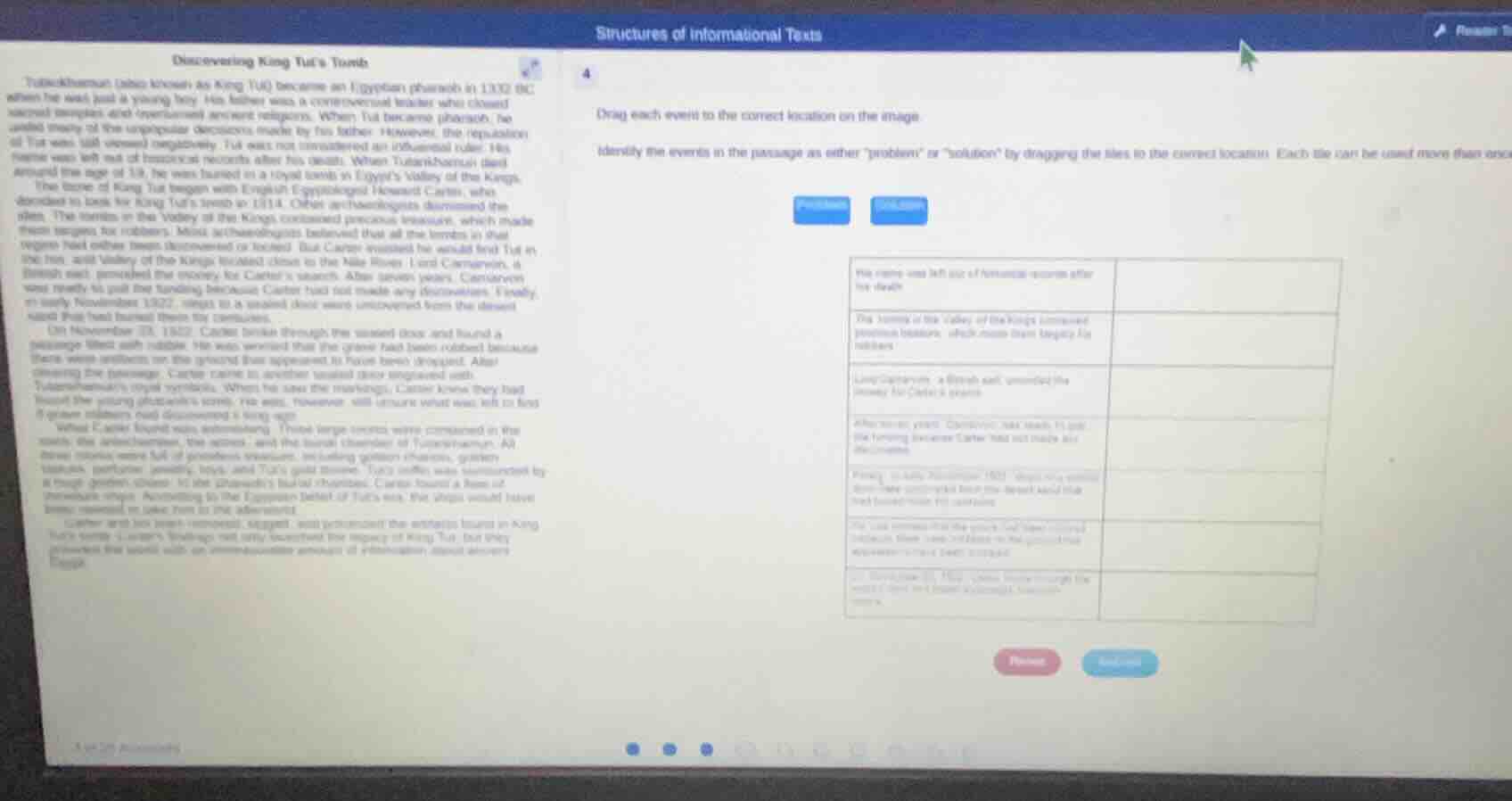
identify the events in the passage as either “problem” or “solution” by dragging the tiles to the correct location. each tile can be used more than once.
problem solution
his name was left out of historical records after his death.
the tombs of the valley of the kings contained precious treasure, which made them targets for robbers.
carter decided to search and uncover the mystery of tut’s tomb.
after seven years, carnarvon was ready to pull the funding because carter had not made any discoveries.
finally, in early november 1922, signs of a sealed door were uncovered from the desert sand that had buried them for the centuries.
the tomb’s passage was filled with rubble, and there were markings on the passing that appeared to have been dragged.
on november 26, 1922, carter broke through the sealed door to enter king tut’s tomb.
please
To solve this, we analyze each event to determine if it's a "Problem" (an issue or challenge) or "Solution" (an action that resolves or addresses a problem):
Event 1: "His name was left out of historical records after his death"
- This is a Problem because it describes a gap or issue (lack of historical documentation).
Event 2: "The tombs in the Valley of the Kings contained precious treasures, which made them targets for robbers. Most archaeologists believed that all the tombs in that region had either been discovered or looted"
- This is a Problem as it presents challenges (treasures attracting robbers, belief no tombs were undiscovered/untouched).
Event 3: "Howard Carter, a British man, searched for the long - lost tomb of Tutankhamun"
- This is a Solution because Carter’s search is an action taken to address the problem of the lost tomb.
Event 4: "After several years, Carter’s team found it, but the funding for Carter’s search had made any discoveries. It really was ready to quit the funding, because Carter had not made any discoveries"
- This is a Problem as it describes a challenge (lack of funding due to no discoveries).
Event 5: "Finally, in early November 1922, workmen’s steps were uncovered from the desert sand. They had found the tomb of Tutankhamun"
- This is a Solution as it is the successful outcome of Carter’s search (discovering the tomb).
Event 6: "On November 26, 1922, Carter broke through the sealed door and found a passage filled with rubble. He was worried that the grave had been robbed because there were markings on the passage that appeared to have been disturbed"
- This is a Problem as it presents a concern (possible robbery of the grave).
Event 7: "After clearing the passage, Carter came to another sealed door. Beyond, after opening the passage, Carter came to another sealed door. Beyond Tutankhamun’s royal symbols. When he took the markings, Carter knew they had found the pharaoh’s tomb undisturbed a long time ago"
- This is a Solution as it resolves the earlier problem of possible robbery (finding the tomb undisturbed).
Final Categorization:
- Problem:
- His name was left out of historical records after his death.
- The tombs in the Valley of the Kings contained precious treasures, which made them targets for robbers. Most archaeologists believed that all the tombs in that region had either been discovered or looted.
- After several years, Carter’s team found it, but the funding for Carter’s search had made any discoveries. It really was ready to quit the funding, because Carter had not made any discoveries.
- On November 26, 1922, Carter broke through the sealed door and found a passage filled with rubble. He was worried that the grave had been robbed because there were markings on the passage that appeared to have been disturbed.
- Solution:
- Howard Carter, a British man, searched for the long - lost tomb of Tutankhamun.
- Finally, in early November 1922, workmen’s steps were uncovered from the desert sand. They had found the tomb of Tutankhamun.
- After clearing the passage, Carter came to another sealed door. Beyond, after opening the passage, Carter came to another sealed door. Beyond Tutankhamun’s royal symbols. When he took the markings, Carter knew they had found the pharaoh’s tomb undisturbed a long time ago.
To present this in the drag - and - drop format (matching each event to "Problem" or "Solution"):
| Event | Category |
|---|
| His name was left out of historical records after his death | Pro…

Snap & solve any problem in the app
Get step-by-step solutions on Sovi AI
Photo-based solutions with guided steps
Explore more problems and detailed explanations
To solve this, we analyze each event to determine if it's a "Problem" (an issue or challenge) or "Solution" (an action that resolves or addresses a problem):
Event 1: "His name was left out of historical records after his death"
- This is a Problem because it describes a gap or issue (lack of historical documentation).
Event 2: "The tombs in the Valley of the Kings contained precious treasures, which made them targets for robbers. Most archaeologists believed that all the tombs in that region had either been discovered or looted"
- This is a Problem as it presents challenges (treasures attracting robbers, belief no tombs were undiscovered/untouched).
Event 3: "Howard Carter, a British man, searched for the long - lost tomb of Tutankhamun"
- This is a Solution because Carter’s search is an action taken to address the problem of the lost tomb.
Event 4: "After several years, Carter’s team found it, but the funding for Carter’s search had made any discoveries. It really was ready to quit the funding, because Carter had not made any discoveries"
- This is a Problem as it describes a challenge (lack of funding due to no discoveries).
Event 5: "Finally, in early November 1922, workmen’s steps were uncovered from the desert sand. They had found the tomb of Tutankhamun"
- This is a Solution as it is the successful outcome of Carter’s search (discovering the tomb).
Event 6: "On November 26, 1922, Carter broke through the sealed door and found a passage filled with rubble. He was worried that the grave had been robbed because there were markings on the passage that appeared to have been disturbed"
- This is a Problem as it presents a concern (possible robbery of the grave).
Event 7: "After clearing the passage, Carter came to another sealed door. Beyond, after opening the passage, Carter came to another sealed door. Beyond Tutankhamun’s royal symbols. When he took the markings, Carter knew they had found the pharaoh’s tomb undisturbed a long time ago"
- This is a Solution as it resolves the earlier problem of possible robbery (finding the tomb undisturbed).
Final Categorization:
- Problem:
- His name was left out of historical records after his death.
- The tombs in the Valley of the Kings contained precious treasures, which made them targets for robbers. Most archaeologists believed that all the tombs in that region had either been discovered or looted.
- After several years, Carter’s team found it, but the funding for Carter’s search had made any discoveries. It really was ready to quit the funding, because Carter had not made any discoveries.
- On November 26, 1922, Carter broke through the sealed door and found a passage filled with rubble. He was worried that the grave had been robbed because there were markings on the passage that appeared to have been disturbed.
- Solution:
- Howard Carter, a British man, searched for the long - lost tomb of Tutankhamun.
- Finally, in early November 1922, workmen’s steps were uncovered from the desert sand. They had found the tomb of Tutankhamun.
- After clearing the passage, Carter came to another sealed door. Beyond, after opening the passage, Carter came to another sealed door. Beyond Tutankhamun’s royal symbols. When he took the markings, Carter knew they had found the pharaoh’s tomb undisturbed a long time ago.
To present this in the drag - and - drop format (matching each event to "Problem" or "Solution"):
| Event | Category |
|---|---|
| The tombs in the Valley of the Kings contained precious treasures, which made them targets for robbers. Most archaeologists believed that all the tombs in that region had either been discovered or looted | Problem |
| Howard Carter, a British man, searched for the long - lost tomb of Tutankhamun | Solution |
| After several years, Carter’s team found it, but the funding for Carter’s search had made any discoveries. It really was ready to quit the funding, because Carter had not made any discoveries | Problem |
| Finally, in early November 1922, workmen’s steps were uncovered from the desert sand. They had found the tomb of Tutankhamun | Solution |
| On November 26, 1922, Carter broke through the sealed door and found a passage filled with rubble. He was worried that the grave had been robbed because there were markings on the passage that appeared to have been disturbed | Problem |
| After clearing the passage, Carter came to another sealed door. Beyond, after opening the passage, Carter came to another sealed door. Beyond Tutankhamun’s royal symbols. When he took the markings, Carter knew they had found the pharaoh’s tomb undisturbed a long time ago | Solution |
If we were to list the answers as per the drag - and - drop (matching each event to "Problem" or "Solution"):
- "His name was left out of historical records after his death" → Problem
- "The tombs in the Valley of the Kings contained precious treasures, which made them targets for robbers. Most archaeologists believed that all the tombs in that region had either been discovered or looted" → Problem
- "Howard Carter, a British man, searched for the long - lost tomb of Tutankhamun" → Solution
- "After several years, Carter’s team found it, but the funding for Carter’s search had made any discoveries. It really was ready to quit the funding, because Carter had not made any discoveries" → Problem
- "Finally, in early November 1922, workmen’s steps were uncovered from the desert sand. They had found the tomb of Tutankhamun" → Solution
- "On November 26, 1922, Carter broke through the sealed door and found a passage filled with rubble. He was worried that the grave had been robbed because there were markings on the passage that appeared to have been disturbed" → Problem
- "After clearing the passage, Carter came to another sealed door. Beyond, after opening the passage, Carter came to another sealed door. Beyond Tutankhamun’s royal symbols. When he took the markings, Carter knew they had found the pharaoh’s tomb undisturbed a long time ago" → Solution
If we need to present the answers in a more concise way (matching each event to the category):
Problem:
- His name was left out of historical records after his death.
- The tombs in the Valley of the Kings contained precious treasures, which made them targets for robbers. Most archaeologists believed that all the tombs in that region had either been discovered or looted.
- After several years, Carter’s team found it, but the funding for Carter’s search had made any discoveries. It really was ready to quit the funding, because Carter had not made any discoveries.
- On November 26, 1922, Carter broke through the sealed door and found a passage filled with rubble. He was worried that the grave had been robbed because there were markings on the passage that appeared to have been disturbed.
Solution:
- Howard Carter, a British man, searched for the long - lost tomb of Tutankhamun.
- Finally, in early November 1922, workmen’s steps were uncovered from the desert sand. They had found the tomb of Tutankhamun.
- After clearing the passage, Carter came to another sealed door. Beyond, after opening the passage, Carter came to another sealed door. Beyond Tutankhamun’s royal symbols. When he took the markings, Carter knew they had found the pharaoh’s tomb undisturbed a long time ago.