QUESTION IMAGE
Question
student 3
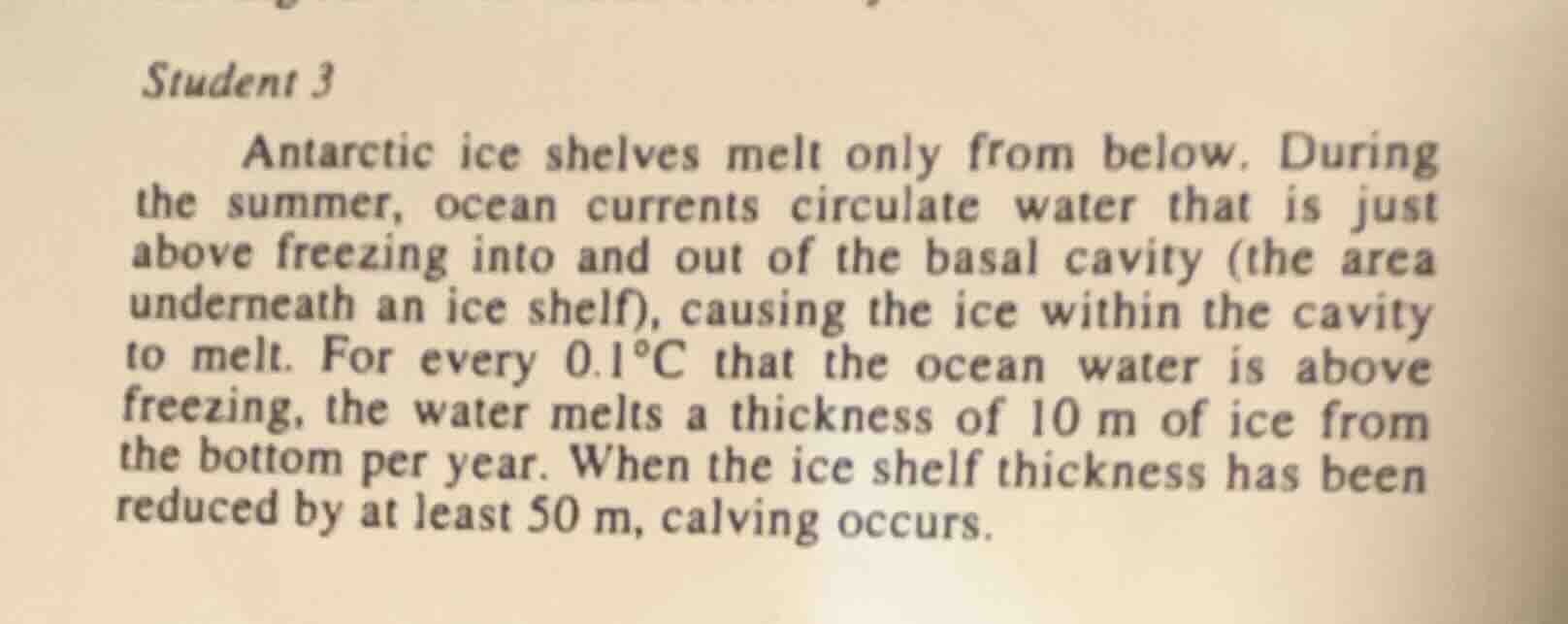
antarctic ice shelves melt only from below. during
the summer, ocean currents circulate water that is just
above freezing into and out of the basal cavity (the area
underneath an ice shelf), causing the ice within the cavity
to melt. for every 0.1°c that the ocean water is above
freezing, the water melts a thickness of 10 m of ice from
the bottom per year. when the ice shelf thickness has been
reduced by at least 50 m, calving occurs.
Since no specific question is provided about this text, it's hard to give a targeted answer. If you want to know about the discipline this belongs to (e.g., Natural Science - specifically maybe Environmental Sciences or Physics related to thermodynamics and glaciology), or have a question like calculating the time for calving given a certain ocean temperature above freezing, please clarify your question. For example, if the question was "If the ocean water is 0.5°C above freezing, how many years will it take for calving to occur?", here's how to solve it:
Step1: Find the melting rate per °C
Given that for every \( 0.1^\circ\text{C} \) above freezing, 10 m of ice melts per year. So per \( 1^\circ\text{C} \), the melting rate is \( \frac{10}{0.1}= 100 \) m/year per \( ^\circ\text{C} \).
Step2: Calculate melting rate for 0.5°C
For \( 0.5^\circ\text{C} \) above freezing, the melting rate \( r = 0.5\times100 = 50 \) m/year.
Step3: Find time for calving
Calving occurs when ice thickness is reduced by at least 50 m. Using \( \text{time} = \frac{\text{thickness reduction needed}}{\text{melting rate}} \), so \( t=\frac{50}{50}= 1 \) year.

Snap & solve any problem in the app
Get step-by-step solutions on Sovi AI
Photo-based solutions with guided steps
Explore more problems and detailed explanations
1 year