QUESTION IMAGE
Question
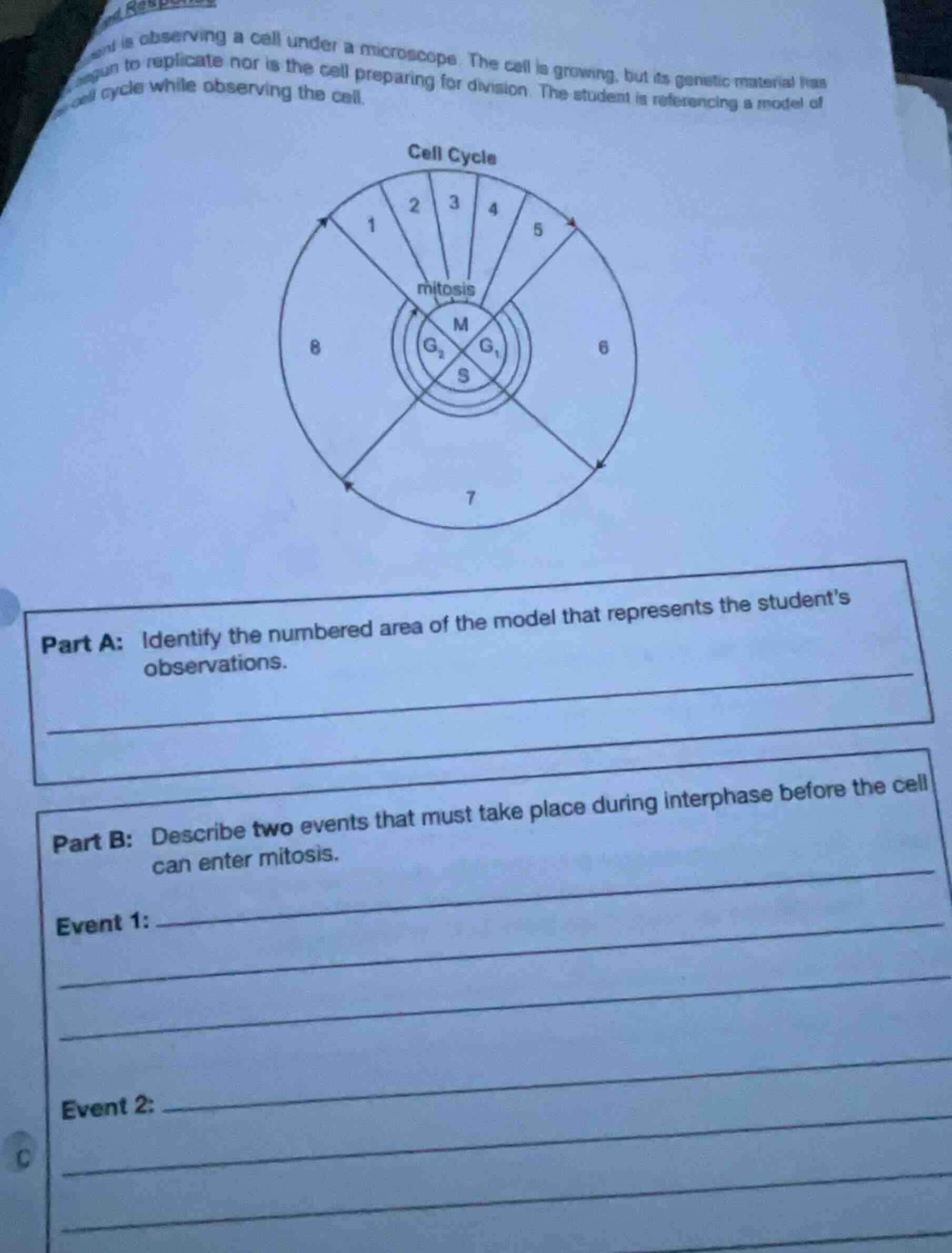
a student is observing a cell under a microscope. the cell is growing, but its genetic material has not begun to replicate nor is the cell preparing for division. the student is referencing a model of the cell cycle while observing the cell.
cell cycle diagram with numbered areas and phases m, g₁, s, g₂
part a: identify the numbered area of the model that represents the student’s observations.
____________________
part b: describe two events that must take place during interphase before the cell can enter mitosis.
event 1: ____________________
event 2: ____________________
Part A
The cell is growing, genetic material not replicating, and not preparing for division. In the cell cycle, \( G_1 \) phase (Gap 1) is when the cell grows, synthesizes proteins, and the genetic material (DNA) has not yet replicated (that's S phase) nor is it preparing for mitosis (which would be \( G_2 \) after S). Looking at the model, the area corresponding to \( G_1 \) - related part (since the numbered areas: let's analyze, the inner circles are \( G_1 \), S, \( G_2 \), M (mitosis). The outer numbered areas: the cell is in a growth phase without DNA replication or division prep, so it's the \( G_1 \) - associated outer area. From the diagram, the area with \( G_1 \) in the inner and outer area 6? Wait, no, typically \( G_1 \) is growth, no DNA replication. Wait, the student's observation: cell growing, genetic material not replicated, not preparing for division. So \( G_1 \) phase. In the diagram, the outer areas: let's see, the inner has \( G_1 \), S, \( G_2 \), M. The outer numbered 1 - 8? Wait, the key is \( G_1 \): cell grows, organelles multiply, DNA not replicated. So the area representing \( G_1 \) - the outer part corresponding to \( G_1 \) is area 6? Wait, maybe the outer area 6 (or check: the inner circle \( G_1 \), then outer area 6? Wait, maybe the correct number is 6? Wait, no, let's re - think. The cell cycle stages: \( G_1 \) (growth, no DNA replication), S (DNA replication), \( G_2 \) (prep for mitosis, after S), M (mitosis). So the student sees cell growing, DNA not replicated, not preparing for division → \( G_1 \). In the diagram, the outer area associated with \( G_1 \) is area 6? Wait, maybe the answer is 6? Wait, no, maybe 8? Wait, no, let's check the diagram again. The inner circles: \( G_1 \), S, \( G_2 \), M. The outer numbered areas: 1,2,3,4,5,6,7,8. The \( G_1 \) is in the inner, and the outer area connected to \( G_1 \) is 6? Or maybe 8? Wait, I think the correct numbered area is 6? Wait, no, perhaps the answer is 6? Wait, maybe I made a mistake. Alternatively, the area with \( G_1 \) in the inner and outer area 6. So the student's observation is \( G_1 \) phase, so the numbered area is 6.
Interphase has three parts: \( G_1 \), S, \( G_2 \). Before mitosis (M phase), interphase ( \( G_1 \), S, \( G_2 \)) must occur. Two events:
- Event 1: During the S (Synthesis) phase of interphase, the cell's genetic material (DNA) is replicated. This is necessary so that each daughter cell gets a complete set of DNA during mitosis.
- Event 2: During the \( G_2 \) (Gap 2) phase of interphase, the cell synthesizes proteins (like tubulin for spindle fibers) and organelles, and checks for DNA damage, preparing for mitosis. Also, during \( G_1 \) (but the question is before mitosis, so S and \( G_2 \) are before mitosis (since mitosis is M, after \( G_2 \)). Wait, the question says "during interphase before the cell can enter mitosis". So interphase is \( G_1 \), S, \( G_2 \). So two events:
Event 1: DNA replication (S phase) - the cell replicates its DNA so that there are two copies for each chromosome, which will be separated during mitosis.
Event 2: Cell growth and organelle duplication ( \( G_1 \) and \( G_2 \) - but more precisely, during \( G_2 \), the cell prepares for mitosis by producing necessary proteins and organelles, or during \( G_1 \), but since before mitosis, S and \( G_2 \) are closer. Wait, the main events before mitosis (M) in interphase: S (DNA replication) and \( G_2 \) (pre - mitotic preparation: protein synthesis, organelle growth, checkpoints). So:
Event 1: The cell replicates its DNA (during the S phase of interphase). This ensures that each daughter cell will receive a full set of genetic information.
Event 2: The cell synthesizes proteins and organelles (during the \( G_2 \) phase of interphase) that are required for cell division (mitosis), such as the proteins needed to form the mitotic spindle.

Snap & solve any problem in the app
Get step-by-step solutions on Sovi AI
Photo-based solutions with guided steps
Explore more problems and detailed explanations
6