QUESTION IMAGE
Question
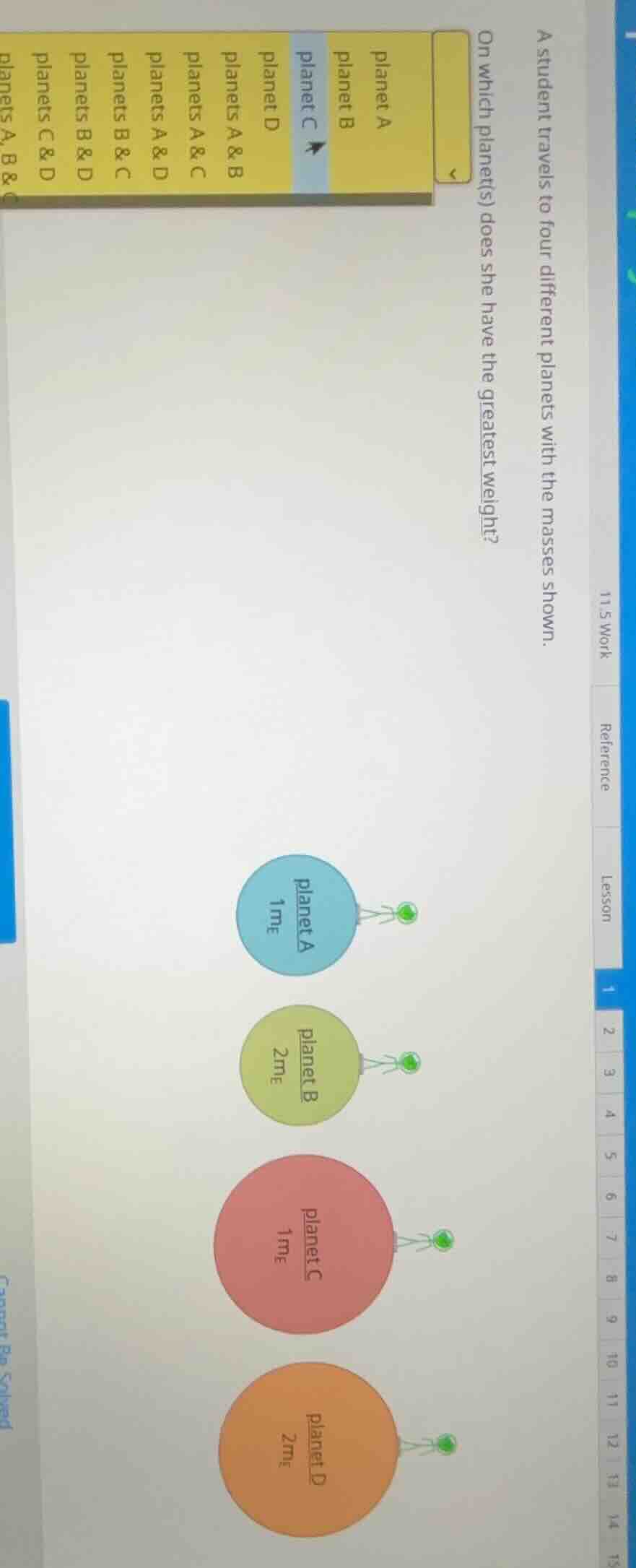
a student travels to four different planets with the masses shown. on which planet(s) does she have the greatest weight? planet a planet b planet c planet d planets a & b planets a & c planets a & d planets b & c planets b & d planets c & d planets a, b & c
Step1: Recall the relationship between weight, mass, and gravity
Weight \( W \) is given by the formula \( W = m \times g \), where \( m \) is the mass of the object (the student, which is constant) and \( g \) is the gravitational acceleration of the planet. Since the student's mass \( m \) is constant, weight is directly proportional to the planet's gravitational acceleration. Gravitational acceleration \( g \) of a planet is related to its mass \( M \) and radius \( r \) by \( g=\frac{GM}{r^{2}} \) (where \( G \) is the gravitational constant). From the diagram, we can infer the relative size (radius) and mass of each planet. Planet A: mass \( 1m_E \), small radius; Planet B: mass \( 2m_E \), small radius; Planet C: mass \( 1m_E \), large radius; Planet D: mass \( 2m_E \), large radius.
Step2: Analyze the effect of mass and radius on gravity
For two planets with the same mass, the one with smaller radius will have a larger \( g \) (since \( g\propto\frac{1}{r^{2}} \) for same \( M \)). For two planets with the same radius, the one with larger mass will have a larger \( g \) (since \( g\propto M \) for same \( r \)).
- Compare Planet A and Planet C (same mass \( 1m_E \)): Planet A has a smaller radius than Planet C, so \( g_A>g_C \).
- Compare Planet B and Planet D (same mass \( 2m_E \)): Planet B has a smaller radius than Planet D, so \( g_B>g_D \).
- Compare Planet A (mass \( 1m_E \), small radius) and Planet B (mass \( 2m_E \), small radius): Since \( g\propto M \) for same \( r \), and \( M_B = 2M_A \), \( g_B>g_A \).
- Compare Planet B (mass \( 2m_E \), small radius) and any other: Planet B has a relatively large mass and small radius. Planet D has large mass but large radius, so \( g_B > g_D \); Planet A has small mass, so \( g_B>g_A \); Planet C has small mass and large radius, so \( g_B>g_C \). Wait, but wait, maybe I misread the diagram. Wait, looking at the diagram again: Planet C is a large red circle (large radius) with mass \( 1m_E \), Planet D is a large orange circle (large radius) with mass \( 2m_E \), Planet B is a small green circle (small radius) with mass \( 2m_E \), Planet A is a small blue circle (small radius) with mass \( 1m_E \). Wait, maybe the radius: the size of the planet (the circle) indicates radius. So Planet A: small radius, mass \( 1m_E \); Planet B: small radius, mass \( 2m_E \); Planet C: large radius, mass \( 1m_E \); Planet D: large radius, mass \( 2m_E \).
Now, let's calculate \( g \) relative to each other. Let's assume \( G = 1 \), \( m = 1 \) for simplicity. Let radius of small planets (A, B) be \( r = 1 \), radius of large planets (C, D) be \( r = 2 \).
- \( g_A=\frac{G\times1m_E}{1^{2}} = Gm_E \)
- \( g_B=\frac{G\times2m_E}{1^{2}} = 2Gm_E \)
- \( g_C=\frac{G\times1m_E}{2^{2}}=\frac{Gm_E}{4} \)
- \( g_D=\frac{G\times2m_E}{2^{2}}=\frac{2Gm_E}{4}=\frac{Gm_E}{2} \)
Now, comparing \( g_A = Gm_E \), \( g_B = 2Gm_E \), \( g_C=\frac{Gm_E}{4} \), \( g_D=\frac{Gm_E}{2} \). So \( g_B \) is the largest? Wait, but wait, maybe the radius of Planet B and Planet D: maybe I got the radius wrong. Wait, the diagram: Planet B's circle is smaller than Planet D's circle, so radius of B < radius of D. Planet A's circle is same size as Planet B? Wait, looking at the image: Planet A (blue) and Planet B (green) are same size (small), Planet C (red) and Planet D (orange) are same size (large). So:
- Planet A: mass \( 1m_E \), radius \( r \)
- Planet B: mass \( 2m_E \), radius \( r \)
- Planet C: mass \( 1m_E \), radius \( R \) ( \( R > r \))
- Planet D: mass \( 2m_E \), radius \( R \) ( \( R > r \))
Th…

Snap & solve any problem in the app
Get step-by-step solutions on Sovi AI
Photo-based solutions with guided steps
Explore more problems and detailed explanations
planets B & D