QUESTION IMAGE
Question
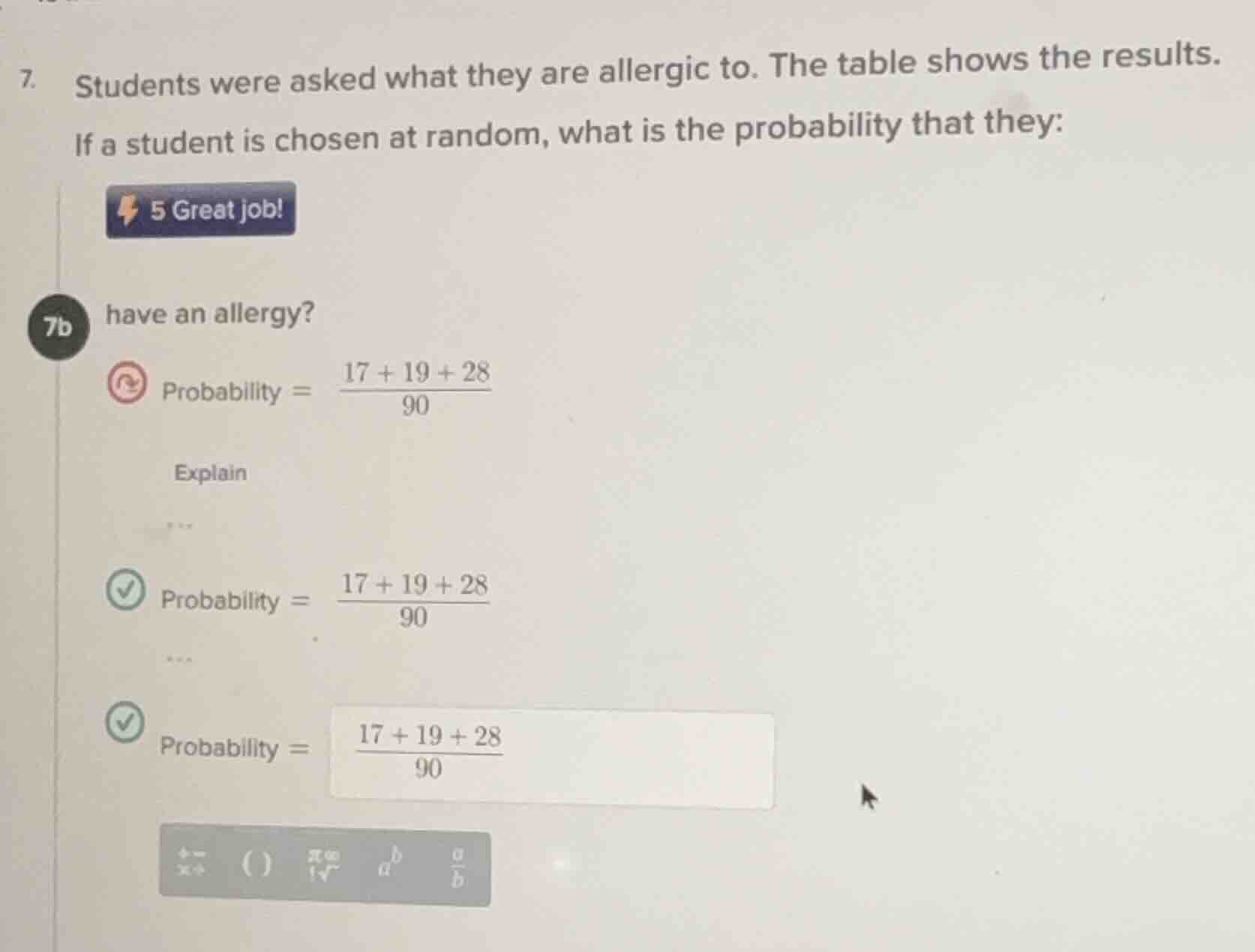
- students were asked what they are allergic to. the table shows the results. if a student is chosen at random, what is the probability that they: 7b have an allergy? probability = \\(\frac{17 + 19 + 28}{90}\\) explain probability = \\(\frac{17 + 19 + 28}{90}\\) probability = \\(\frac{17 + 19 + 28}{90}\\)
Step1: Calculate the numerator (number of students with allergies)
We need to sum the number of students allergic to different things. So, \(17 + 19 + 28\). First, \(17+19 = 36\), then \(36 + 28=64\).
Step2: Calculate the probability
The total number of students is 90. Probability is the number of favorable outcomes (students with allergies) divided by total outcomes (total students). So, we have \(\frac{64}{90}\), which can be simplified by dividing numerator and denominator by 2: \(\frac{32}{45}\).

Snap & solve any problem in the app
Get step-by-step solutions on Sovi AI
Photo-based solutions with guided steps
Explore more problems and detailed explanations
\(\frac{32}{45}\) (or approximately \(0.711\) if a decimal is preferred)