QUESTION IMAGE
Question
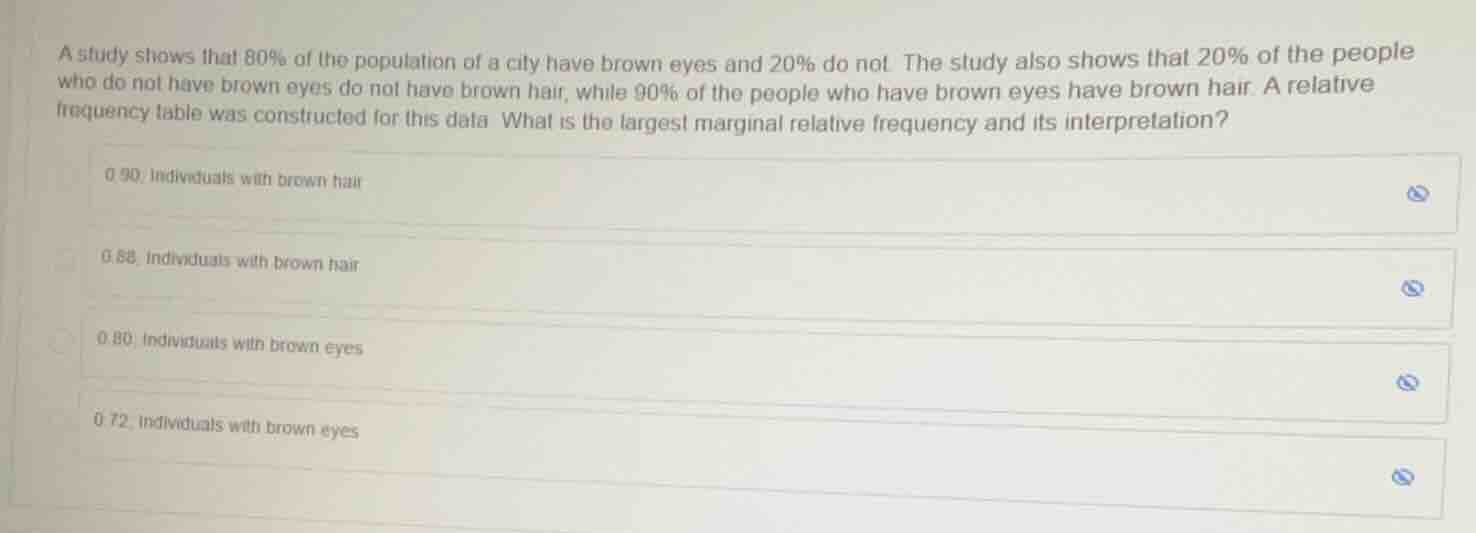
a study shows that 80% of the population of a city have brown eyes and 20% do not. the study also shows that 20% of the people who do not have brown eyes do not have brown hair, while 90% of the people who have brown eyes have brown hair. a relative frequency table was constructed for this data. what is the largest marginal relative frequency and its interpretation?
0.90: individuals with brown hair
0.88: individuals with brown hair
0.80: individuals with brown eyes
0.72: individuals with brown eyes
Step1: Calculate brown hair (brown eyes)
$0.80 \times 0.90 = 0.72$
Step2: Calculate brown hair (non-brown eyes)
$0.20 \times (1-0.20) = 0.20 \times 0.80 = 0.16$
Step3: Total brown hair frequency
$0.72 + 0.16 = 0.88$
Step4: Identify marginal frequencies
Marginal frequencies: brown eyes = 0.80, non-brown eyes = 0.20, brown hair = 0.88, non-brown hair = $1-0.88=0.12$

Snap & solve any problem in the app
Get step-by-step solutions on Sovi AI
Photo-based solutions with guided steps
Explore more problems and detailed explanations
0.88; Individuals with brown hair