QUESTION IMAGE
Question
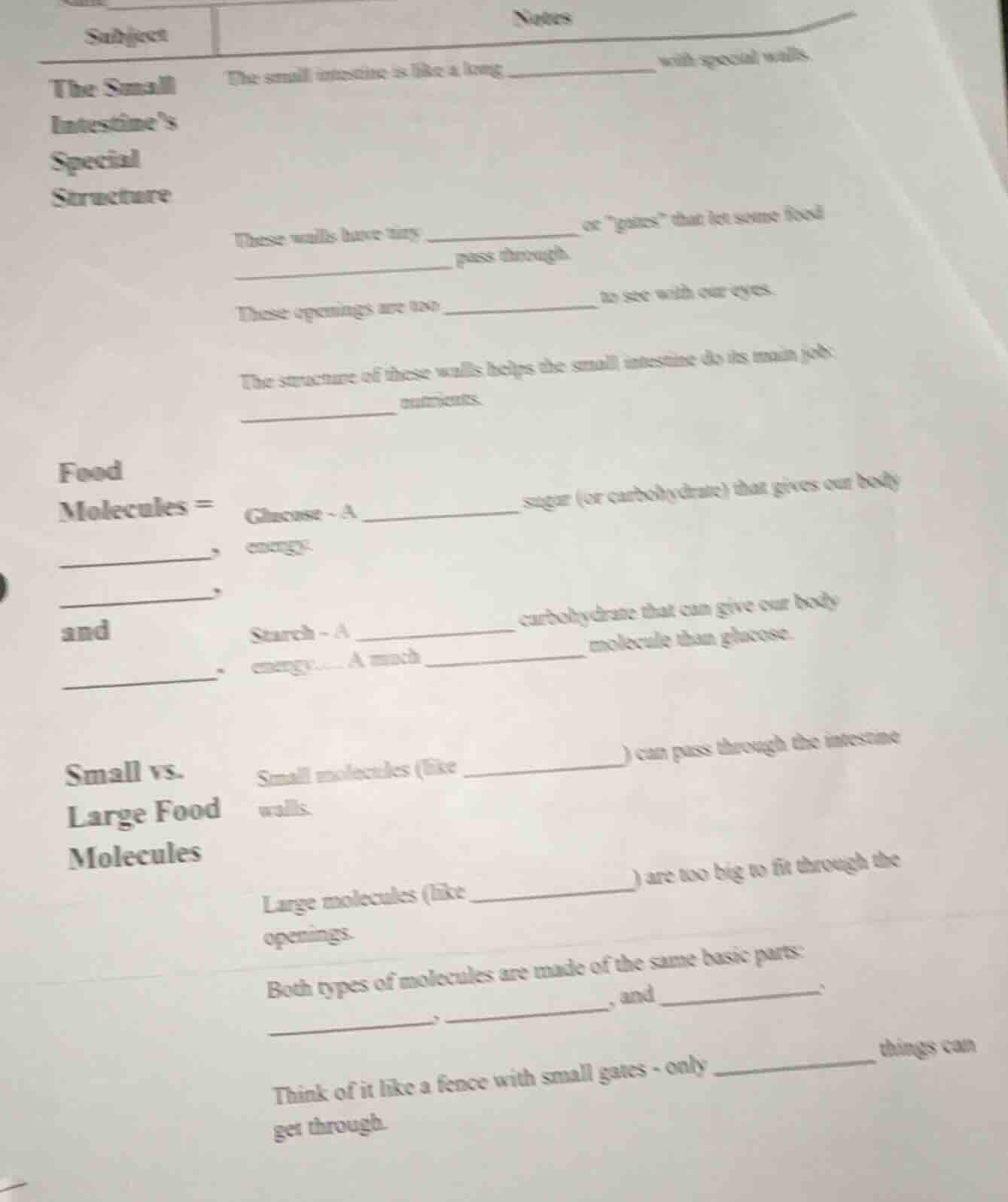
subject notes the small intestine’s special structure the small intestine is like a long ________ with special walls. these walls have tiny ______ or \gates\ that let some food ______ pass through. these openings are too ______ to see with our eyes. the structure of these walls helps the small intestine do its main job: ______ nutrients. food molecules = ______, ______, and ______. glucose - a ______ sugar (or carbohydrate) that gives our body energy. starch - a ______ carbohydrate that can give our body energy... a much ______ molecule than glucose. small vs. large food molecules small molecules (like ______) can pass through the intestine walls. large molecules (like ______) are too big to fit through the openings. both types of molecules are made of the same basic parts: ______, ______, and ______. think of it like a fence with small gates - only ________ things can get through.
To solve this fill - in - the - blank problem related to the small intestine and food molecules, we rely on knowledge from Biology (specifically human physiology and biochemistry).
1. The Small Intestine’s Special Structure
- The small intestine is like a long tube with special walls. (The small intestine is a tubular organ in the digestive system.)
- These walls have tiny openings or “gates” that let some food molecules pass through. (The walls of the small intestine have structures that allow the passage of digested food molecules.)
- These openings are too small to see with our eyes. (The openings in the intestinal wall are microscopic.)
- The structure of these walls helps the small intestine do its main job: absorb nutrients. (The primary function of the small intestine is to absorb nutrients from digested food.)
2. Food Molecules
Food molecules are typically carbohydrates, proteins, and fats (the three main macronutrient groups).
- Glucose - A simple sugar (or carbohydrate) that gives our body energy. (Glucose is a monosaccharide, a simple sugar.)
- Starch - A complex carbohydrate that can give our body energy... A much larger molecule than glucose. (Starch is a polysaccharide, a complex carbohydrate made up of many glucose units, so it is larger than a single glucose molecule.)
3. Small vs. Large Food Molecules
- Small molecules (like glucose) can pass through the intestine walls. (Glucose is a small, simple sugar molecule that can be absorbed.)
- Large molecules (like starch) are too big to fit through the openings. (Starch is a large, complex molecule and needs to be broken down into smaller molecules like glucose to be absorbed.)
- Both types of molecules are made of the same basic parts: carbon, hydrogen, and oxygen (carbohydrates like glucose and starch are made up of these elements; proteins also contain nitrogen, but for the basic comparison here, carbon, hydrogen, and oxygen are common).
- Think of it like a fence with small gates - only small things can get through. (This is an analogy for the selective absorption of small molecules through the intestinal wall.)

Snap & solve any problem in the app
Get step-by-step solutions on Sovi AI
Photo-based solutions with guided steps
Explore more problems and detailed explanations
s:
- The small intestine is like a long \(\boldsymbol{\text{tube}}\) with special walls.
- These walls have tiny \(\boldsymbol{\text{openings}}\) or “gates” that let some food \(\boldsymbol{\text{molecules}}\) pass through.
- These openings are too \(\boldsymbol{\text{small}}\) to see with our eyes.
- The structure of these walls helps the small intestine do its main job: \(\boldsymbol{\text{absorb}}\) nutrients.
- Food Molecules = \(\boldsymbol{\text{carbohydrates}}\), \(\boldsymbol{\text{proteins}}\), and \(\boldsymbol{\text{fats}}\).
- Glucose - A \(\boldsymbol{\text{simple}}\) sugar (or carbohydrate) that gives our body energy.
- Starch - A \(\boldsymbol{\text{complex}}\) carbohydrate that can give our body energy... A much \(\boldsymbol{\text{larger}}\) molecule than glucose.
- Small molecules (like \(\boldsymbol{\text{glucose}}\)) can pass through the intestine walls.
- Large molecules (like \(\boldsymbol{\text{starch}}\)) are too big to fit through the openings.
- Both types of molecules are made of the same basic parts: \(\boldsymbol{\text{carbon}}\), \(\boldsymbol{\text{hydrogen}}\), and \(\boldsymbol{\text{oxygen}}\).
- Think of it like a fence with small gates - only \(\boldsymbol{\text{small}}\) things can get through.