QUESTION IMAGE
Question
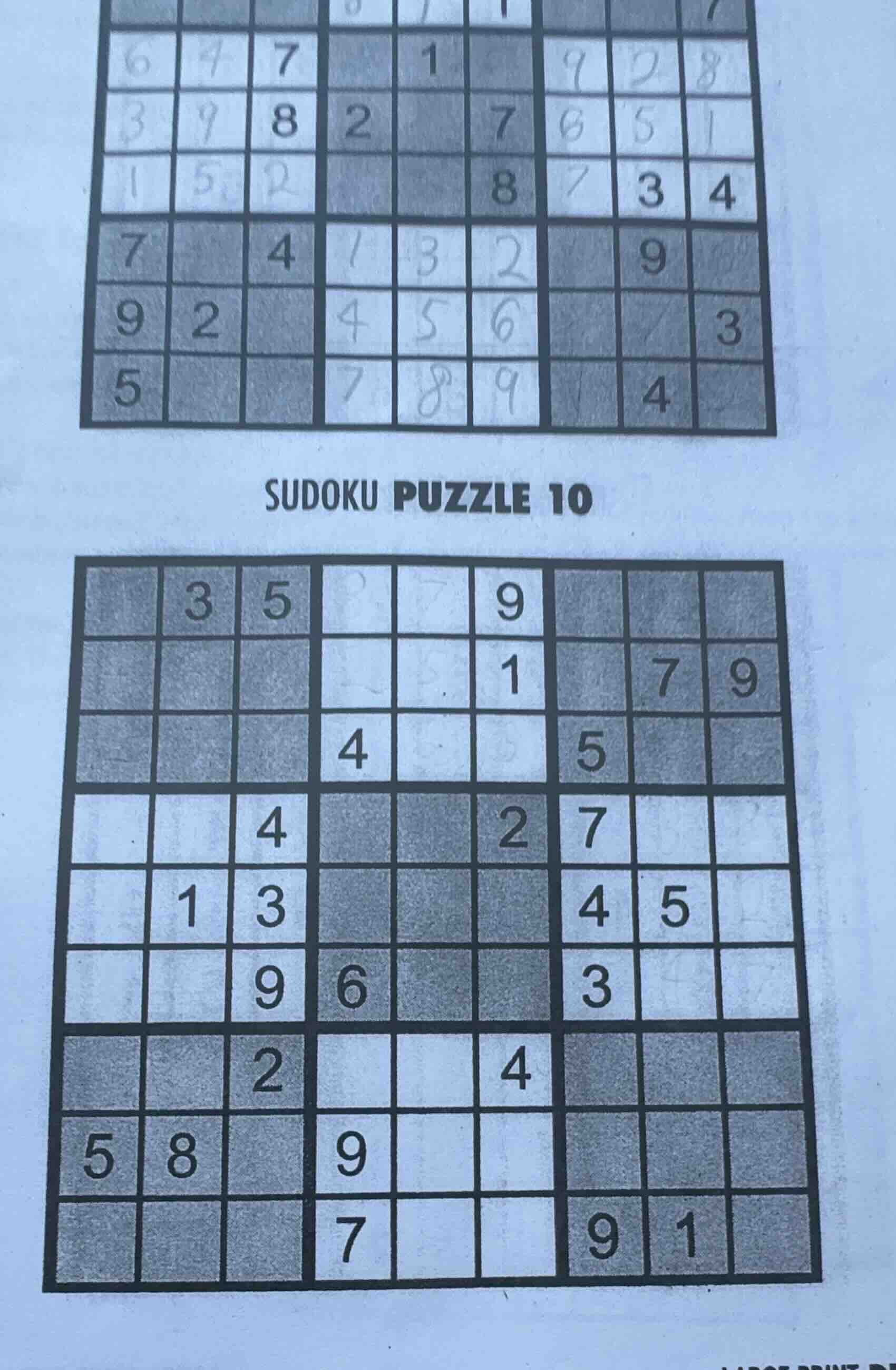
sudoku puzzle 10
To solve a Sudoku puzzle, we follow these general steps:
Step 1: Understand the Sudoku Rules
A Sudoku grid is a 9x9 grid divided into 3x3 subgrids (called "regions"). The goal is to fill the grid with numbers 1 - 9 such that:
- Each row contains all numbers 1 - 9 without repetition.
- Each column contains all numbers 1 - 9 without repetition.
- Each 3x3 region contains all numbers 1 - 9 without repetition.
Step 2: Start with Filled Cells and Look for Easy Entries
Let's analyze the given Sudoku (the lower one labeled "Sudoku Puzzle 10"):
Row 5, Column 2 (R5C2) is 1; Row 5, Column 3 (R5C3) is 3; Row 5, Column 7 (R5C7) is 4; Row 5, Column 8 (R5C8) is 5.
Row 2, Column 8 (R2C8) is 7; Row 2, Column 9 (R2C9) is 9; Row 2, Column 6 (R2C6) is 1.
Row 3, Column 4 (R3C4) is? Wait, let's list some filled cells:
- Row 1 (R1): C2=3, C3=5, C6=9
- Row 2 (R2): C6=1, C8=7, C9=9
- Row 3 (R3): C4=4, C7=5
- Row 4 (R4): C3=4, C6=2, C7=7
- Row 5 (R5): C2=1, C3=3, C7=4, C8=5
- Row 6 (R6): C3=9, C4=6, C7=3
- Row 7 (R7): C3=2, C6=4
- Row 8 (R8): C1=5, C2=8, C4=9
- Row 9 (R9): C4=7, C7=9, C8=1
Step 3: Analyze Regions, Rows, and Columns for Missing Numbers
Let's take Region 1 (Top - Left 3x3: R1 - R3, C1 - C3)
Filled cells in Region 1:
- R1C2=3, R1C3=5
- R2: All C1 - C3 are empty (let's call R2C1, R2C2, R2C3)
- R3: All C1 - C3 are empty (R3C1, R3C2, R3C3)
- R1C1 is empty.
Numbers missing in Region 1: 1,2,4,6,7,8 (since 3,5 are present; 9 is in R1C6, so not in Region 1)
Column 1 (C1)
Filled cells in C1:
- R8C1=5
- R4C1: empty; R5C1: empty; R6C1: empty; R7C1: empty; R9C1: empty; R1C1: empty; R2C1: empty; R3C1: empty
Numbers missing in C1: 1,2,3,4,6,7,8,9 (only 5 is present)
Let's look at Row 8 (R8): C1=5, C2=8, C4=9, C5=?, C6=?, C7=?, C8=?, C9=?
Filled in R8: 5 (C1), 8 (C2), 9 (C4)
Missing in R8: 1,2,3,4,6,7
But R8 is in Region 7 (R7 - R9, C1 - C3) and Region 8 (R7 - R9, C4 - C6) and Region 9 (R7 - R9, C7 - C9)
Region 9 (Bottom - Right 3x3: R7 - R9, C7 - C9)
Filled cells in Region 9:
- R7C7:? Wait, R7C7 is empty; R7C8: empty; R7C9: empty
- R8C7: empty; R8C8: empty; R8C9: empty
- R9C7=9, R9C8=1, R9C9: empty
Filled in Region 9: R9C7=9, R9C8=1
Missing: 2,3,4,5,6,7,8
But R5C8=5, R4C7=7, R6C7=3, R5C7=4, R4C6=2, so let's check Column 7 (C7):
Filled in C7:
- R4C7=7
- R5C7=4
- R6C7=3
- R7C7: empty
- R8C7: empty
- R9C7=9
- R1C7: empty; R2C7:7 (wait, R2C8=7, so R2C7 is empty? Wait, R2: C6=1, C8=7, C9=9. So R2C7 is empty. R3C7=5. R1C7 is empty.
So C7 filled: 4 (R5C7), 3 (R6C7), 7 (R4C7), 9 (R9C7), 5 (R3C7)
Missing in C7: 1,2,6,8
Step 4: Let's Try to Find a Cell with Only One Possible Number
Let's take R9 (Row 9): C4=7, C7=9, C8=1, C1=?, C2=?, C3=?, C5=?, C6=?, C9=?
Region 9 (R7 - R9, C7 - C9): R9C7=9, R9C8=1, so R9C9 must be from {2,3,4,5,6,7,8} (but 9,1 used). Also, Column 9 (C9):
Filled in C9:
- R2C9=9
- R4C9: empty; R5C9: empty; R6C9:7 (wait, R6C9: let's check R6: C3=9, C4=6, C7=3, so R6C9 is empty. R7C9: empty; R8C9: empty; R9C9: empty; R1C9: empty; R3C9: empty.
Numbers missing in C9: 2,3,4,5,6,7,8 (9 is in R2C9)
Let's look at R5 (Row 5): C2=1, C3=3, C6=?, C7=4, C8=5, C9=?
Filled in R5: 1 (C2), 3 (C3), 4 (C7), 5 (C8)
Missing in R5: 2,6,7,8,9 (since 1,3,4,5 used)
Column 6 (C6):
Filled in C6:
- R1C6=9
- R2C6=1
- R4C6=2
- R5C6: empty
- R6C6: empty
- R7C6=4
- R8C6: empty
- R9C6: empty
Numbers missing in C6: 3,5,6,7,8 (1,2,4,9 used)
Step 5: Let's Try a Different Approach - Look for Cells with Only One Possible Number
Let's take R7 (Row 7): C3=2, C6=4, so R7…

Snap & solve any problem in the app
Get step-by-step solutions on Sovi AI
Photo-based solutions with guided steps
Explore more problems and detailed explanations
To solve a Sudoku puzzle, we follow these general steps:
Step 1: Understand the Sudoku Rules
A Sudoku grid is a 9x9 grid divided into 3x3 subgrids (called "regions"). The goal is to fill the grid with numbers 1 - 9 such that:
- Each row contains all numbers 1 - 9 without repetition.
- Each column contains all numbers 1 - 9 without repetition.
- Each 3x3 region contains all numbers 1 - 9 without repetition.
Step 2: Start with Filled Cells and Look for Easy Entries
Let's analyze the given Sudoku (the lower one labeled "Sudoku Puzzle 10"):
Row 5, Column 2 (R5C2) is 1; Row 5, Column 3 (R5C3) is 3; Row 5, Column 7 (R5C7) is 4; Row 5, Column 8 (R5C8) is 5.
Row 2, Column 8 (R2C8) is 7; Row 2, Column 9 (R2C9) is 9; Row 2, Column 6 (R2C6) is 1.
Row 3, Column 4 (R3C4) is? Wait, let's list some filled cells:
- Row 1 (R1): C2=3, C3=5, C6=9
- Row 2 (R2): C6=1, C8=7, C9=9
- Row 3 (R3): C4=4, C7=5
- Row 4 (R4): C3=4, C6=2, C7=7
- Row 5 (R5): C2=1, C3=3, C7=4, C8=5
- Row 6 (R6): C3=9, C4=6, C7=3
- Row 7 (R7): C3=2, C6=4
- Row 8 (R8): C1=5, C2=8, C4=9
- Row 9 (R9): C4=7, C7=9, C8=1
Step 3: Analyze Regions, Rows, and Columns for Missing Numbers
Let's take Region 1 (Top - Left 3x3: R1 - R3, C1 - C3)
Filled cells in Region 1:
- R1C2=3, R1C3=5
- R2: All C1 - C3 are empty (let's call R2C1, R2C2, R2C3)
- R3: All C1 - C3 are empty (R3C1, R3C2, R3C3)
- R1C1 is empty.
Numbers missing in Region 1: 1,2,4,6,7,8 (since 3,5 are present; 9 is in R1C6, so not in Region 1)
Column 1 (C1)
Filled cells in C1:
- R8C1=5
- R4C1: empty; R5C1: empty; R6C1: empty; R7C1: empty; R9C1: empty; R1C1: empty; R2C1: empty; R3C1: empty
Numbers missing in C1: 1,2,3,4,6,7,8,9 (only 5 is present)
Let's look at Row 8 (R8): C1=5, C2=8, C4=9, C5=?, C6=?, C7=?, C8=?, C9=?
Filled in R8: 5 (C1), 8 (C2), 9 (C4)
Missing in R8: 1,2,3,4,6,7
But R8 is in Region 7 (R7 - R9, C1 - C3) and Region 8 (R7 - R9, C4 - C6) and Region 9 (R7 - R9, C7 - C9)
Region 9 (Bottom - Right 3x3: R7 - R9, C7 - C9)
Filled cells in Region 9:
- R7C7:? Wait, R7C7 is empty; R7C8: empty; R7C9: empty
- R8C7: empty; R8C8: empty; R8C9: empty
- R9C7=9, R9C8=1, R9C9: empty
Filled in Region 9: R9C7=9, R9C8=1
Missing: 2,3,4,5,6,7,8
But R5C8=5, R4C7=7, R6C7=3, R5C7=4, R4C6=2, so let's check Column 7 (C7):
Filled in C7:
- R4C7=7
- R5C7=4
- R6C7=3
- R7C7: empty
- R8C7: empty
- R9C7=9
- R1C7: empty; R2C7:7 (wait, R2C8=7, so R2C7 is empty? Wait, R2: C6=1, C8=7, C9=9. So R2C7 is empty. R3C7=5. R1C7 is empty.
So C7 filled: 4 (R5C7), 3 (R6C7), 7 (R4C7), 9 (R9C7), 5 (R3C7)
Missing in C7: 1,2,6,8
Step 4: Let's Try to Find a Cell with Only One Possible Number
Let's take R9 (Row 9): C4=7, C7=9, C8=1, C1=?, C2=?, C3=?, C5=?, C6=?, C9=?
Region 9 (R7 - R9, C7 - C9): R9C7=9, R9C8=1, so R9C9 must be from {2,3,4,5,6,7,8} (but 9,1 used). Also, Column 9 (C9):
Filled in C9:
- R2C9=9
- R4C9: empty; R5C9: empty; R6C9:7 (wait, R6C9: let's check R6: C3=9, C4=6, C7=3, so R6C9 is empty. R7C9: empty; R8C9: empty; R9C9: empty; R1C9: empty; R3C9: empty.
Numbers missing in C9: 2,3,4,5,6,7,8 (9 is in R2C9)
Let's look at R5 (Row 5): C2=1, C3=3, C6=?, C7=4, C8=5, C9=?
Filled in R5: 1 (C2), 3 (C3), 4 (C7), 5 (C8)
Missing in R5: 2,6,7,8,9 (since 1,3,4,5 used)
Column 6 (C6):
Filled in C6:
- R1C6=9
- R2C6=1
- R4C6=2
- R5C6: empty
- R6C6: empty
- R7C6=4
- R8C6: empty
- R9C6: empty
Numbers missing in C6: 3,5,6,7,8 (1,2,4,9 used)
Step 5: Let's Try a Different Approach - Look for Cells with Only One Possible Number
Let's take R7 (Row 7): C3=2, C6=4, so R7: C1, C2, C4, C5, C7, C8, C9 are empty.
Region 7 (R7 - R9, C1 - C3): R7C3=2, R8C1=5, R8C2=8, R9C1: empty, R9C2: empty, R9C3: empty, R7C1: empty, R7C2: empty.
Numbers in Region 7:
- R7C3=2
- R8C1=5, R8C2=8
So missing in Region 7: 1,3,4,6,7,9 (2,5,8 present)
Column 3 (C3):
Filled cells in C3:
- R1C3=5
- R4C3=4
- R5C3=3
- R6C3=9
- R7C3=2
So C3 has 2,3,4,5,9. Missing: 1,6,7,8
Ah! C3 is almost filled. Let's list C3:
- R1C3=5
- R2C3: empty
- R3C3: empty
- R4C3=4
- R5C3=3
- R6C3=9
- R7C3=2
- R8C3: empty (R8C3: R8 has C3 empty)
- R9C3: empty
Wait, R8C3: R8 has C3 empty. But R8 is in Region 7 (C1 - C3), and R8C1=5, R8C2=8, so R8C3 must be from {1,3,4,6,7,9} (but C3 already has 2,3,4,5,9, so R8C3 can't be 3,4,5,9. So R8C3: 1,6,7 (since 2 is in R7C3, 8 in R8C2, 5 in R8C1)
But C3 missing numbers: 1,6,7,8. Wait, R7C3=2, R1C3=5, R4C3=4, R5C3=3, R6C3=9. So missing in C3: 1,6,7,8. So R2C3, R3C3, R8C3, R9C3 must be 1,6,7,8 in some order.
Let's look at Row 2 (R2): C6=1, C8=7, C9=9, so R2: C1, C2, C3, C4, C5 are empty.
Numbers missing in R2: 2,3,4,5,6,8 (1,7,9 used)
Column 4 (C4):
Filled cells in C4:
- R3C4=4
- R4C4: empty
- R5C4: empty
- R6C4=6
- R7C4: empty
- R8C4=9
- R9C4=7
- R1C4: empty (R1C4: R1 has C4 empty)
- R2C4: empty
Numbers missing in C4: 1,2,3,5,8 (4,6,7,9 used)
Step 6: Let's Focus on R9 (Row 9)
R9: C4=7, C7=9, C8=1. So R9 has C1, C2, C3, C5, C6, C9 empty.
Region 9 (R7 - R9, C7 - C9): R9C7=9, R9C8=1, so R9C9 must be from {2,3,4,5,6,7,8} (but 9,1 used). Also, Column 9 (C9) has R2C9=9, so R9C9 can't be 9.
Let's check R9C6 (Column 6, Row 9)
Column 6 (C6) has R1C6=9, R2C6=1, R4C6=2, R7C6=4. So missing in C6: 3,5,6,7,8.
R9C6 is in Row 9, so numbers in Row 9: C4=7, so 7 is used. So R9C6 can't be 7. So R9C6: 3,5,6,8.
Step 7: Let's Try to Find a Cell with Only One Option
Let's take R7C5 (Row 7, Column 5). Wait, maybe this is getting too complex. Let's use a more systematic approach:
Let's list all cells and their possible numbers (abbreviated):
- R1C1: Region 1 (R1 - R3, C1 - C3), Row 1, Column 1.
- Region 1 missing: 1,2,4,6,7,8
- Row 1 missing: 1,2,4,6,7,8 (R1 has C2=3, C3=5, C6=9)
- Column 1 missing: 1,2,3,4,6,7,8,9 (only 5 present)
- Possible: 1,2,4,6,7,8 (since 3 is in R1C2, so R1C1 can't be 3)
- R1C4: Row 1, Column 4.
- Region 2 (R1 - R3, C4 - C6): R1C6=9, R2C6=1, so Region 2 has 9,1. Missing: 2,3,4,5,6,7,8
- Row 1 missing: 1,2,4,6,7,8 (3,5 in C2, C3; 9 in C6)
- Column 4 missing: 1,2,3,5,8 (4,6,7,9 used)
- Possible: 2,8 (since 1: R2C6=1, so R1C4 can't be 1; 3: R1C2=3, so[LLM SSE On Failure]