QUESTION IMAGE
Question
supporting an inference with evidence
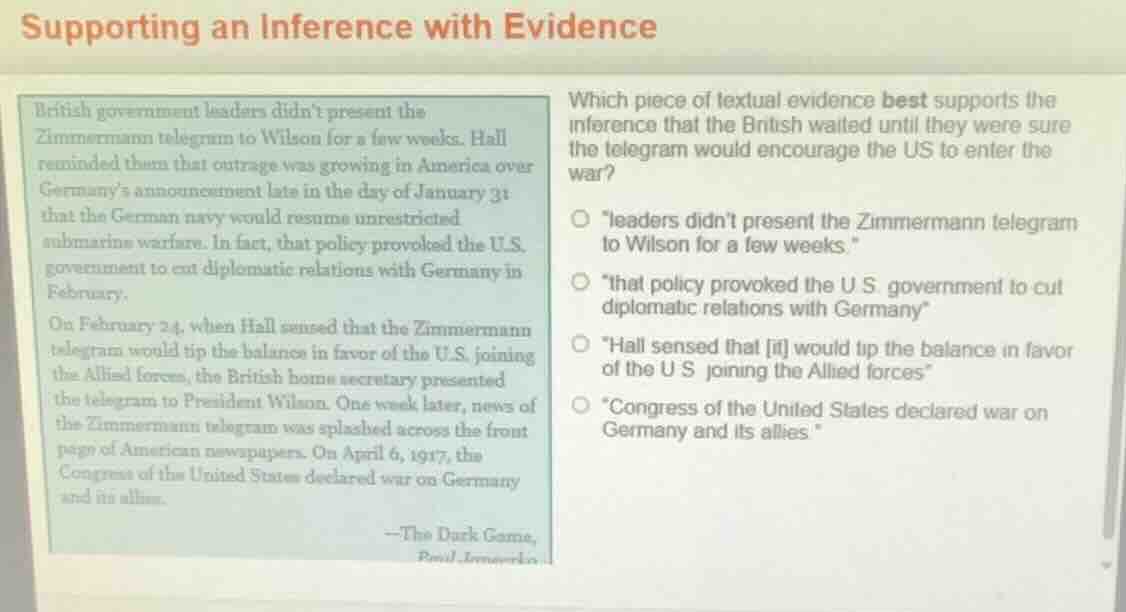
british government leaders didnt present the zimmermann telegram to wilson for a few weeks. hall reminded them that outrage was growing in america over germanys announcement late in the day of january 31 that the german navy would resume unrestricted submarine warfare. in fact, that policy provoked the u.s. government to cut diplomatic relations with germany in february.
on february 24, when hall sensed that the zimmermann telegram would tip the balance in favor of the u.s. joining the allied forces, the british home secretary presented the telegram to president wilson. one week later, news of the zimmermann telegram was splashed across the front pages of american newspapers. on april 6, 1917, the congress of the united states declared war on germany and its allies.
--the dark game,
paul janeczko
which piece of textual evidence best supports the inference that the british waited until they were sure the telegram would encourage the us to enter the war?
○ \leaders didnt present the zimmermann telegram to wilson for a few weeks.\
○ \that policy provoked the u s. government to cut diplomatic relations with germany\
○ \hall sensed that it would tip the balance in favor of the u s joining the allied forces\
○ \congress of the united states declared war on germany and its allies \
The question asks for evidence that the British waited until they were sure the telegram would push the US into war. The correct option directly states that Hall (a British figure) knew the telegram would lead the US to join the Allied forces, which is the reasoning behind the delayed presentation. The other options either only state the delay, mention an unrelated policy consequence, or note the final declaration of war without linking to the British's strategic wait.

Snap & solve any problem in the app
Get step-by-step solutions on Sovi AI
Photo-based solutions with guided steps
Explore more problems and detailed explanations
"Hall sensed that [it] would tip the balance in favor of the U S joining the Allied forces"