QUESTION IMAGE
Question
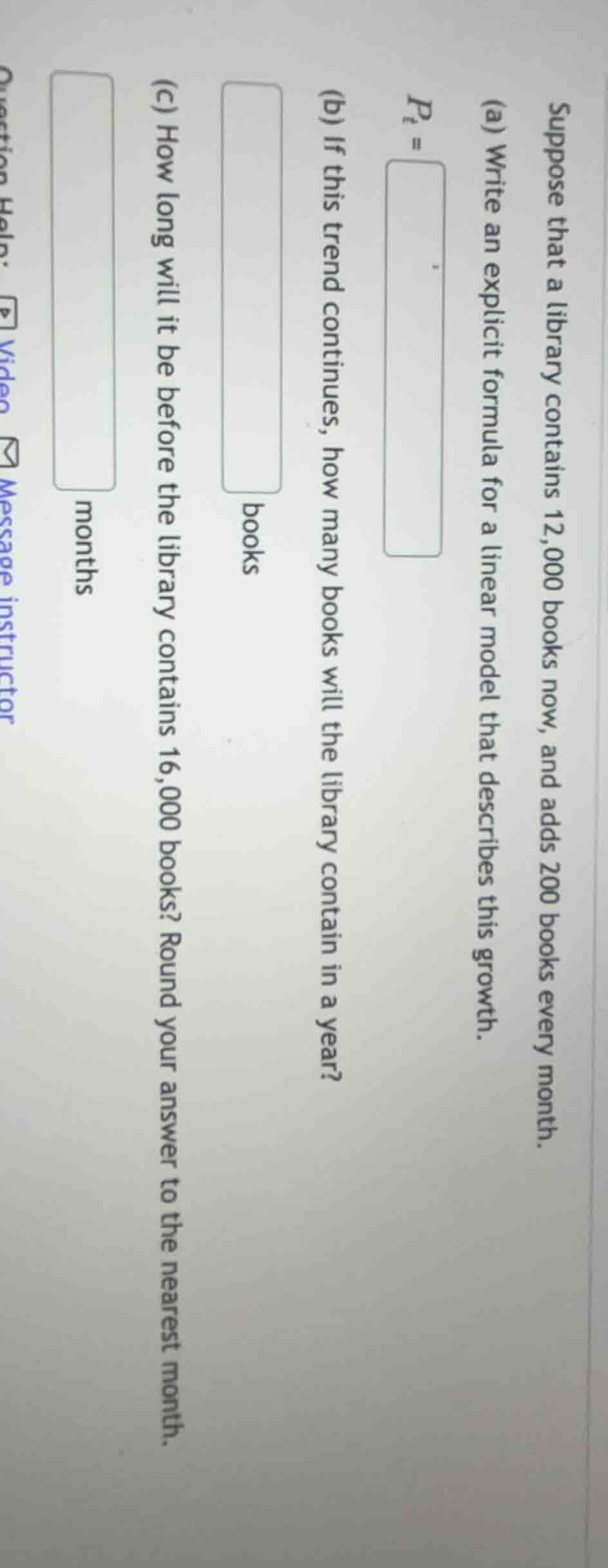
suppose that a library contains 12,000 books now, and adds 200 books every month.
(a) write an explicit formula for a linear model that describes this growth.
$p_t = $
(b) if this trend continues, how many books will the library contain in a year?
\boxed{\quad} books
(c) how long will it be before the library contains 16,000 books? round your answer to the nearest month.
\boxed{\quad} months
Part (a)
Step1: Identify linear model form
A linear model has the form \( P_t = P_0 + rt \), where \( P_0 \) is the initial quantity, \( r \) is the rate of change, and \( t \) is time (in months here). The initial number of books \( P_0 = 12000 \), and the rate \( r = 200 \) books per month.
Step2: Write the formula
Substitute \( P_0 = 12000 \) and \( r = 200 \) into the linear model: \( P_t = 12000 + 200t \).
Step1: Determine time for a year
A year has 12 months, so \( t = 12 \).
Step2: Substitute into the formula
Use \( P_t = 12000 + 200t \), substitute \( t = 12 \): \( P_{12} = 12000 + 200(12) \).
Step3: Calculate the value
First, calculate \( 200(12) = 2400 \). Then, \( 12000 + 2400 = 14400 \).
Step1: Set up the equation
We want to find \( t \) when \( P_t = 16000 \). Use the formula \( 16000 = 12000 + 200t \).
Step2: Solve for \( t \)
Subtract 12000 from both sides: \( 16000 - 12000 = 200t \), which simplifies to \( 4000 = 200t \).
Step3: Divide to find \( t \)
Divide both sides by 200: \( t = \frac{4000}{200} = 20 \).

Snap & solve any problem in the app
Get step-by-step solutions on Sovi AI
Photo-based solutions with guided steps
Explore more problems and detailed explanations
\( P_t = 12000 + 200t \)