QUESTION IMAGE
Question
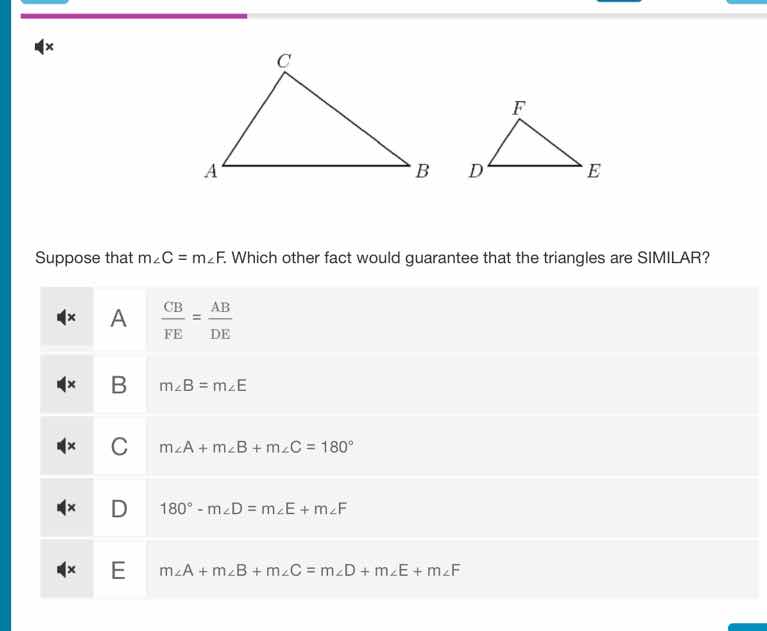
suppose that m∠c = m∠f. which other fact would guarantee that the triangles are similar? a (\frac{cb}{fe} = \frac{ab}{de}) b (m∠b = m∠e) c (m∠a + m∠b + m∠c = 180°) d (180° - m∠d = m∠e + m∠f) e (m∠a + m∠b + m∠c = m∠d + m∠e + m∠f)
To determine which fact guarantees the triangles are similar, we use the triangle similarity criteria (AA, SAS, SSS). We know \( m\angle C = m\angle F \).
Step 1: Analyze Option A
The ratio \( \frac{CB}{FE}=\frac{AB}{DE} \) involves sides, but we don't know if the included angles are equal. This doesn't guarantee similarity.
Step 2: Analyze Option B
If \( m\angle B = m\angle E \) and we already know \( m\angle C = m\angle F \), by the AA (Angle - Angle) similarity criterion, the triangles \( \triangle ABC \) and \( \triangle DEF \) are similar.
Step 3: Analyze Option C
The sum of angles in a triangle is always \( 180^{\circ} \), this is a property of all triangles and doesn't guarantee similarity between these two triangles.
Step 4: Analyze Option D
\( 180^{\circ}-m\angle D=m\angle E + m\angle F \) is just the angle - sum property of a triangle (\( m\angle D+m\angle E + m\angle F=180^{\circ} \)) and doesn't give a relation between the angles of the two triangles to guarantee similarity.
Step 5: Analyze Option E
The sum of angles in any triangle is \( 180^{\circ} \), so \( m\angle A + m\angle B + m\angle C=m\angle D + m\angle E + m\angle F = 180^{\circ} \) is always true and doesn't guarantee similarity.

Snap & solve any problem in the app
Get step-by-step solutions on Sovi AI
Photo-based solutions with guided steps
Explore more problems and detailed explanations
B. \( m\angle B = m\angle E \)