QUESTION IMAGE
Question
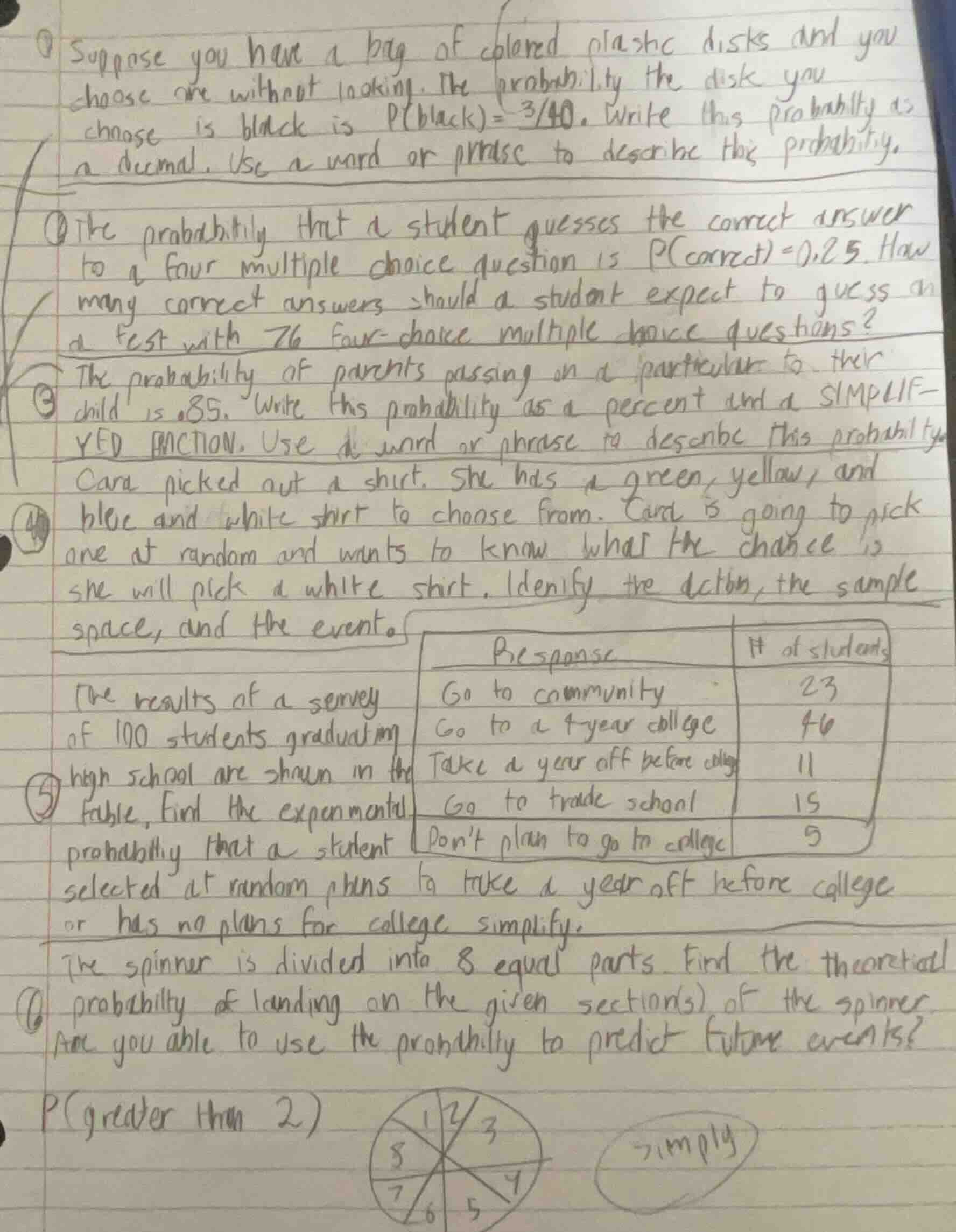
- suppose you have a bag of colored plastic disks and you choose one without looking. the probability the disk you choose is black is p(black) = 3/40. write this probability as a decimal. use a word or phrase to describe this probability. 2. the probability that a student guesses the correct answer to a four - multiple choice question is p(correct)=0.25. how many correct answers should a student expect to guess on a test with 76 four - choice multiple choice questions? 3. the probability of parents passing on a particular to their child is 0.85. write this probability as a percent and a simplified fraction. use a word or phrase to describe this probability. 4. cara picked out a shirt. she has a green, yellow, and blue and white shirt to choose from. cara is going to pick one at random and wants to know what the chance is she will pick a white shirt. identify the action, the sample space, and the event. 5. the results of a survey of 100 students graduating high school are shown in the table. find the experimental probability that a student selected at random plans to take a year off before college or has no plans for college simplify. (table: response - go to community: 23; go to a 4 - year college: 46; take a year off before college: 11; go to trade school: 15; dont plan to go to college: 5) 6. the spinner is divided into 8 equal parts. find the theoretical probability of landing on the given section(s) of the spinner. are you able to use the probability to predict future events? p(greater than 2)
Problem 1
Step1: Convert fraction to decimal
$\frac{3}{40} = 3 \div 40 = 0.075$
Step2: Describe probability
Since $0.075 < 0.5$, the event is unlikely.
Problem 2
Step1: Define expected value formula
$\text{Expected Correct Answers} = n \times P(\text{correct})$
Step2: Substitute values
$n=76$, $P(\text{correct})=0.25$
$\text{Expected Correct Answers} = 76 \times 0.25 = 19$
Problem 3
Step1: Convert decimal to percent
$0.85 \times 100 = 85\%$
Step2: Convert decimal to fraction
$0.85 = \frac{85}{100} = \frac{17}{20}$
Step3: Describe probability
Since $0.85 > 0.5$, the event is likely.
Problem 4
Step1: Identify the action
The action is picking a shirt randomly.
Step2: List sample space
All possible shirts: {green, yellow, blue, white}
Step3: Define the event
The specific outcome: picking a white shirt.
Problem 5
Step1: Find favorable outcomes
Number of students taking a year off + no college plans: $11 + 5 = 16$
Step2: Calculate experimental probability
$\text{Probability} = \frac{\text{Favorable Outcomes}}{\text{Total Outcomes}} = \frac{16}{100} = \frac{4}{25}$
Problem 6
Step1: Count favorable sections
Sections greater than 2: 3, 4, 5, 6, 7, 8 (6 sections)
Step2: Calculate theoretical probability
$\text{Probability} = \frac{\text{Favorable Sections}}{\text{Total Sections}} = \frac{6}{8} = \frac{3}{4}$
Step3: Address prediction question
Theoretical probability can estimate the relative frequency of future spinner spins, so it can help predict future events.

Snap & solve any problem in the app
Get step-by-step solutions on Sovi AI
Photo-based solutions with guided steps
Explore more problems and detailed explanations
- Decimal: 0.075; Description: Unlikely
- 19 correct answers
- Percent: 85%; Fraction: $\frac{17}{20}$; Description: Likely
- Action: Picking a shirt at random; Sample Space: {green shirt, yellow shirt, blue shirt, white shirt}; Event: Picking a white shirt
- $\frac{4}{25}$
- Probability: $\frac{3}{4}$; Yes, it can help predict future events