QUESTION IMAGE
Question
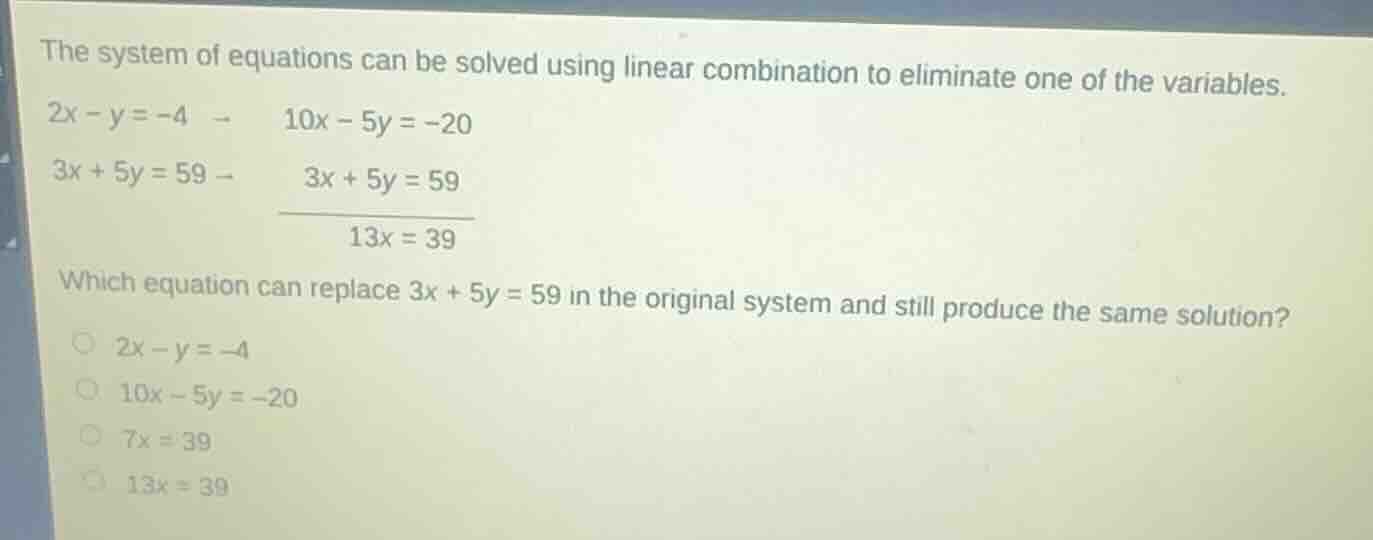
the system of equations can be solved using linear combination to eliminate one of the variables.
$2x - y = -4$ → $10x - 5y = -20$
$3x + 5y = 59$ → $3x + 5y = 59$
\overline{\quad\quad\quad\quad\quad\quad\quad\quad\quad\quad}
$13x = 39$
which equation can replace $3x + 5y = 59$ in the original system and still produce the same solution?
\circ $2x - y = -4$
\circ $10x - 5y = -20$
\circ $7x = 39$
\circ $13x = 39$
Step1: Recall the concept of equivalent systems
An equivalent system of equations has the same solution set. When we perform linear combinations (adding or subtracting equations) on a system, the resulting equation is part of an equivalent system.
Step2: Analyze the given operations
In the provided solution, we have the two original equations \(2x - y=-4\) (scaled to \(10x - 5y=-20\)) and \(3x + 5y = 59\). When we add these two equations (\(10x-5y=-20\) and \(3x + 5y=59\)), we get \(13x=39\).
Step3: Determine the equivalent equation
The equation \(13x = 39\) is obtained by combining the two original equations, so it is part of an equivalent system. The other options: \(2x - y=-4\) is one of the original equations, but replacing \(3x + 5y = 59\) with it would change the system (it would be a system with two copies of \(2x - y=-4\) which is not equivalent in terms of solving for the same variables). \(10x - 5y=-20\) is a multiple of \(2x - y=-4\) and replacing \(3x + 5y = 59\) with it would not give the same combination. \(7x=39\) is not obtained from the combination. Only \(13x = 39\) is the result of combining the two equations and is part of the equivalent system.

Snap & solve any problem in the app
Get step-by-step solutions on Sovi AI
Photo-based solutions with guided steps
Explore more problems and detailed explanations
D. \(13x = 39\) (assuming the options are labeled A: \(2x - y=-4\), B: \(10x - 5y=-20\), C: \(7x = 39\), D: \(13x = 39\))