QUESTION IMAGE
Question
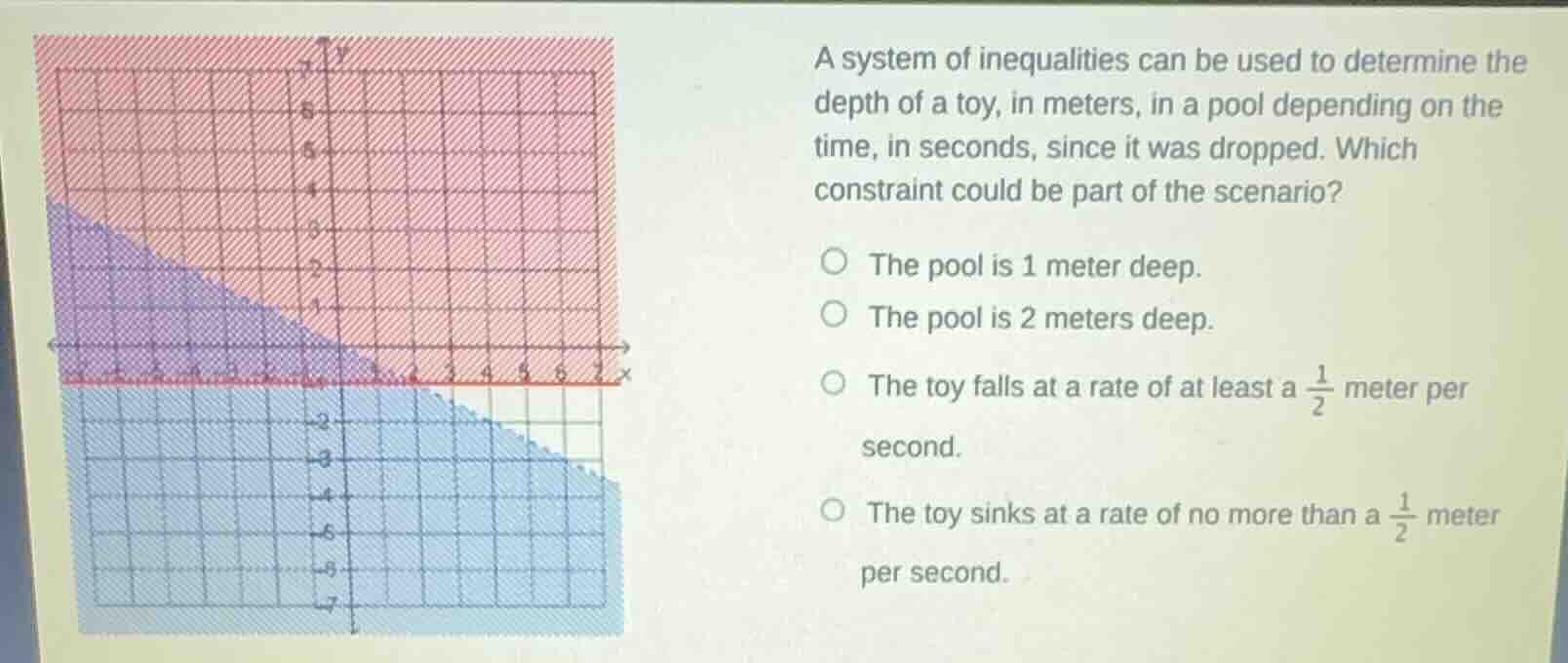
a system of inequalities can be used to determine the depth of a toy, in meters, in a pool depending on the time, in seconds, since it was dropped. which constraint could be part of the scenario?
the pool is 1 meter deep.
the pool is 2 meters deep.
the toy falls at a rate of at least a \\(\frac{1}{2}\\) meter per second.
the toy sinks at a rate of no more than a \\(\frac{1}{2}\\) meter per second.
Step1: Analyze the pool depth
The graph's horizontal line (the pool's depth) is at \( y = -1 \)? Wait, no, looking at the grid, the blue region (maybe the pool depth) and the red. Wait, actually, the pool's depth is the maximum depth the toy can reach. Wait, the y - axis: let's see the horizontal line (the pool's depth) is at \( y=-1 \)? No, maybe the pool depth is 1 meter? Wait, no, let's think about the inequality. Wait, the toy is dropped, so depth \( d(t) \). The pool's depth: if the pool is 1 meter deep, but looking at the options, the pool depth options are 1 or 2. Wait, no, let's check the slope. The line in the graph: let's find the slope. Let's take two points on the line. Suppose when \( x = 0 \), \( y = 0 \)? No, wait, the line goes from, say, (0, 0) to (2, -1)? Wait, no, let's calculate the slope. The slope \( m=\frac{\Delta y}{\Delta x}\). If we take two points: when \( x = 0 \), \( y = 0 \); when \( x = 2 \), \( y=-1 \). Then slope \( m=\frac{-1 - 0}{2 - 0}=-\frac{1}{2}\). So the rate of sinking is \( \frac{1}{2} \) meter per second (since depth is negative, but the rate of change of depth with respect to time: the slope is -1/2, so the toy sinks at a rate of \( \frac{1}{2} \) meter per second, but the constraint about the rate: "no more than \( \frac{1}{2} \) meter per second" or "at least"? Wait, the slope is -1/2, so the rate of change of depth (how fast it sinks) is \( \frac{1}{2} \) meter per second (since depth increases negatively, but the speed is 1/2 m/s). Wait, the option: "The toy sinks at a rate of no more than a \( \frac{1}{2} \) meter per second." Wait, no, the slope is -1/2, so the rate of sinking is \( \frac{1}{2} \) m/s. Wait, but let's check the pool depth. Wait, the horizontal line (the pool's bottom) is at \( y=-1 \)? No, maybe the pool is 1 meter deep? Wait, no, the options for pool depth: 1 or 2. Wait, the line in the graph: when does the depth stop? Wait, maybe the pool depth is 1 meter? No, let's re - evaluate.
Wait, the problem is about a system of inequalities for the depth of a toy in a pool over time. Let's consider the slope of the line in the graph. The line has a slope of \( -\frac{1}{2} \), which means that for each second (increase in x), the depth (y) decreases by \( \frac{1}{2} \) meter (or increases in depth, since depth is negative). So the rate at which the toy sinks is \( \frac{1}{2} \) meter per second. Now, the options about the rate: "The toy sinks at a rate of no more than a \( \frac{1}{2} \) meter per second." Wait, the slope is -1/2, so the rate of sinking is \( \frac{1}{2} \) m/s. So the constraint on the rate: if the slope is -1/2, then the toy sinks at a rate of \( \frac{1}{2} \) m/s, so "no more than \( \frac{1}{2} \) m/s" would mean that the rate is less than or equal to \( \frac{1}{2} \) m/s, which matches the slope (since the slope is -1/2, the rate of sinking is \( \frac{1}{2} \) m/s, so it's "no more than" because the rate is exactly \( \frac{1}{2} \), so it's within the constraint of "no more than \( \frac{1}{2} \) m/s".
Wait, also, the pool depth: if the pool is 1 meter deep, but the line goes to y = -1? No, maybe the pool is 1 meter deep? Wait, no, let's check the options again. The options are:
- The pool is 1 meter deep.
- The pool is 2 meters deep.
- The toy falls at a rate of at least a \( \frac{1}{2} \) meter per second.
- The toy sinks at a rate of no more than a \( \frac{1}{2} \) meter per second.
We calculated the slope as -1/2, so the rate of sinking is \( \frac{1}{2} \) m/s. So the rate is equal to \( \frac{1}{2} \) m/s, so "no more than \(…

Snap & solve any problem in the app
Get step-by-step solutions on Sovi AI
Photo-based solutions with guided steps
Explore more problems and detailed explanations
The toy sinks at a rate of no more than a \( \frac{1}{2} \) meter per second.