QUESTION IMAGE
Question
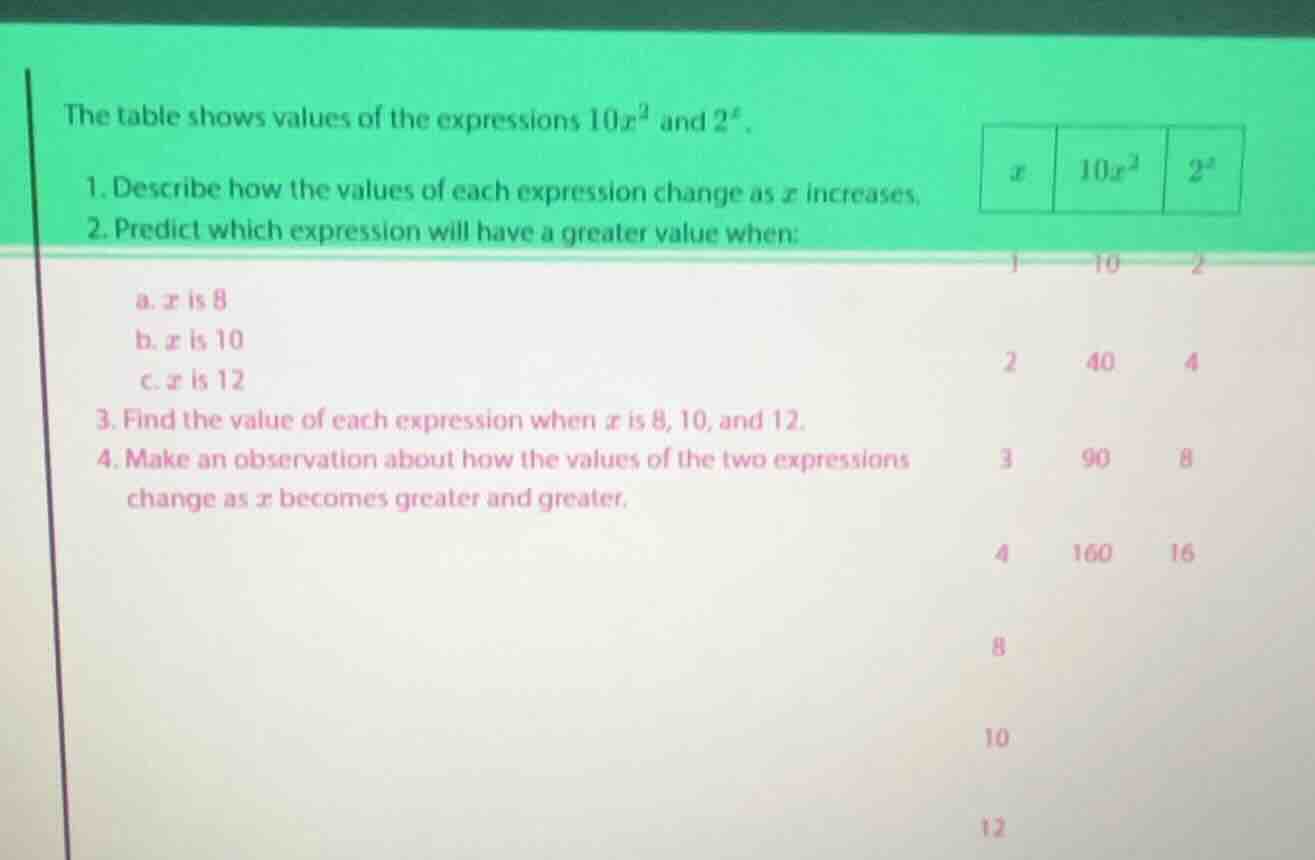
the table shows values of the expressions $10x^2$ and $2^x$.
- describe how the values of each expression change as $x$ increases.
- predict which expression will have a greater value when:
a. $x$ is 8
b. $x$ is 10
c. $x$ is 12
- find the value of each expression when $x$ is 8, 10, and 12.
- make an observation about how the values of the two expressions change as $x$ becomes greater and greater.
(the table has columns $x$, $10x^2$, $2^x$ with rows showing $x$ values 1,2,3,4,8,10,12 and corresponding $10x^2$ and $2^x$ values: for $x=1$, $10x^2=10$, $2^x=2$; $x=2$, $10x^2=40$, $2^x=4$; $x=3$, $10x^2=90$, $2^x=8$; $x=4$, $10x^2=160$, $2^x=16$; $x=8,10,12$ have empty $10x^2$ and $2^x$ cells initially.)
Part 1: Describe how the values of each expression change as \( x \) increases
For \( 10x^2 \): As \( x \) increases, \( x^2 \) increases quadratically, so \( 10x^2 \) increases quadratically (the rate of increase accelerates, but it is a polynomial growth).
For \( 2^x \): As \( x \) increases, \( 2^x \) increases exponentially (the rate of increase accelerates much faster than polynomial growth).
Part 2: Predict which expression is greater
a. \( x = 8 \)
- Calculate \( 10x^2 \): \( 10(8)^2 = 10(64) = 640 \)
- Calculate \( 2^x \): \( 2^8 = 256 \)
Since \( 640 > 256 \), \( 10x^2 \) is greater.
b. \( x = 10 \)
- Calculate \( 10x^2 \): \( 10(10)^2 = 10(100) = 1000 \)
- Calculate \( 2^x \): \( 2^{10} = 1024 \)
Since \( 1024 > 1000 \), \( 2^x \) is greater.
c. \( x = 12 \)
- Calculate \( 10x^2 \): \( 10(12)^2 = 10(144) = 1440 \)
- Calculate \( 2^x \): \( 2^{12} = 4096 \)
Since \( 4096 > 1440 \), \( 2^x \) is greater.
Part 3: Find the value of each expression
\( x = 8 \)
- \( 10x^2 \): \( 10(8)^2 = 10 \times 64 = 640 \)
- \( 2^x \): \( 2^8 = 256 \)
\( x = 10 \)
- \( 10x^2 \): \( 10(10)^2 = 10 \times 100 = 1000 \)
- \( 2^x \): \( 2^{10} = 1024 \)
\( x = 12 \)
- \( 10x^2 \): \( 10(12)^2 = 10 \times 144 = 1440 \)
- \( 2^x \): \( 2^{12} = 4096 \)
Part 4: Observation as \( x \) becomes very large
For small \( x \), \( 10x^2 \) (polynomial) may be greater, but as \( x \) increases, \( 2^x \) (exponential) grows much faster than \( 10x^2 \). Eventually, exponential growth outpaces polynomial growth, so \( 2^x \) will be much larger than \( 10x^2 \) for sufficiently large \( x \).
Final Answers (Summarized)
- \( 10x^2 \): Quadratic growth; \( 2^x \): Exponential growth.
- a. \( 10x^2 \); b. \( 2^x \); c. \( 2^x \)
- \( x=8 \): \( 10x^2=640 \), \( 2^x=256 \); \( x=10 \): \( 10x^2=1000 \), \( 2^x=1024 \); \( x=12 \): \( 10x^2=1440 \), \( 2^x=4096 \)
- Exponential (\( 2^x \)) outpaces polynomial (\( 10x^2 \)) for large \( x \).

Snap & solve any problem in the app
Get step-by-step solutions on Sovi AI
Photo-based solutions with guided steps
Explore more problems and detailed explanations
Part 1: Describe how the values of each expression change as \( x \) increases
For \( 10x^2 \): As \( x \) increases, \( x^2 \) increases quadratically, so \( 10x^2 \) increases quadratically (the rate of increase accelerates, but it is a polynomial growth).
For \( 2^x \): As \( x \) increases, \( 2^x \) increases exponentially (the rate of increase accelerates much faster than polynomial growth).
Part 2: Predict which expression is greater
a. \( x = 8 \)
- Calculate \( 10x^2 \): \( 10(8)^2 = 10(64) = 640 \)
- Calculate \( 2^x \): \( 2^8 = 256 \)
Since \( 640 > 256 \), \( 10x^2 \) is greater.
b. \( x = 10 \)
- Calculate \( 10x^2 \): \( 10(10)^2 = 10(100) = 1000 \)
- Calculate \( 2^x \): \( 2^{10} = 1024 \)
Since \( 1024 > 1000 \), \( 2^x \) is greater.
c. \( x = 12 \)
- Calculate \( 10x^2 \): \( 10(12)^2 = 10(144) = 1440 \)
- Calculate \( 2^x \): \( 2^{12} = 4096 \)
Since \( 4096 > 1440 \), \( 2^x \) is greater.
Part 3: Find the value of each expression
\( x = 8 \)
- \( 10x^2 \): \( 10(8)^2 = 10 \times 64 = 640 \)
- \( 2^x \): \( 2^8 = 256 \)
\( x = 10 \)
- \( 10x^2 \): \( 10(10)^2 = 10 \times 100 = 1000 \)
- \( 2^x \): \( 2^{10} = 1024 \)
\( x = 12 \)
- \( 10x^2 \): \( 10(12)^2 = 10 \times 144 = 1440 \)
- \( 2^x \): \( 2^{12} = 4096 \)
Part 4: Observation as \( x \) becomes very large
For small \( x \), \( 10x^2 \) (polynomial) may be greater, but as \( x \) increases, \( 2^x \) (exponential) grows much faster than \( 10x^2 \). Eventually, exponential growth outpaces polynomial growth, so \( 2^x \) will be much larger than \( 10x^2 \) for sufficiently large \( x \).
Final Answers (Summarized)
- \( 10x^2 \): Quadratic growth; \( 2^x \): Exponential growth.
- a. \( 10x^2 \); b. \( 2^x \); c. \( 2^x \)
- \( x=8 \): \( 10x^2=640 \), \( 2^x=256 \); \( x=10 \): \( 10x^2=1000 \), \( 2^x=1024 \); \( x=12 \): \( 10x^2=1440 \), \( 2^x=4096 \)
- Exponential (\( 2^x \)) outpaces polynomial (\( 10x^2 \)) for large \( x \).