QUESTION IMAGE
Question
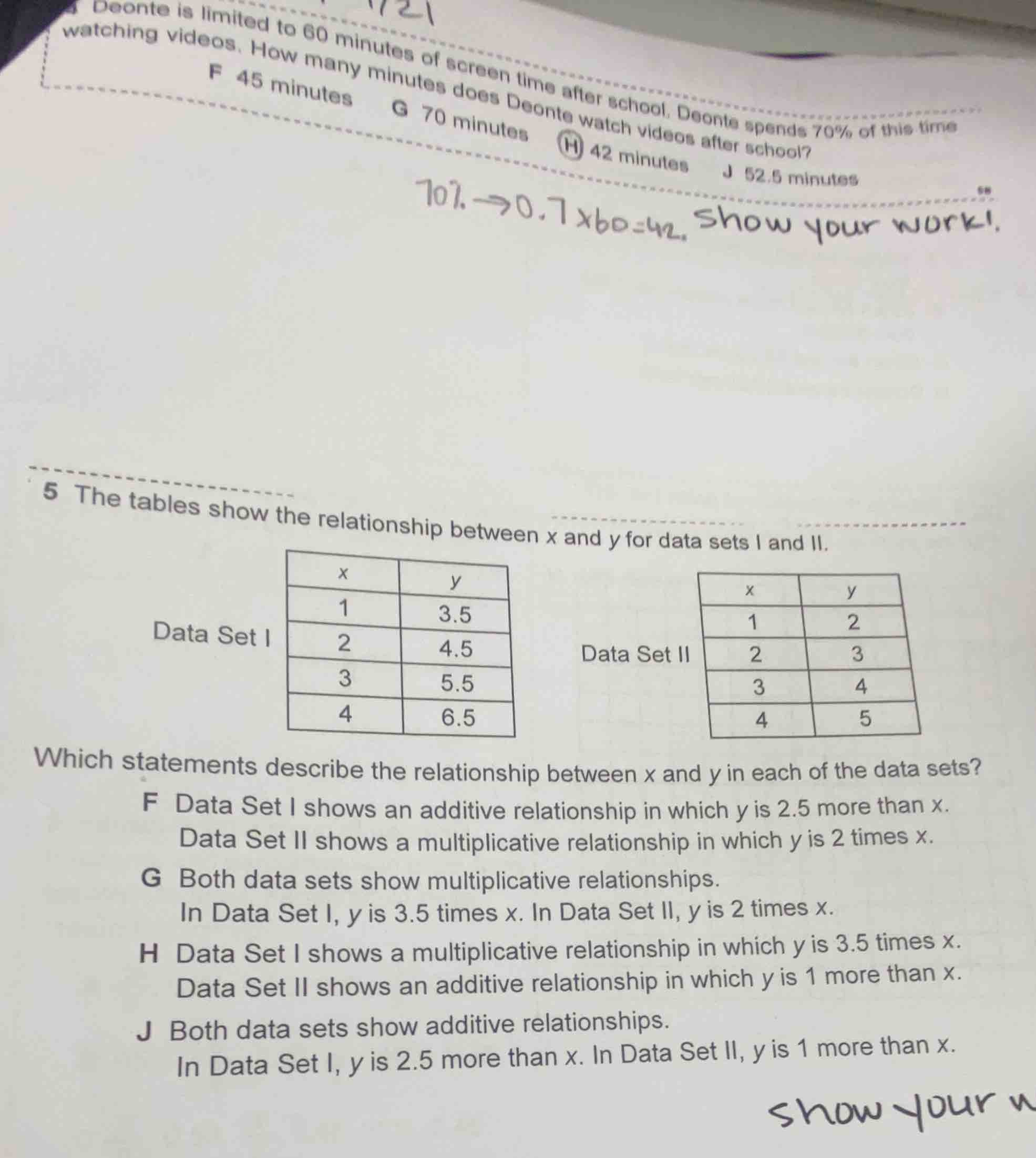
5 the tables show the relationship between x and y for data sets i and ii.
data set i
| x | y |
|---|---|
| 2 | 4.5 |
| 3 | 5.5 |
| 4 | 6.5 |
data set ii
| x | y |
|---|---|
| 2 | 3 |
| 3 | 4 |
| 4 | 5 |
which statements describe the relationship between x and y in each of the data sets?
f data set i shows an additive relationship in which y is 2.5 more than x.
data set ii shows a multiplicative relationship in which y is 2 times x.
g both data sets show multiplicative relationships.
in data set i, y is 3.5 times x. in data set ii, y is 2 times x.
h data set i shows a multiplicative relationship in which y is 3.5 times x.
data set ii shows an additive relationship in which y is 1 more than x.
j both data sets show additive relationships.
in data set i, y is 2.5 more than x. in data set ii, y is 1 more than x.
Problem 4 (Deonte's Screen Time)
Step1: Convert percentage to decimal
To find 70% of 60 minutes, first convert 70% to a decimal. 70% is equivalent to $0.7$.
Step2: Multiply by total time
Multiply the decimal by the total screen time (60 minutes). So, $0.7\times60 = 42$.
- Data Set I: Check the difference between \( y \) and \( x \) for each pair:
- For \( x = 1 \), \( y - x = 3.5 - 1 = 2.5 \)
- For \( x = 2 \), \( y - x = 4.5 - 2 = 2.5 \)
- For \( x = 3 \), \( y - x = 5.5 - 3 = 2.5 \)
- For \( x = 4 \), \( y - x = 6.5 - 4 = 2.5 \)
This shows an additive relationship where \( y = x + 2.5 \) (y is 2.5 more than x).
- Data Set II: Check the difference between \( y \) and \( x \) for each pair:
- For \( x = 1 \), \( y - x = 2 - 1 = 1 \)
- For \( x = 2 \), \( y - x = 3 - 2 = 1 \)
- For \( x = 3 \), \( y - x = 4 - 3 = 1 \)
- For \( x = 4 \), \( y - x = 5 - 4 = 1 \)
This shows an additive relationship where \( y = x + 1 \) (y is 1 more than x).
- Now analyze the options:
- Option F: Data Set II is not multiplicative (it's additive), so F is wrong.
- Option G: Both are not multiplicative (they are additive), so G is wrong.
- Option H: Data Set I is additive (not multiplicative), so H is wrong.
- Option J: Both are additive. In Data Set I, \( y = x + 2.5 \) (y is 2.5 more than x). In Data Set II, \( y = x + 1 \) (y is 1 more than x). This matches.

Snap & solve any problem in the app
Get step-by-step solutions on Sovi AI
Photo-based solutions with guided steps
Explore more problems and detailed explanations
H 42 minutes