QUESTION IMAGE
Question
6.1 take - home
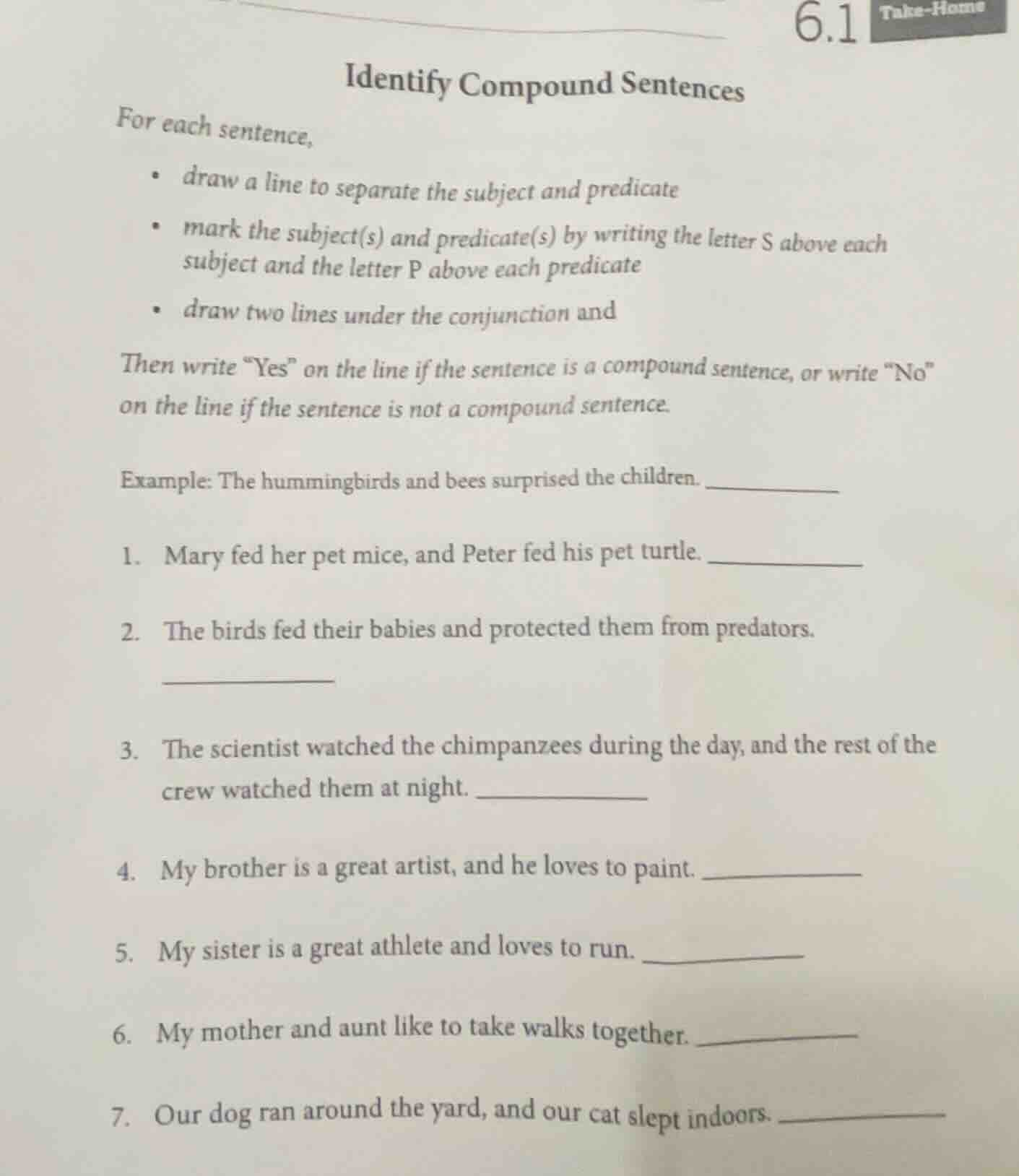
identify compound sentences
for each sentence,
- draw a line to separate the subject and predicate
- mark the subject(s) and predicate(s) by writing the letter s above each subject and the letter p above each predicate
- draw two lines under the conjunction and
then write “yes” on the line if the sentence is a compound sentence, or write “no” on the line if the sentence is not a compound sentence.
example: the hummingbirds and bees surprised the children.
- mary fed her pet mice, and peter fed his pet turtle.
- the birds fed their babies and protected them from predators.
- the scientist watched the chimpanzees during the day, and the rest of the crew watched them at night.
- my brother is a great artist, and he loves to paint.
- my sister is a great athlete and loves to run.
- my mother and aunt like to take walks together.
- our dog ran around the yard, and our cat slept indoors.
1. Sentence: Mary fed her pet mice, and Peter fed his pet turtle.
A compound sentence has at least two independent clauses (each with a subject and predicate) joined by a conjunction. Here, "Mary fed her pet mice" (S: Mary, P: fed her pet mice) and "Peter fed his pet turtle" (S: Peter, P: fed his pet turtle) are independent clauses joined by "and". So it is a compound sentence.
This has one subject ("The birds") and two predicates ("fed their babies" and "protected them from predators") joined by "and", so it is a simple sentence (not compound, as it has one independent clause).
There are two independent clauses: "The scientist watched the chimpanzees during the day" (S: The scientist, P: watched the chimpanzees during the day) and "the rest of the crew watched them at night" (S: the rest of the crew, P: watched them at night) joined by "and". So it is a compound sentence.

Snap & solve any problem in the app
Get step-by-step solutions on Sovi AI
Photo-based solutions with guided steps
Explore more problems and detailed explanations
Yes