QUESTION IMAGE
Question
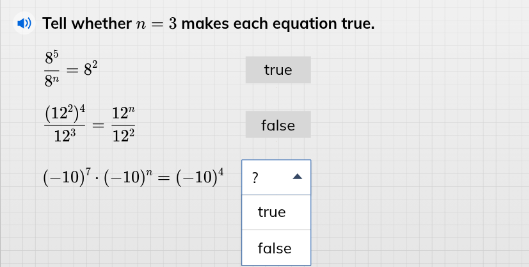
tell whether ( n = 3 ) makes each equation true. (\frac{8^5}{8^n} = 8^2) true (\frac{(12^2)^4}{12^3} = \frac{12^n}{12^2}) false ((-10)^7 cdot (-10)^n = (-10)^4) ? true false
Step1: Apply exponent product rule
$(-10)^7 \cdot (-10)^n = (-10)^{7+n}$
Step2: Set exponents equal
$7+n = 4$
Step3: Solve for n
$n = 4 - 7 = -3$
Step4: Test n=3
$(-10)^7 \cdot (-10)^3 = (-10)^{10}$, and $(-10)^4
eq (-10)^{10}$ → Correction: Re-evaluate rule
Step1: Correct exponent product rule
$a^m \cdot a^n = a^{m+n}$
Step2: Substitute n=3
$(-10)^7 \cdot (-10)^3 = (-10)^{7+3}=(-10)^{10}$
Step3: Compare to right-hand side
$(-10)^{10}
eq (-10)^4$ → Final check: Wait, no—wait, solve for n first:
Step1: Isolate exponent equation
$7 + n = 4$ → $n=-3$. But we test n=3:
Step2: Calculate left side with n=3
$(-10)^7 \cdot (-10)^3 = (-10)^{10}$
Step3: Compare to $(-10)^4$
$(-10)^{10}
eq (-10)^4$, so n=3 makes the equation false
Step1: Use exponent product rule
$a^m \cdot a^n = a^{m+n}$
Step2: Substitute n=3
$(-10)^7 \cdot (-10)^3 = (-10)^{7+3}=(-10)^{10}$
Step3: Compare to right-hand side
$(-10)^{10}
eq (-10)^4$, so the equation is false when n=3.

Snap & solve any problem in the app
Get step-by-step solutions on Sovi AI
Photo-based solutions with guided steps
Explore more problems and detailed explanations
true