QUESTION IMAGE
Question
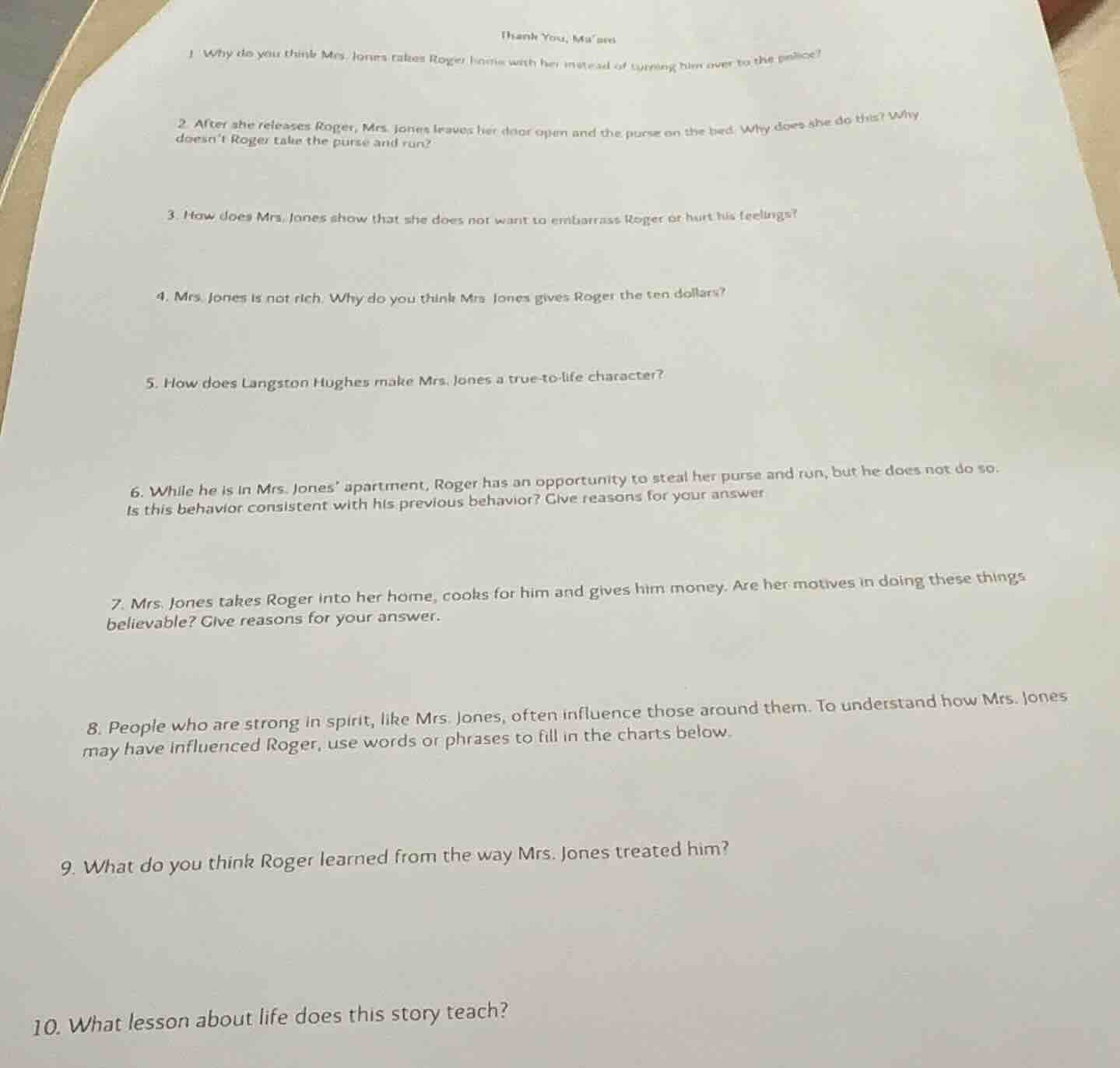
thank you, maam1. why do you think mrs. jones takes roger home with her instead of turning him over to the police?2. after she releases roger, mrs. jones leaves her door open and the purse on the bed. why does she do this? why doesnt roger take the purse and run?3. how does mrs. jones show that she does not want to embarrass roger or hurt his feelings?4. mrs. jones is not rich. why do you think mrs. jones gives roger the ten dollars?5. how does langston hughes make mrs. jones a true-to-life character?6. while he is in mrs. jones apartment, roger has an opportunity to steal her purse and run, but he does not do so. is this behavior consistent with his previous behavior? give reasons for your answer7. mrs. jones takes roger into her home, cooks for him and gives him money. are her motives in doing these things believable? give reasons for your answer.8. people who are strong in spirit, like mrs. jones, often influence those around them. to understand how mrs. jones may have influenced roger, use words or phrases to fill in the charts below.9. what do you think roger learned from the way mrs. jones treated him?10. what lesson about life does this story teach?
- She recognizes Roger is desperate, not a hardened criminal; she wants to teach him respect and accountability instead of punishing him.
- She does this to build trust, showing she believes Roger can make the right choice. Roger doesn't run because he's treated with kindness and respect for the first time, and he doesn't want to betray that trust.
- She avoids asking him personal questions about his home life, doesn't call the police (which would publicly shame him), and talks to him as an equal rather than a delinquent.
- She understands his need (he wanted money for shoes) and wants to give him a legitimate way to get what he needs, fostering integrity instead of theft.
- Hughes gives her realistic flaws (she is gruff, works a tiring job) and relatable empathy; she has a past she hints at ("I have done things, too"), making her feel like a real person with lived experience, not a one-dimensional "hero."
- It is consistent. Roger's theft was an act of desperation, not inherent malice. When treated with kindness, his underlying decency comes out—he never intended to harm anyone, just get what he needed, so he rejects the chance to betray trust.
- Yes. Her motives are rooted in her own past struggles (she implies she made mistakes too) and a genuine desire to guide a lost kid instead of letting him get caught in a cycle of punishment and crime. This is a believable, compassionate response from someone who knows hardship.
- (Example entries for the chart)
- Roger's change: From desperate/thieving → Trusting/grateful
- Mrs. Jones' actions: Offers food, gives money, respects his dignity
- Impact: Roger learns to value honesty and kindness
- Roger learned that people can show compassion instead of punishment, that he is worthy of respect, and that there are better, more honest ways to get what he needs instead of stealing. He also learned the importance of trust and reciprocating kindness.
- The story teaches that empathy and understanding are more powerful tools for growth and change than punishment; that everyone deserves a second chance, and small acts of kindness can alter the course of someone's life.

Snap & solve any problem in the app
Get step-by-step solutions on Sovi AI
Photo-based solutions with guided steps
Explore more problems and detailed explanations
- She wants to teach him respect, not punish him.
- She builds trust; Roger values her kindness.
- She avoids shaming him, treats him as an equal.
- To give him a legitimate way to meet his need.
- She has relatable flaws and a hinted-at past.
- Yes—his theft was desperate, not malicious.
- Yes—rooted in her own past struggles.
- (Sample) Roger: Desperate → Grateful; Jones: Offers food → Builds trust
- Kindness, honesty, and the value of trust.
- Empathy beats punishment; everyone deserves a second chance.