QUESTION IMAGE
Question
c: thats a lot of work!
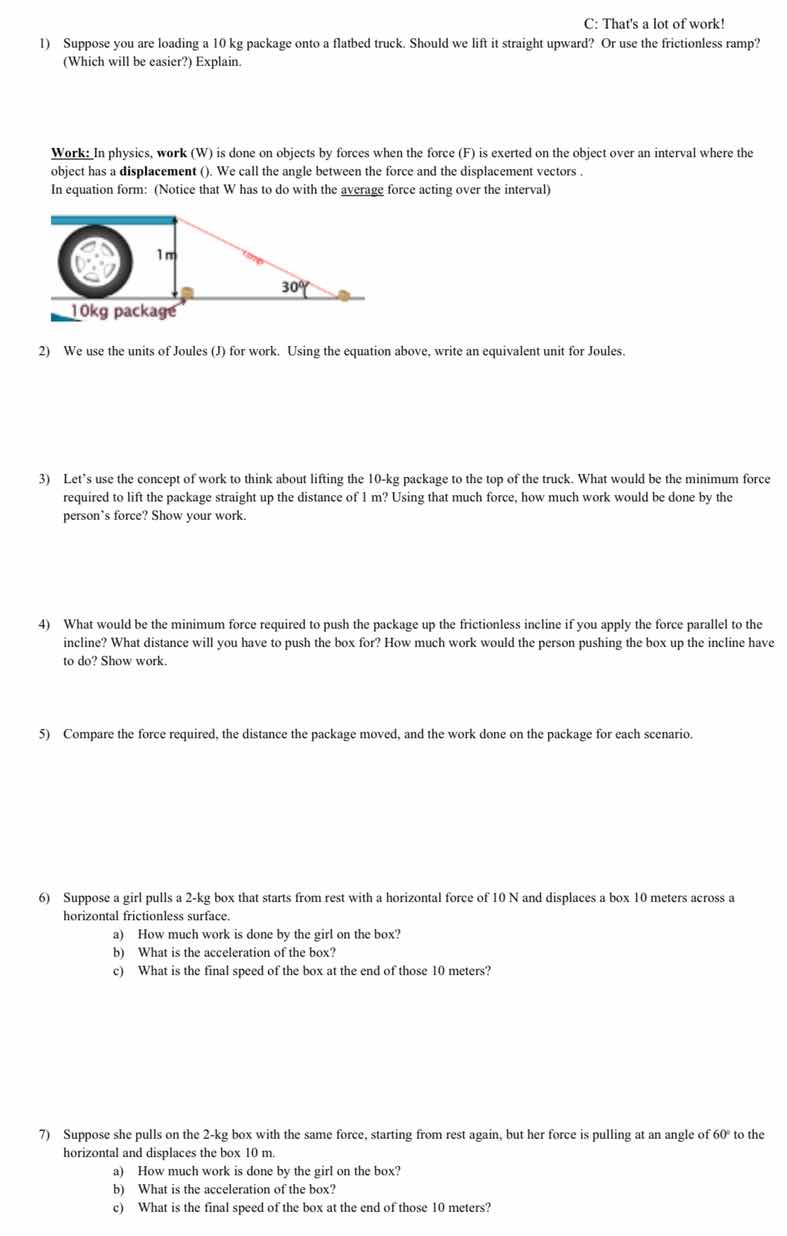
- suppose you are loading a 10 kg package onto a flatbed truck. should we lift it straight upward? or use the frictionless ramp? (which will be easier?) explain.
work: in physics, work (w) is done on objects by forces when the force (f) is exerted on the object over an interval where the object has a displacement (l). we call the angle between the force and the displacement vectors.
in equation form: (notice that w has to do with the average force acting over the interval)
(image of a 10kg package, a truck wheel, a 1m vertical distance, and a ramp at 30°)
- we use the units of joules (j) for work. using the equation above, write an equivalent unit for joules.
- lets use the concept of work to think about lifting the 10 - kg package to the top of the truck. what would be the minimum force required to lift the package straight up the distance of 1 m? using that much force, how much work would be done by the person’s force? show your work.
- what would be the minimum force required to push the package up the frictionless incline if you apply the force parallel to the incline? what distance will you have to push the box for? how much work would the person pushing the box up the incline have to do? show work.
- compare the force required, the distance the package moved, and the work done on the package for each scenario.
- suppose a girl pulls a 2 - kg box that starts from rest with a horizontal force of 10 n and displaces a box 10 meters across a horizontal frictionless surface.
a) how much work is done by the girl on the box?
b) what is the acceleration of the box?
c) what is the final speed of the box at the end of those 10 meters?
- suppose she pulls on the 2 - kg box with the same force, starting from rest again, but her force is pulling at an angle of 60° to the horizontal and displaces the box 10 m.
a) how much work is done by the girl on the box?
b) what is the acceleration of the box?
c) what is the final speed of the box at the end of those 10 meters?
Question 1
To determine which is easier (lifting straight up or using a frictionless ramp), we analyze the force and work involved. Lifting straight up requires a force equal to the weight of the package ($F = mg$). Using a ramp, the force is reduced because the force is applied over a longer distance (the length of the ramp), but the work done (force × distance) should be the same in both cases (since work is related to the change in potential energy, $mgh$, and the ramp is frictionless, so no energy is lost to friction). The key is that the force required to push up the ramp is less than the weight of the package, so pushing up the ramp is easier.
Step1: Recall the work formula
The work formula is $W = F \cdot d \cdot \cos\theta$, where $F$ is force, $d$ is distance, and $\theta$ is the angle between them. In SI units, force is measured in Newtons (N) and distance in meters (m).
Step2: Determine the unit of Joule
Since $W$ (in Joules) $= F$ (in Newtons) $\times d$ (in meters) $\times \cos\theta$ (dimensionless), the unit of Joule (J) is equivalent to Newton - meter (N·m).
Step1: Find the minimum force to lift straight up
To lift the package straight up at a constant velocity (minimum force, since acceleration is zero), the force $F$ must balance the weight of the package. The weight $F_g=mg$, where $m = 10\ kg$ and $g = 9.8\ m/s^2$. So $F=mg=10\ kg\times9.8\ m/s^2 = 98\ N$.
Step2: Calculate the work done
The distance $d = 1\ m$, and the force is applied in the direction of displacement ($\theta = 0^{\circ}$, so $\cos\theta=1$). Using the work formula $W = Fd\cos\theta$, we substitute $F = 98\ N$, $d = 1\ m$, and $\cos(0^{\circ}) = 1$. So $W=98\ N\times1\ m\times1 = 98\ J$.

Snap & solve any problem in the app
Get step-by-step solutions on Sovi AI
Photo-based solutions with guided steps
Explore more problems and detailed explanations
Using the frictionless ramp is easier. Lifting straight up requires a force equal to the package’s weight ($F = mg$), while pushing up the frictionless ramp requires a smaller force (since the force is applied over a longer distance, and work done $W = Fd = mgh$ is the same in both cases, so a smaller force is needed for the longer distance of the ramp).