QUESTION IMAGE
Question
theorem
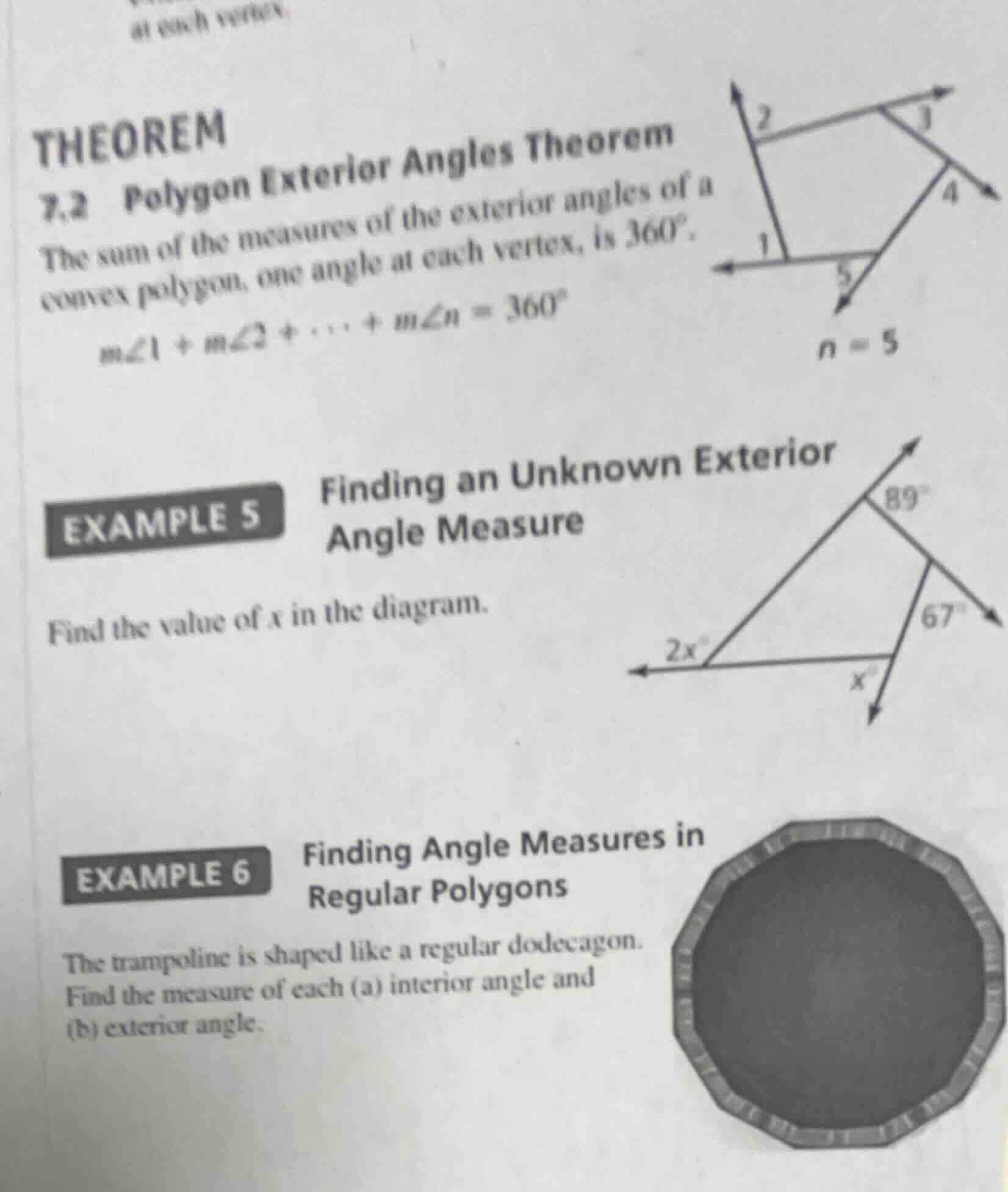
7.2 polygon exterior angles theorem
the sum of the measures of the exterior angles of a
convex polygon, one angle at each vertex, is 360°.
$m\angle1 + m\angle2 + \dots + m\angle n = 360°$
example 5 finding an unknown exterior angle measure
find the value of $x$ in the diagram.
example 6 finding angle measures in regular polygons
the trampoline is shaped like a regular dodecagon.
find the measure of each (a) interior angle and
(b) exterior angle.
Example 5:
Step1: Apply Polygon Exterior Angles Theorem
The sum of exterior angles of a convex polygon (here, a triangle, so \( n = 3 \)) is \( 360^\circ \). So, \( 2x + 89 + 67 + x = 360 \)? Wait, no, wait. Wait, the diagram: let's check the number of exterior angles. Wait, the polygon here—wait, the example 5 diagram: let's see, the angles are \( 2x^\circ \), \( 89^\circ \), \( 67^\circ \), and \( x^\circ \)? Wait, no, wait, the Polygon Exterior Angles Theorem: for a convex polygon with \( n \) sides, the sum of exterior angles (one at each vertex) is \( 360^\circ \). Let's count the vertices. The diagram: let's see, the angles are \( 2x \), \( 89 \), \( 67 \), and \( x \)? Wait, no, maybe I miscounted. Wait, the problem says "Find the value of \( x \) in the diagram." Let's re-express: the exterior angles are \( 2x^\circ \), \( 89^\circ \), \( 67^\circ \), and \( x^\circ \)? Wait, no, wait, maybe it's a quadrilateral? Wait, no, the theorem: sum of exterior angles (one per vertex) is \( 360^\circ \). Let's check the angles: \( 2x + 89 + 67 + x = 360 \)? Wait, no, wait, maybe I made a mistake. Wait, the diagram: let's see, the angles are \( 2x \), \( 89 \), \( 67 \), and \( x \). Wait, that's four angles? Wait, no, maybe the polygon is a triangle? Wait, no, the sum of exterior angles of any convex polygon (regardless of sides) is \( 360^\circ \). So let's add the given exterior angles: \( 2x + 89 + 67 + x = 360 \)? Wait, no, wait, maybe there's a typo? Wait, no, let's do it correctly. Wait, the angles are \( 2x^\circ \), \( 89^\circ \), \( 67^\circ \), and \( x^\circ \). Wait, that's four angles? Wait, no, maybe the diagram has four exterior angles? Wait, no, the Polygon Exterior Angles Theorem: for a convex polygon with \( n \) vertices, \( n \) exterior angles (one at each vertex) sum to \( 360^\circ \). So let's add them: \( 2x + 89 + 67 + x = 360 \)? Wait, no, wait, maybe I missed an angle? Wait, no, let's check the problem again. "Find the value of \( x \) in the diagram." The diagram has angles \( 2x^\circ \), \( 89^\circ \), \( 67^\circ \), and \( x^\circ \). Wait, that's four angles? Wait, no, maybe it's a quadrilateral? Wait, the sum of exterior angles of a quadrilateral is also \( 360^\circ \). So:
\( 2x + 89 + 67 + x = 360 \)
Combine like terms:
\( 3x + 156 = 360 \)
Subtract 156 from both sides:
\( 3x = 360 - 156 = 204 \)
Divide by 3:
\( x = \frac{204}{3} = 68 \)
Wait, but let's check again. Wait, maybe the diagram has three exterior angles? Wait, no, the angles are \( 2x \), \( 89 \), \( 67 \), and \( x \). Wait, maybe the diagram is a triangle, but with one angle's exterior angle? No, the Polygon Exterior Angles Theorem: for any convex polygon, the sum of exterior angles (one at each vertex) is \( 360^\circ \). So regardless of the number of sides, the sum is \( 360^\circ \). So let's proceed with the equation:
\( 2x + 89 + 67 + x = 360 \)
\( 3x + 156 = 360 \)
\( 3x = 360 - 156 = 204 \)
\( x = 68 \)
Step2: Solve for \( x \)
After combining like terms and solving the linear equation, we get \( x = 68 \).
Step1: Recall Formula for Interior Angles
The formula for the measure of each interior angle of a regular \( n \)-sided polygon is \( \frac{(n - 2) \times 180^\circ}{n} \). A dodecagon has \( n = 12 \) sides.
Step2: Substitute \( n = 12 \) into the Formula
\( \frac{(12 - 2) \times 180^\circ}{12} = \frac{10 \times 180^\circ}{12} = \frac{1800^\circ}{12} = 150^\circ \)
(b) Exterior Angle of Regular Dodecagon
Step1: Recall Polygon Exterior Angles Theorem
The sum of exterior angles of any convex polygon is \( 360^\circ \). For a regular polygon, all exterior angles are equal. So each exterior angle is \( \frac{360^\circ}{n} \), where \( n = 12 \) for a dodecagon.
Step2: Calculate the Exterior Angle
\( \frac{360^\circ}{12} = 30^\circ \)

Snap & solve any problem in the app
Get step-by-step solutions on Sovi AI
Photo-based solutions with guided steps
Explore more problems and detailed explanations
\( x = 68 \)