QUESTION IMAGE
Question
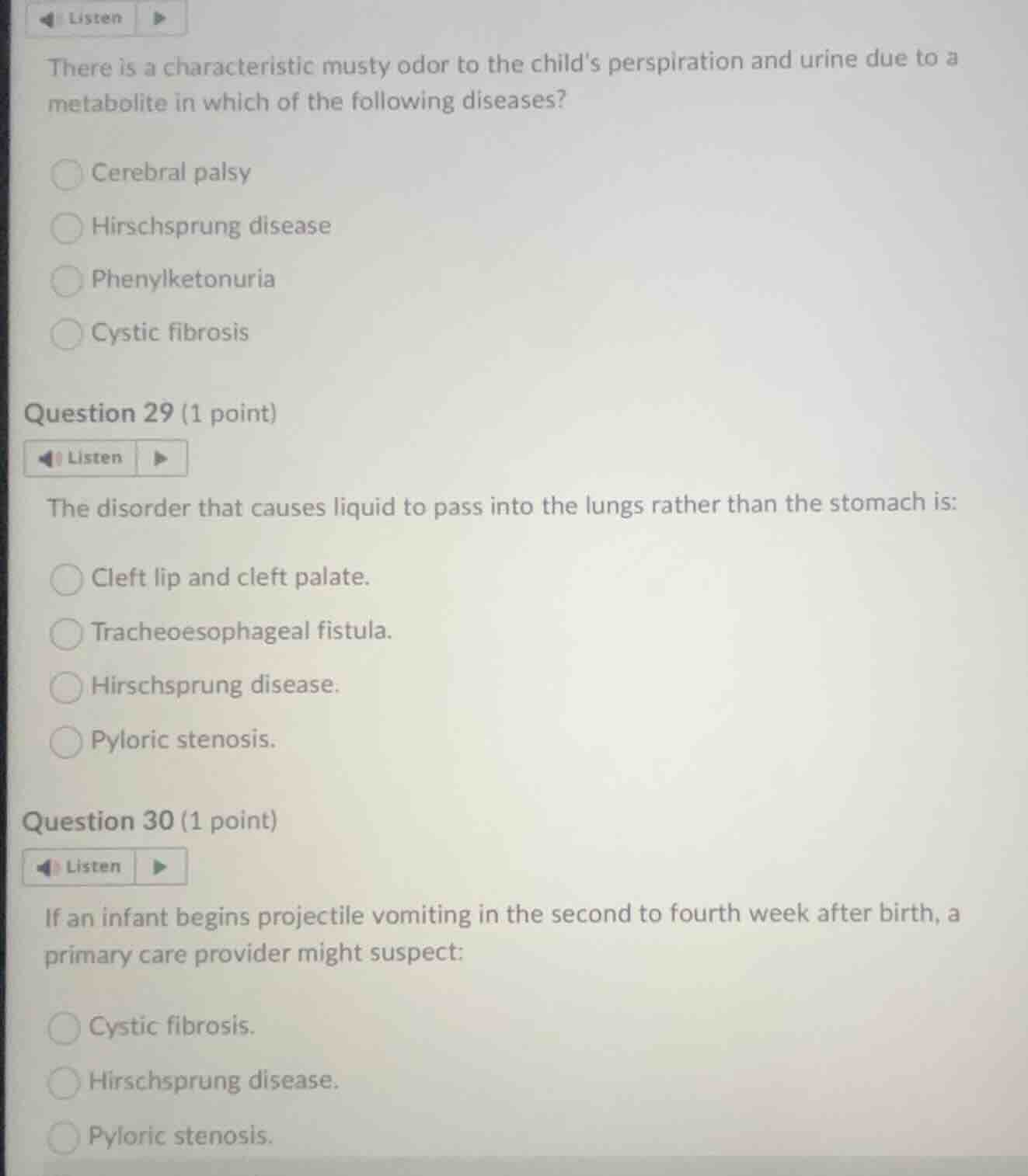
there is a characteristic musty odor to the childs perspiration and urine due to a metabolite in which of the following diseases? cerebral palsy hirschsprung disease phenylketonuria cystic fibrosis question 29 (1 point) the disorder that causes liquid to pass into the lungs rather than the stomach is: cleft lip and cleft palate. tracheoesophageal fistula. hirschsprung disease. pyloric stenosis. question 30 (1 point) if an infant begins projectile vomiting in the second to fourth week after birth, a primary care provider might suspect: cystic fibrosis. hirschsprung disease. pyloric stenosis.
- For the first question: Phenylketonuria is an inborn error of metabolism where the body cannot break down phenylalanine, leading to a buildup of metabolites that cause a musty odor in sweat and urine. The other conditions do not cause this specific odor.
- For Question 29: Tracheoesophageal fistula is a congenital defect where there is an abnormal connection between the trachea (windpipe) and esophagus, causing liquids to enter the lungs instead of the stomach. The other conditions affect different parts of the digestive or facial structures without this specific trachea-esophagus connection issue.
- For Question 30: Pyloric stenosis is a narrowing of the pylorus (the opening between the stomach and small intestine) that typically presents with projectile vomiting in infants 2-4 weeks after birth. The other listed conditions do not have this specific timing and symptom as a key feature.

Snap & solve any problem in the app
Get step-by-step solutions on Sovi AI
Photo-based solutions with guided steps
Explore more problems and detailed explanations
- Phenylketonuria
- Tracheoesophageal fistula.
- Pyloric stenosis.