QUESTION IMAGE
Question
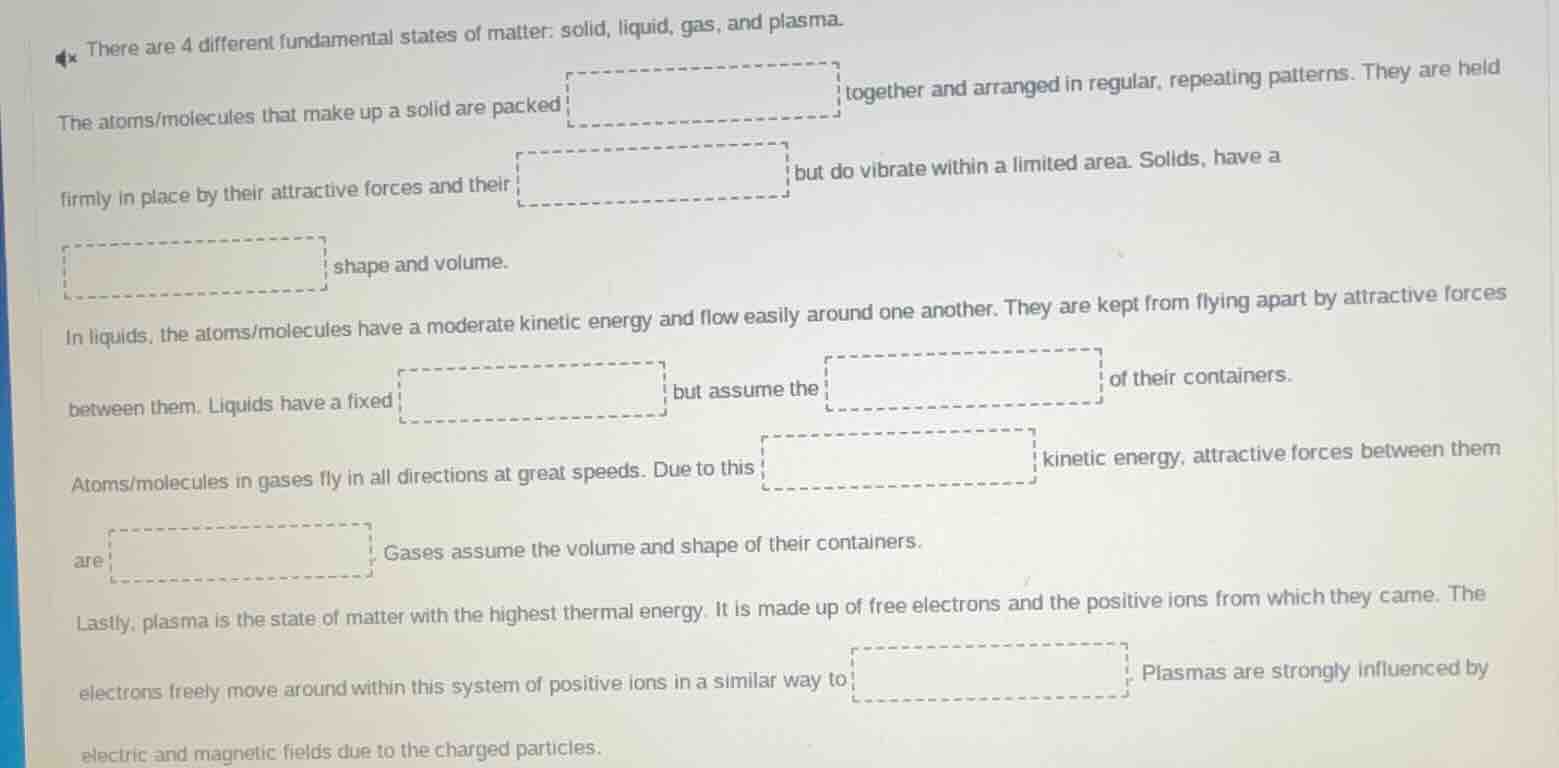
there are 4 different fundamental states of matter: solid, liquid, gas, and plasma. the atoms/molecules that make up a solid are packed together and arranged in regular, repeating patterns. they are held firmly in place by their attractive forces and their but do vibrate within a limited area. solids, have a shape and volume. in liquids, the atoms/molecules have a moderate kinetic energy and flow easily around one another. they are kept from flying apart by attractive forces between them. liquids have a fixed but assume the of their containers. atoms/molecules in gases fly in all directions at great speeds. due to this kinetic energy, attractive forces between them are gases assume the volume and shape of their containers. lastly, plasma is the state of matter with the highest thermal energy. it is made up of free electrons and the positive ions from which they came. the electrons freely move around within this system of positive ions in a similar way to plasmas are strongly influenced by electric and magnetic fields due to the charged particles.
Each blank is filled based on the core properties of each state of matter:
- Solids have tightly packed particles that cannot move freely, only vibrate, and have fixed shape/volume.
- Liquids have fixed volume but take the shape of their container.
- Gases have high kinetic energy that overcomes interparticle attractive forces.
- Plasma's charged particles move similarly to gas particles.

Snap & solve any problem in the app
Get step-by-step solutions on Sovi AI
Photo-based solutions with guided steps
Explore more problems and detailed explanations
- tightly
- positions are fixed
- fixed
- volume
- shape
- high
- negligible
- gas particles