QUESTION IMAGE
Question
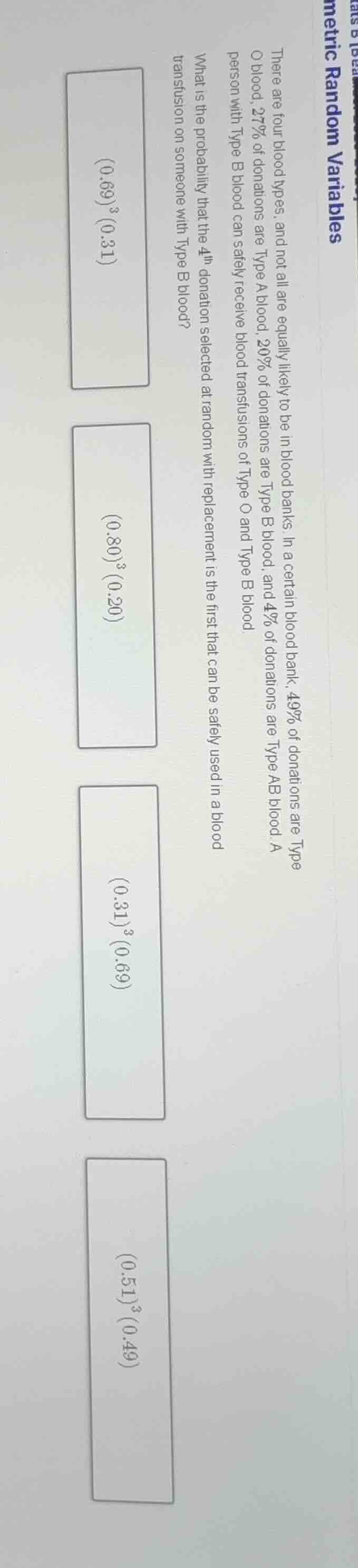
there are four blood types, and not all are equally likely to be in blood banks. in a certain blood bank, 49% of donations are type o blood, 27% of donations are type a blood, 20% of donations are type b blood, and 4% of donations are type ab blood. a person with type b blood can safely receive blood transfusions of type o and type b blood. what is the probability that the 4th donation selected at random with replacement is the first that can be safely used in a blood transfusion on someone with type b blood?
(0.69)^3(0.31)
(0.80)^3(0.20)
(0.31)^3(0.69)
(0.51)^3(0.49)
Step1: Determine safe blood types for Type B
A person with Type B blood can safely receive Type O and Type B blood. Calculate the probability of a single donation not being safe (i.e., being Type A or AB).
Probability of Type A: \( 0.49 \), Type AB: \( 0.04 \). So probability of unsafe donation: \( 0.49 + 0.04 = 0.53 \)? Wait, no—wait, safe is O (0.27) and B (0.20). So probability of safe donation: \( 0.27 + 0.20 = 0.47 \)? Wait, no, the problem says "the 4th donation is the first that can be safely used". So we need the first three to be unsafe, and the fourth to be safe.
Wait, let's recalculate: Total donations: Type O (49%? Wait, no, the problem says: 49% Type O, 27% Type A, 20% Type B, 4% Type AB. Wait, "49% of donations are Type O blood, 27% of donations are Type A blood, 20% of donations are Type B blood, and 4% of donations are Type AB blood." A person with Type B can safely receive Type O and Type B. So probability of a safe donation (O or B): \( 0.49 + 0.20 = 0.69 \)? Wait, no—wait, Type O is 49%? Wait, the problem statement: "49% of donations are Type O blood, 27% of donations are Type A blood, 20% of donations are Type B blood, and 4% of donations are Type AB blood. A person with Type B blood can safely receive blood transfusions of Type O and Type B blood." Wait, no—wait, maybe I misread. Wait, the user's problem: "49% of donations are Type O blood, 27% of donations are Type A blood, 20% of donations are Type B blood, and 4% of donations are Type AB blood. A person with Type B blood can safely receive blood transfusions of Type O and Type B blood." So probability of a single donation being safe (O or B): \( 0.49 + 0.20 = 0.69 \)? Wait, no—Type O is 49% (0.49), Type B is 20% (0.20). So safe: 0.49 + 0.20 = 0.69. Then unsafe (A or AB): 0.27 + 0.04 = 0.31.
So we need the first three donations to be unsafe (probability 0.31 each, with replacement), and the fourth to be safe (probability 0.69). Wait, no—wait, the question is "the 4th donation selected at random with replacement is the first that can be safely used". So first three: unsafe, fourth: safe.
Probability of unsafe donation: \( 1 - \) probability of safe donation. Wait, safe is O (0.49) + B (0.20) = 0.69. So unsafe is 1 - 0.69 = 0.31.
Therefore, probability that first three are unsafe (each with probability 0.31) and fourth is safe (0.69): \( (0.31)^3 \times (0.69) \). Wait, but looking at the options: one of the options is \( (0.31)^3(0.69) \), another is \( (0.69)^3(0.31) \), etc. Wait, let's check the options again. The options are:
- \( (0.69)^3(0.31) \)
- \( (0.80)^3(0.20) \)
- \( (0.31)^3(0.69) \)
- \( (0.51)^3(0.49) \)
Wait, maybe I messed up safe vs unsafe. Let's re-express: A person with Type B can receive O and B. So O is 49% (0.49), B is 20% (0.20). So safe: 0.49 + 0.20 = 0.69. Unsafe: A (0.27) + AB (0.04) = 0.31. So the event "4th is first safe" means first three are unsafe (prob 0.31 each) and fourth is safe (prob 0.69). So the probability is \( (0.31)^3 \times (0.69) \), which is option 3. Wait, but let's check the options. The third option is \( (0.31)^3(0.69) \), which matches.
Wait, but let's confirm:
- Probability of unsafe donation (A or AB): 0.27 + 0.04 = 0.31.
- Probability of safe donation (O or B): 0.49 + 0.20 = 0.69.
- We need the first three donations to be unsafe (each with probability 0.31, independent events, so \( (0.31)^3 \)) and the fourth to be safe (probability 0.69). So the probability is \( (0.31)^3 \times 0.69 \), which is \( (0.31)^3(0.69) \), which is one of the options (the third one).
Step2: Match with the optio…

Snap & solve any problem in the app
Get step-by-step solutions on Sovi AI
Photo-based solutions with guided steps
Explore more problems and detailed explanations
\( (0.31)^3(0.69) \) (the third option, assuming the options are ordered as given: the third box has \( (0.31)^3(0.69) \))