QUESTION IMAGE
Question
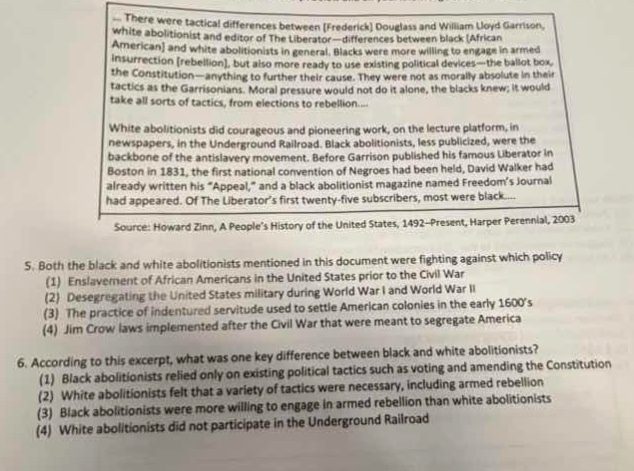
.. there were tactical differences between frederick douglass and william lloyd garrison, white abolitionist and editor of the liberator—differences between black (african american) and white abolitionists in general. blacks were more willing to engage in armed insurrection (rebellion), but also more ready to use existing political devices—the ballot box, the constitution—anything to further their cause. they were not as morally absolute in their tactics as the garrisonians. moral pressure would not do it alone, the blacks knew; it would take all sorts of tactics, from elections to rebellion...
white abolitionists did courageous and pioneering work, on the lecture platform, in newspapers, in the underground railroad. black abolitionists, less publicized, were the backbone of the antislavery movement. before garrison published his famous liberator in boston in 1831, the first national convention of negroes had been held, david walker had already written his “appeal,” and a black abolitionist magazine named freedom’s journal had appeared. of the liberator’s first twenty - five subscribers, most were black...
source: howard zinn, a people’s history of the united states, 1492 - present, harper perennial, 2003
- both the black and white abolitionists mentioned in this document were fighting against which policy
(1) enslavement of african americans in the united states prior to the civil war
(2) disengagement of the united states military during world war i and world war ii
(3) the practice of indentured servitude used to settle american colonies in the early 1600’s
(4) jim crow laws implemented after the civil war that were meant to segregate america
- according to this excerpt, what was one key difference between black and white abolitionists?
(1) black abolitionists relied only on existing political tactics such as voting and amending the constitution
(2) white abolitionists felt that a variety of tactics were necessary, including armed rebellion
(3) black abolitionists were more willing to engage in armed rebellion than white abolitionists
(4) white abolitionists did not participate in the underground railroad
Question 5
We analyze each option:
- Option (1): The excerpt is about abolitionists before the Civil War fighting against enslavement. Enslavement of African Americans was the main issue they fought against. The other options (2: desegregation in WWI/WWII is not relevant as this is pre - Civil War; 3: indentured servants in early 1600s is not related to abolitionist cause; 4: Jim Crow laws were post - Civil War) are incorrect.
- Option (1): The text says blacks knew moral pressure alone wouldn't work and they would use all tactics from moral to rebellion, so black abolitionists didn't rely only on existing political tactics. So (1) is wrong.
- Option (2): The text states "Blacks were more willing to engage in armed insurrection... they were not morally absolute in their tactics as the Garrisonians. Moral pressure would not do it alone, the blacks knew; it would take all sorts of tactics, from elections to rebellion...". This shows black abolitionists felt a variety of tactics (including armed rebellion) were necessary.
- Option (3): The text says whites were less willing to engage in armed insurrection, so (3) is wrong.
- Option (4): The text says white abolitionists did work on the lecture platform, newspapers, and Underground Railroad, so (4) is wrong.

Snap & solve any problem in the app
Get step-by-step solutions on Sovi AI
Photo-based solutions with guided steps
Explore more problems and detailed explanations
(1) Enslavement of African Americans in the United States prior to the Civil War