QUESTION IMAGE
Question
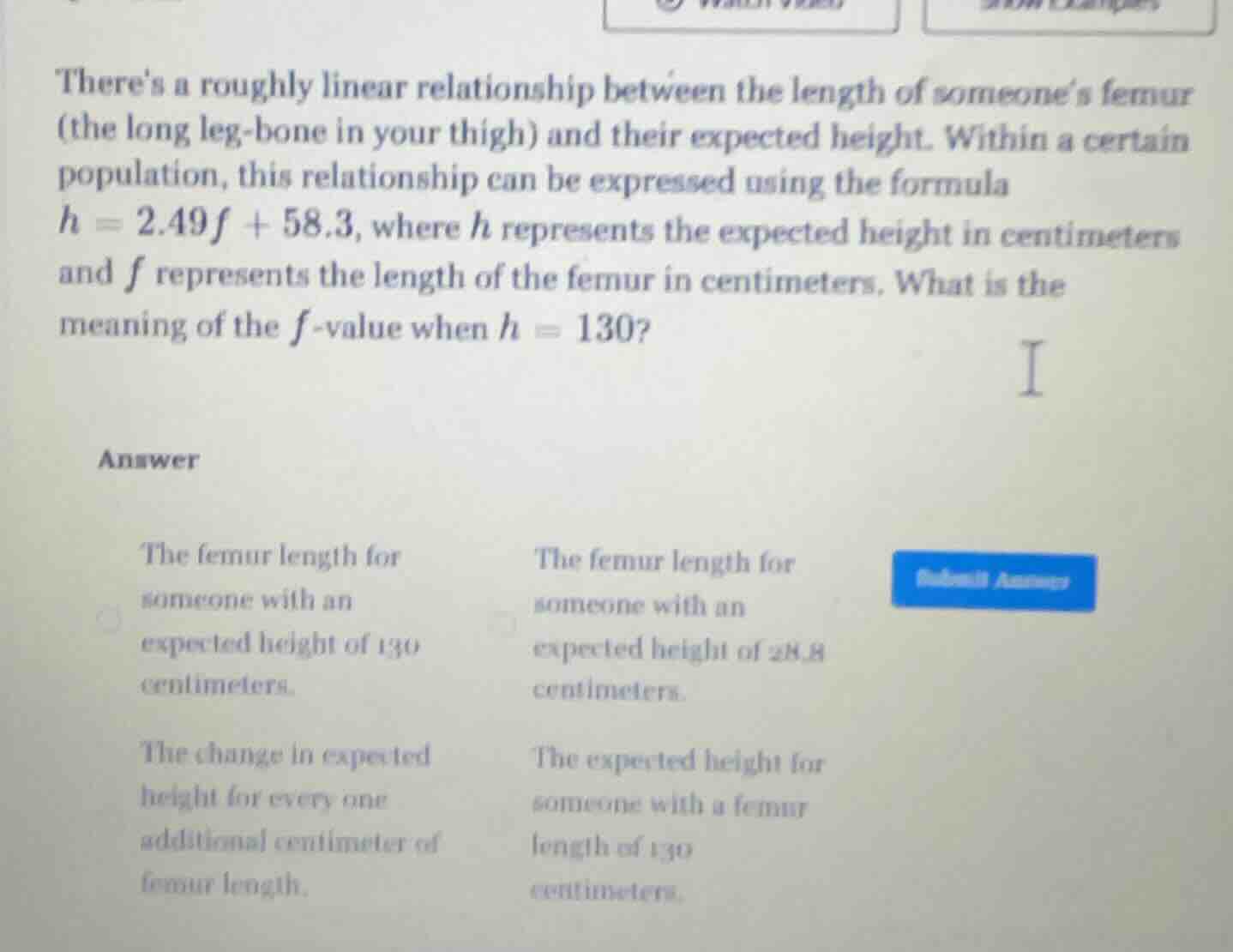
theres a roughly linear relationship between the length of someones femur (the long leg - bone in your thigh) and their expected height. within a certain population, this relationship can be expressed using the formula $h = 2.49f+58.3$, where $h$ represents the expected height in centimeters and $f$ represents the length of the femur in centimeters. what is the meaning of the $f$-value when $h = 130$?
answer
the femur length for someone with an expected height of 130 centimeters.
the femur length for someone with an expected height of 28.8 centimeters.
the change in expected height for every one additional centimeter of femur length.
the expected height for someone with a femur length of 130 centimeters.
Step1: Understand the formula
The formula is \( h = 2.49f + 58.3 \), where \( h \) is height and \( f \) is femur length. We are given \( h = 130 \) and need to find the meaning of \( f \) here.
Step2: Analyze the variables
When we substitute \( h = 130 \) into the formula and solve for \( f \), we are finding the femur length that corresponds to an expected height of 130 centimeters. Let's check the options:
- Option 1: Says "The femur length for someone with an expected height of 130 centimeters." This matches because we're solving for \( f \) when \( h = 130 \), so \( f \) here is the femur length for height 130 cm.
- Option 2: Height of 28.8 cm is incorrect (solving \( 130 = 2.49f + 58.3 \) gives \( f \approx 28.8 \), but \( f \) is femur length, not height).
- Option 3: Talks about change in height, but \( f \) is a specific length, not a rate of change.
- Option 4: Says femur length of 130, but we're solving for \( f \) when \( h = 130 \), not \( f = 130 \).

Snap & solve any problem in the app
Get step-by-step solutions on Sovi AI
Photo-based solutions with guided steps
Explore more problems and detailed explanations
The femur length for someone with an expected height of 130 centimeters.