QUESTION IMAGE
Question
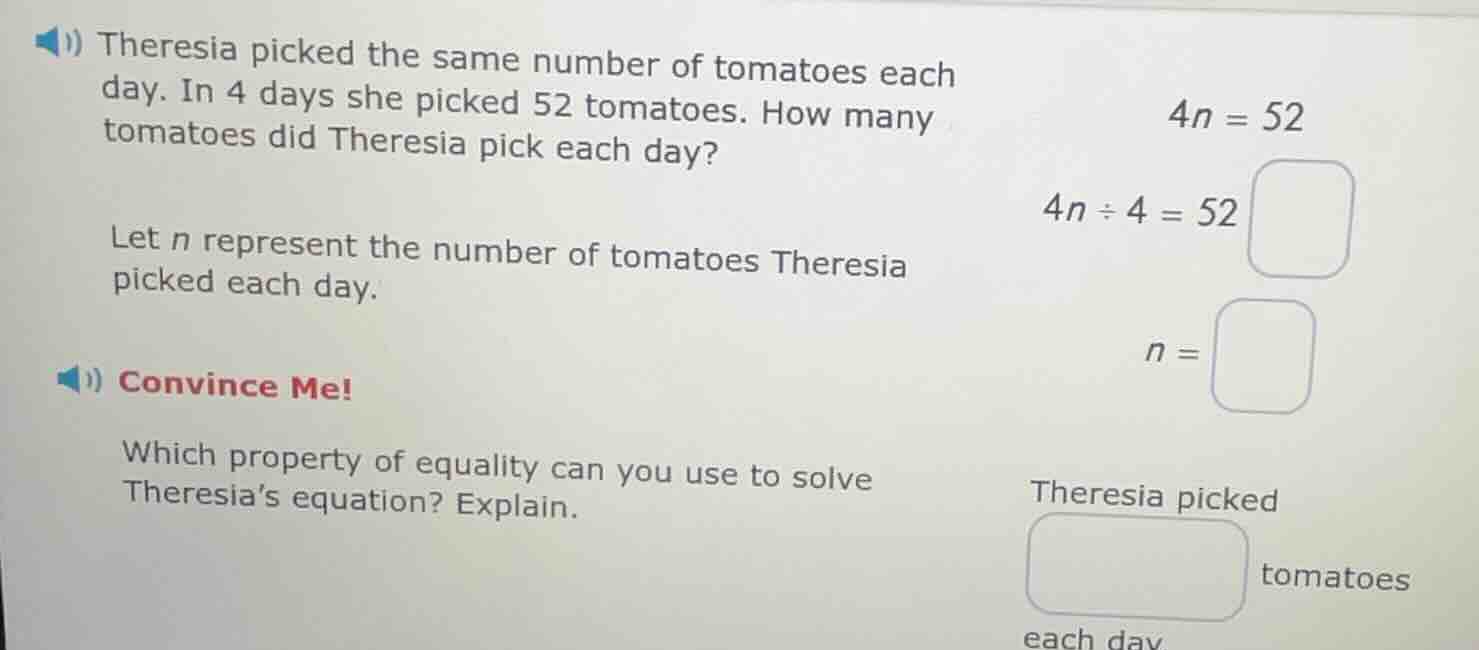
theresia picked the same number of tomatoes each day. in 4 days she picked 52 tomatoes. how many tomatoes did theresia pick each day?
let n represent the number of tomatoes theresia picked each day.
convince me!
which property of equality can you use to solve theresia’s equation? explain.
4n = 52
4n ÷ 4 = 52□
n = □
theresia picked □ tomatoes each day
Step1: Apply Division Property of Equality
To solve for \( n \) in the equation \( 4n = 52 \), we use the division property of equality, which states that if we divide both sides of an equation by the same non - zero number, the equation remains true. So we divide both sides of \( 4n=52 \) by 4.
\( 4n\div4 = 52\div4 \)
Step2: Simplify Both Sides
Simplify the left - hand side: \( 4n\div4=n \).
Simplify the right - hand side: \( 52\div4 = 13 \).
So \( n = 13 \).
For the "Convince Me!" part:
The property of equality used is the division property of equality. The division property of equality says that if \( a=b \) and \( c
eq0 \), then \( \frac{a}{c}=\frac{b}{c} \). In the equation \( 4n = 52 \), we want to isolate \( n \). Since \( n \) is multiplied by 4, we divide both sides of the equation by 4 (a non - zero number). This keeps the equation balanced and allows us to find the value of \( n \).

Snap & solve any problem in the app
Get step-by-step solutions on Sovi AI
Photo-based solutions with guided steps
Explore more problems and detailed explanations
For the equation filling:
The first box (after \( 52 \)) is filled with \( \div4 \), \( n = 13 \), and the last box (for the number of tomatoes each day) is 13.
For the "Convince Me!" part: The division property of equality is used. Because to isolate \( n \) in \( 4n = 52 \), we divide both sides by 4 (the coefficient of \( n \)) which is allowed by the division property of equality (dividing both sides of an equation by the same non - zero number preserves the equality).