QUESTION IMAGE
Question
1 think about it
review the supporting questions that you developed at the
beginning of the chapter. review the evidence that you gathered in
chapter 7. were you able to answer each supporting question?
if there was not enough evidence to answer your supporting
questions, what additional evidence do you think you need to
consider?
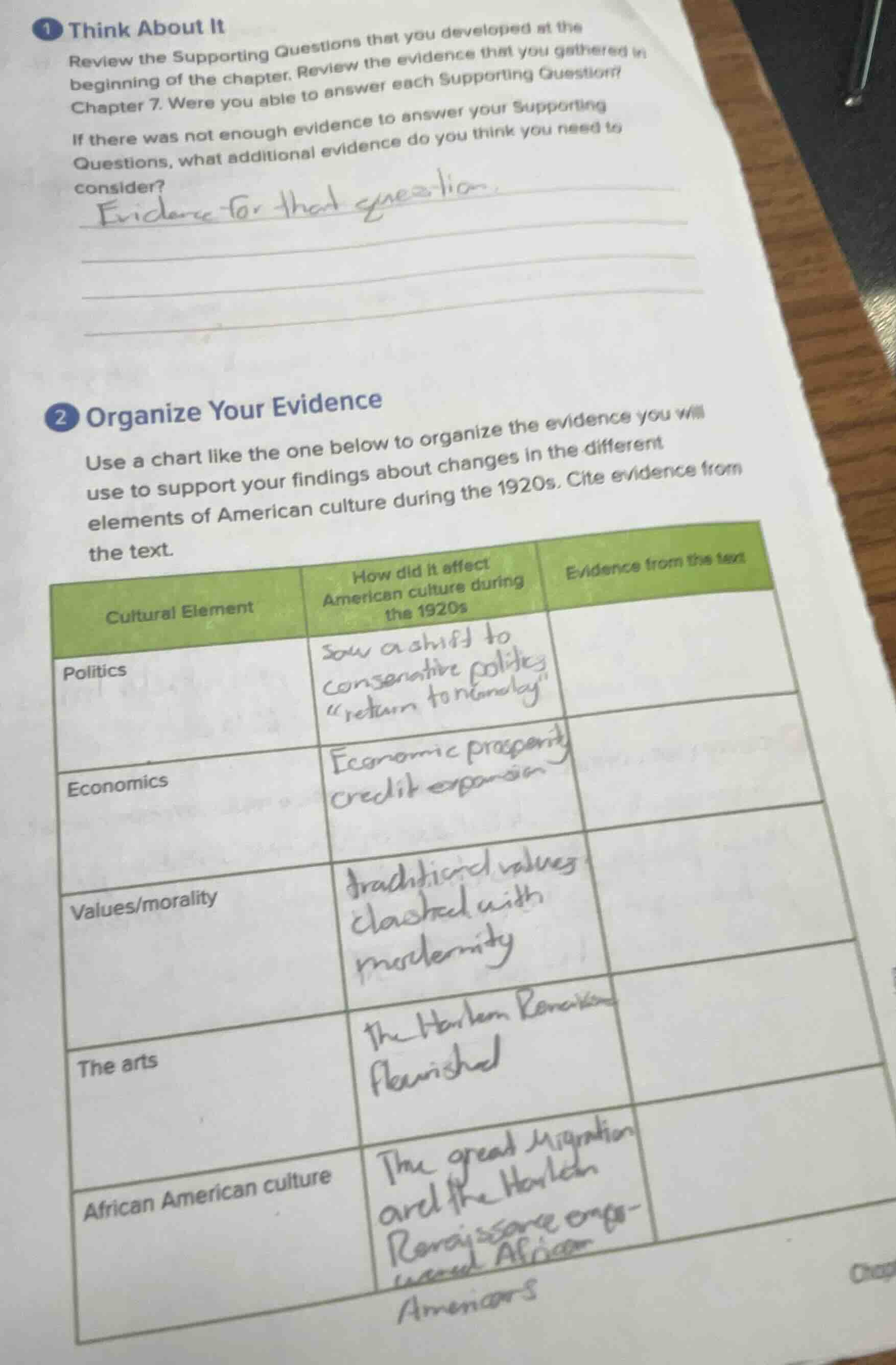
2 organize your evidence
use a chart like the one below to organize the evidence you will
use to support your findings about changes in the different
elements of american culture during the 1920s. cite evidence from
the text.
| cultural element | how did it affect american culture during the 1920s | evidence from the text |
|---|---|---|
| economics | ||
| values/morality | ||
| the arts | ||
| african american culture |
To answer this, we analyze each cultural element and provide text - based evidence:
1. Politics
- How it affected: Saw a shift to conservative politics ("return to normalcy").
- Evidence from the text: After World War I, the United States sought to move away from the international involvement of the war years. The election of Warren G. Harding in 1920 was based on his promise of a "return to normalcy", which meant a return to more traditional, conservative domestic policies and a less active role in international affairs.
2. Economics
- How it affected: Economic prosperity, credit expansion.
- Evidence from the text: During the 1920s, industries like automobile manufacturing (e.g., Ford's assembly line) boomed. There was a significant expansion of consumer credit, with installment plans becoming popular. This allowed more people to buy goods like cars and household appliances, leading to increased consumer spending and economic growth.
3. Values/morality
- How it affected: Traditional values clashed with modernity.
- Evidence from the text: The 1920s saw the rise of the flapper culture, with women wearing shorter dresses, bobbed hair, and engaging in more social activities outside the traditional domestic sphere. This clashed with traditional views of women's roles. Also, the debate over Prohibition (the 18th Amendment) showed a clash between those who supported traditional moral values (seeing alcohol as a vice) and those who wanted to repeal it, as they saw it as an infringement on personal freedom.
4. The arts
- How it affected: The Harlem Renaissance flourished.
- Evidence from the text: The Harlem Renaissance was a cultural movement in the 1920s centered in Harlem, New York. African - American artists, writers, and musicians like Langston Hughes (poetry), Zora Neale Hurston (literature), and Duke Ellington (music) produced a wealth of creative works that celebrated African - American culture, heritage, and experience.
5. African American culture
- How it affected: The Great Migration and the Harlem Renaissance empowered African Americans.
- Evidence from the text: The Great Migration saw millions of African Americans move from the rural South to the urban North. In the North, especially in Harlem, they were able to find new economic opportunities and a more racially tolerant (compared to the South) environment. This migration led to the Harlem Renaissance, which was a powerful expression of African - American identity and culture, and it helped to empower African Americans by giving them a platform to showcase their talents and challenge racial stereotypes.
If we were to fill the "Evidence from the text" column for each row:
| Cultural Element | How did it affect American culture during the 1920s | Evidence from the text |
|---|---|---|
| Economics | Economic prosperity, credit expansion | Industries like auto manufacturing boomed. Installment plans (consumer credit) became popular, increasing consumer spending and economic growth. |
| Values/morality | Traditional values clashed with modernity | Rise of flapper culture (women's changing roles) and Prohibition debate (clash over moral views on alcohol) showed this clash. |
| The arts | The Harlem Renaissance flourished | African - American artists (e.g… |

Snap & solve any problem in the app
Get step-by-step solutions on Sovi AI
Photo-based solutions with guided steps
Explore more problems and detailed explanations
To answer this, we analyze each cultural element and provide text - based evidence:
1. Politics
- How it affected: Saw a shift to conservative politics ("return to normalcy").
- Evidence from the text: After World War I, the United States sought to move away from the international involvement of the war years. The election of Warren G. Harding in 1920 was based on his promise of a "return to normalcy", which meant a return to more traditional, conservative domestic policies and a less active role in international affairs.
2. Economics
- How it affected: Economic prosperity, credit expansion.
- Evidence from the text: During the 1920s, industries like automobile manufacturing (e.g., Ford's assembly line) boomed. There was a significant expansion of consumer credit, with installment plans becoming popular. This allowed more people to buy goods like cars and household appliances, leading to increased consumer spending and economic growth.
3. Values/morality
- How it affected: Traditional values clashed with modernity.
- Evidence from the text: The 1920s saw the rise of the flapper culture, with women wearing shorter dresses, bobbed hair, and engaging in more social activities outside the traditional domestic sphere. This clashed with traditional views of women's roles. Also, the debate over Prohibition (the 18th Amendment) showed a clash between those who supported traditional moral values (seeing alcohol as a vice) and those who wanted to repeal it, as they saw it as an infringement on personal freedom.
4. The arts
- How it affected: The Harlem Renaissance flourished.
- Evidence from the text: The Harlem Renaissance was a cultural movement in the 1920s centered in Harlem, New York. African - American artists, writers, and musicians like Langston Hughes (poetry), Zora Neale Hurston (literature), and Duke Ellington (music) produced a wealth of creative works that celebrated African - American culture, heritage, and experience.
5. African American culture
- How it affected: The Great Migration and the Harlem Renaissance empowered African Americans.
- Evidence from the text: The Great Migration saw millions of African Americans move from the rural South to the urban North. In the North, especially in Harlem, they were able to find new economic opportunities and a more racially tolerant (compared to the South) environment. This migration led to the Harlem Renaissance, which was a powerful expression of African - American identity and culture, and it helped to empower African Americans by giving them a platform to showcase their talents and challenge racial stereotypes.
If we were to fill the "Evidence from the text" column for each row:
| Cultural Element | How did it affect American culture during the 1920s | Evidence from the text |
|---|---|---|
| Economics | Economic prosperity, credit expansion | Industries like auto manufacturing boomed. Installment plans (consumer credit) became popular, increasing consumer spending and economic growth. |
| Values/morality | Traditional values clashed with modernity | Rise of flapper culture (women's changing roles) and Prohibition debate (clash over moral views on alcohol) showed this clash. |
| The arts | The Harlem Renaissance flourished | African - American artists (e.g., Langston Hughes, Zora Neale Hurston, Duke Ellington) produced creative works celebrating their culture in Harlem. |
| African American culture | The Great Migration and the Harlem Renaissance empowered African Americans | Millions of African Americans migrated from South to North (Great Migration). In Harlem, they found opportunities and the Harlem Renaissance expressed their identity, challenging stereotypes. |