QUESTION IMAGE
Question
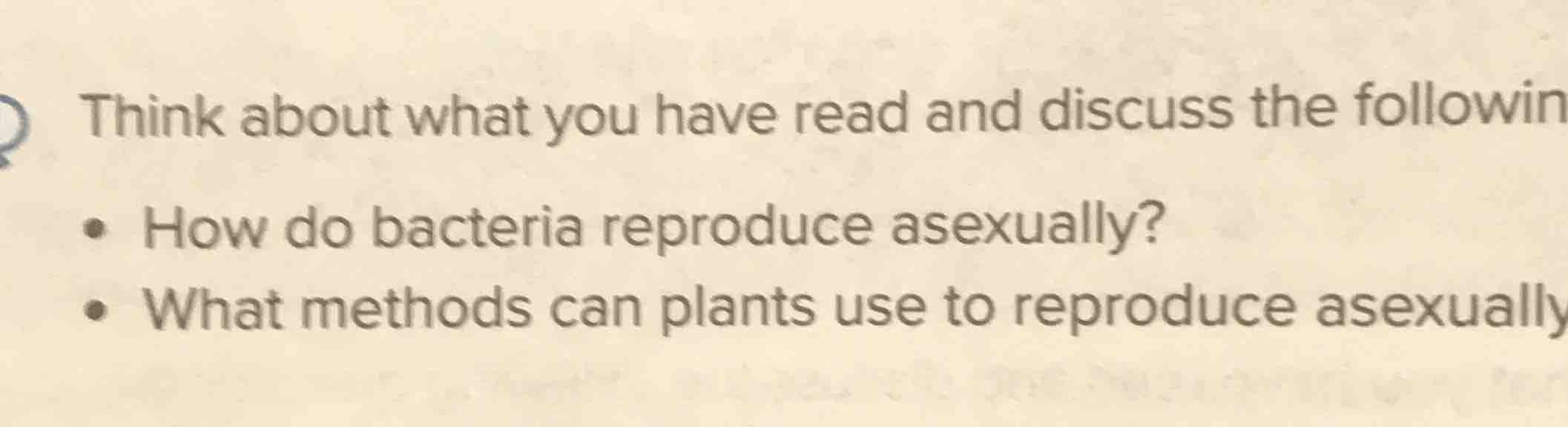
think about what you have read and discuss the followin
- how do bacteria reproduce asexually?
- what methods can plants use to reproduce asexually
1. How do bacteria reproduce asexually?
Bacteria reproduce asexually mainly through binary fission. In this process, the bacterial cell first replicates its circular DNA. Then the cell elongates, and the replicated DNA molecules move to opposite ends of the cell. Finally, the cell membrane and cell wall grow inward, dividing the cell into two genetically identical daughter cells. Some bacteria can also use methods like budding (where a small outgrowth forms and detaches) or fragmentation (breaking into pieces that grow into new cells), but binary fission is the most common.
Plants have several asexual reproduction methods:
- Vegetative propagation: Involves structures like runners (e.g., strawberry plants send out horizontal stems that root), rhizomes (underground stems like in ginger), tubers (potato tubers with eyes that sprout), and bulbs (onion bulbs).
- Budding: A small bud forms on the parent plant and detaches to grow (e.g., in some yeast - like plant organisms, but more common in plants like some cacti).
- Fragmentation: The plant breaks into pieces, and each piece can grow into a new plant (e.g., some ferns or aquatic plants).
- Spore formation: Some non - flowering plants (e.g., ferns, mosses) produce spores. These spores are lightweight and can be dispersed. When conditions are right, a spore can germinate into a new plant.
- Apomixis: Some plants (e.g., certain grasses) produce seeds without fertilization. The embryo develops from the ovule without the need for sperm to fertilize the egg, resulting in offspring genetically identical to the parent.

Snap & solve any problem in the app
Get step-by-step solutions on Sovi AI
Photo-based solutions with guided steps
Explore more problems and detailed explanations
Bacteria reproduce asexually mainly by binary fission (DNA replicates, cell elongates, and divides into two identical daughter cells). Less common methods include budding (small outgrowth detaches) and fragmentation (cell breaks into pieces that regenerate).