QUESTION IMAGE
Question
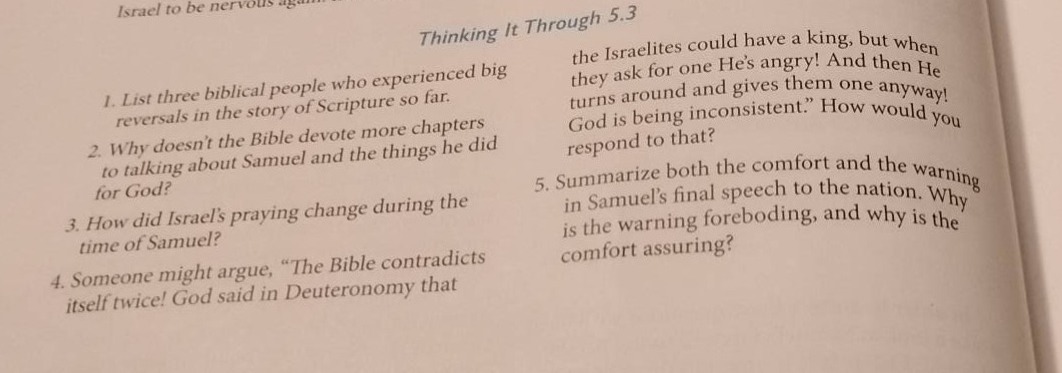
thinking it through 5.3
- list three biblical people who experienced big reversals in the story of scripture so far.
- why doesn’t the bible devote more chapters to talking about samuel and the things he did for god?
- how did israel’s praying change during the time of samuel?
- someone might argue, “the bible contradicts itself twice! god said in deuteronomy that the israelites could have a king, but when they ask for one he’s angry! and then he turns around and gives them one anyway! god is being inconsistent.” how would you respond to that?
- summarize both the comfort and the warning in samuel’s final speech to the nation. why is the warning foreboding, and why is the comfort assuring?
Brief Explanations
- Joseph rose from slavery to ruler, Job lost everything then was restored, and David went from shepherd to king then faced exile—all are major biblical reversals.
- Scripture's priority is revealing God's character and plan, not exhaustive human biographies, so Samuel's life is framed to highlight Israel's rejection of divine rule.
- Initially, Israel prayed for God to free them from foreign oppressors; later, they abandoned trusting God as their sole leader and prayed for a human monarch like neighboring nations.
- God's command in Deuteronomy was not an absolute ban on kings, but a warning against rejecting His sovereignty. His anger was at their rejection of Him, and granting the king allowed Him to work through their choice to fulfill His long-term plan for Israel.
- Samuel's speech balances the consequence of Israel's request (the warning) with the unbroken nature of God's covenant (the comfort). The warning foretells the human cost of their decision, while the comfort anchors them to God's enduring faithfulness.

Snap & solve any problem in the app
Get step-by-step solutions on Sovi AI
Photo-based solutions with guided steps
Explore more problems and detailed explanations
- Examples include Joseph, Job, and David.
- The Bible focuses on theological lessons over biographical detail.
- Israel shifted from praying for deliverance from enemies to praying for a human king.
- God's anger stemmed from Israel rejecting His rule; granting the king was part of His redemptive plan, not inconsistency.
- Comfort: Samuel assured Israel God would remain their God, protect them, and uphold His covenant. Warning: He warned that a king would tax them, conscript their sons, and take their resources, leading to oppression. The warning is foreboding because it predicts tangible harm to Israel's freedom and well-being. The comfort is assuring because it reaffirms God's unchanging faithfulness to His people despite their poor choice.